







The cheapest mining container is rarely the one with the lowest quoted price. The real number shows up after you add power distribution, ventilation, dust control, miner maintenance, shipping, site work and downtime risk. That is why an air cooling mining container is becoming attractive again in 2026: not because air cooling is new, but because many buyers now care more about fast deployment, lower CAPEX and easier maintenance than maximum density.
For small and mid-size operators, especially 3MW to 5MW mining farms, air cooling still has a very practical place. A 20ft or 40ft air cooled mining container can be easier to understand, easier to maintain and faster to deploy than a high-density hydro cooling system. The trade-off is simple: you give up some cooling efficiency and density, but you reduce technical complexity and project risk.
Go air-cooled when speed matters.
Why Air Cooling Is Back on the Buyer Shortlist
Mining economics in 2026 are more sensitive to electricity cost, miner efficiency and uptime. When Bitcoin mining margins tighten, buyers become cautious. They ask different questions:
How much power do I need?
How many miners fit in one container?
Can I deploy in phases?
Can my team maintain it without liquid cooling experience?
What happens if the site is dusty, hot or remote?
Those questions naturally favor air cooling mining containers for first-stage deployment. Air cooling does not require a CDU, dry cooler loop, coolant quality control or water system commissioning. For buyers who are still testing a site, moving to a new country, or starting with a smaller power allocation, that simplicity matters.
A liquid cooling mining container is still the better choice for high-density hydro miners and long-term energy efficiency. But for many first-time or cost-sensitive buyers, a 20ft or 40ft air cooling mining container is the easier entry point.
Pro Tip:
If your buyer is still asking basic questions about transformer size, miner quantity and shipping route, lead with air cooling first. Hydro cooling can come later as an upgrade path.
20ft vs 40ft Air Cooling Mining Container
The right size is not only about container length. It is about available power, miner model, airflow path, service space and how the customer plans to scale.
A 20ft air cooling mining container is usually better for smaller power allocations, pilot projects, ZEC mining setups, or sites where the buyer wants to test operation before expanding. It is easier to place, easier to ship and easier to explain to a beginner buyer.
A 40ft air cooling mining container works better when the site already has enough power capacity and the operator wants stronger miner density in one unit. It gives more room for racks, airflow zoning, electrical distribution and maintenance access. For a 3MW to 5MW farm, multiple 40ft units can create a repeatable modular layout.
The key mistake is buying by container size first. Start with power.
A simple sizing logic:
Available power capacity
Miner model and single-unit power
Number of miners
Total IT load
Fan load and auxiliary load
Site temperature and dust level
Service aisle and maintenance plan
If the site has limited power, a larger container does not create more capacity. It only creates unused space.
Miner Compatibility: S19, S21, Z15 Pro and High-Power ASICs
An air cooling mining container must be sized around heat, not just rack count. Every watt consumed by an ASIC miner becomes heat that must be removed from the container.
For common ASIC models such as Antminer S19 series, Antminer S21 series, Whatsminer air-cooled models or Z15 Pro for ZEC mining, the buying logic is the same: calculate total miner load first, then design airflow and power distribution around that number.
Example framework:
Single miner power x miner quantity = IT load
IT load + fan and control load = facility load
Facility load x 24 hours = daily electricity consumption
This is where many projects go wrong. They ask, “How many miners can fit?” before asking, “How much heat can the container remove under local conditions?”
Air cooling works well when airflow is clean, direct and serviceable. It becomes risky when the layout creates hot air recirculation, dead zones or dust buildup. The problem is not air cooling itself. The problem is poor airflow design.
Airflow Design: The Real Core of an Air Cooled Mining Container
A good air cooling mining container is not just a steel box with fans. It is an airflow machine.
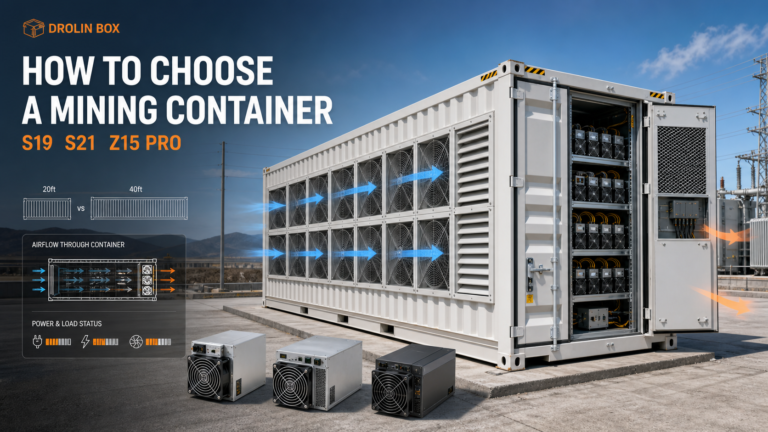
The container needs controlled intake, strong exhaust, rack-level airflow alignment, dust filtering and enough spacing for maintenance. Hot air must leave the container quickly. Fresh air must reach the miners without short-circuiting back into the exhaust path.
Important airflow checks:
Are intake and exhaust separated clearly?
Is hot air recirculation blocked?
Are filters easy to replace?
Can workers access miners without stopping the whole container?
Does the design match local temperature and dust conditions?
Can the fan system maintain airflow after partial filter blockage?
In hot or dusty regions, air cooling needs more attention. Filters, louvers, fan redundancy and cleaning frequency become part of the ROI model. A container that runs well for the first month but loses airflow after dust accumulation is not a low-cost solution. It is a delayed maintenance problem.
Pro Tip:
For remote mining sites, design for maintenance by ordinary technicians. If the filter, fan or PDU cannot be accessed quickly, downtime will eat the savings from a cheaper container.
Power Distribution: Do Not Let the Electrical Side Become the Bottleneck
Many buyers focus on cooling and forget power distribution. That is dangerous. Air cooled containers are usually chosen for simplicity, but they still need serious electrical planning.
Before buying, confirm:
Site voltage
Transformer capacity
Main distribution cabinet
PDU rating
Cable route
Breaker protection
Grounding
Emergency stop logic
Monitoring system
Local electrical compliance
If the container is designed for more miners than the transformer can support, the project will stall. If the PDU layout is difficult to maintain, the site team will struggle. If the breaker design is too weak, nuisance trips can reduce uptime.
For buyers, the correct question is not “What is the container price?” The better question is: “What is the complete deployed cost per running miner?”
Cost Structure: What You Actually Pay For
An air cooling mining container looks cheaper than a liquid cooling system, but the buyer still needs to evaluate total deployment cost.
Main cost items:
Container body and structural modification
Racks and miner layout
Fans, louvers and filters
Electrical cabinets and PDU
Control and monitoring system
Fire safety and emergency controls
Factory test
Shipping and customs
Crane and site placement
Electrical installation
Maintenance parts
Downtime risk
Air cooling usually wins on CAPEX because it avoids CDU, dry cooler, coolant piping and water system complexity. That advantage is real. But low CAPEX only becomes ROI when the container can run stably with clean airflow and reliable power.
The cheapest quote can become expensive if it lacks proper airflow design, factory testing, documentation or after-sales support.
When Air Cooling Is the Right Choice
Choose an air cooling mining container when:
The project needs fast deployment
The buyer wants lower upfront cost
The site team prefers simple maintenance
The climate is manageable
The miner density is moderate
The buyer wants phased expansion
The project is still testing power, land or local operation
Do not choose air cooling blindly when:
Ambient temperature is extremely high
Dust control is difficult
The buyer wants maximum density
Noise restrictions are strict
The site requires very low PUE
The miners are hydro-only models
There is no maintenance plan for filters and fans
Air cooling is not a downgrade. It is a different deployment strategy.
Buyer Checklist Before Ordering
Before requesting a quote, prepare these details:
Country and site location
Available power capacity
Voltage and transformer information
Miner model
Miner quantity
Target hashrate
Local temperature range
Dust and humidity conditions
Container size preference
Expected deployment date
Shipping destination
Maintenance team capability
Need for remote monitoring
Required drawings or technical documents
This information helps the supplier avoid guessing. It also helps the buyer compare quotes more fairly.
A strong supplier should be able to explain the container layout, airflow direction, power distribution, miner compatibility, shipping method, installation process and after-sales support.
Final Verdict for 2026 Buyers
Air cooling mining containers are not the most advanced solution on paper. They are the most practical solution for many buyers who need speed, cost control and operational simplicity.
For 2026, the best strategy is not “air cooling or liquid cooling forever.” The better strategy is staged deployment.
Start with air cooling when the project needs fast launch and lower risk. Move to liquid cooling when power density, miner efficiency and long-term thermal performance become the priority. Use CDU and dry cooler systems when the farm grows into higher-density or AI/HPC-style infrastructure.
For buyers building a small or mid-size ASIC farm, the air cooling mining container remains one of the most direct ways to turn available power into running hashrate without overcomplicating the first deployment.
A good container does not just hold miners. It protects airflow, power and uptime.