






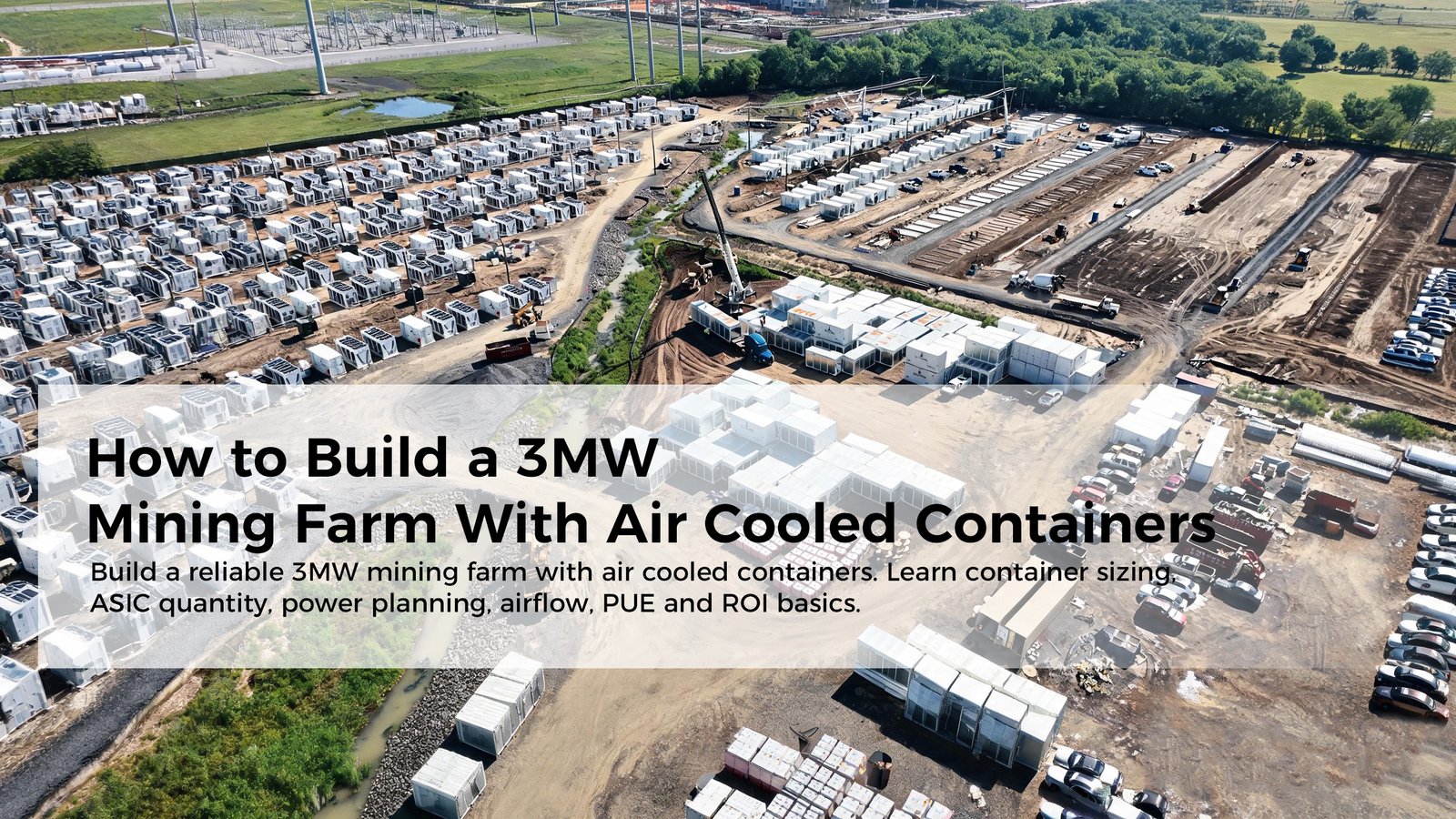

A 3MW mining farm is the point where a container purchase becomes an infrastructure project.
One 40ft container can be delivered quickly. Three megawatts of ASIC load cannot be treated the same way. At this scale, the project needs a power backbone, controlled airflow, site drainage, transformer planning, remote monitoring, maintenance access, and a container layout that still makes sense when summer temperatures rise.
For a buyer targeting a 3MW mining farm, the goal is not to install the maximum number of miners on day one. The goal is to build a repeatable operating system that can run through heat, dust, power fluctuations, filter changes, and miner replacements without quietly destroying ROI.
Start With the 3MW Definition
A “3MW mining farm” should normally mean approximately 3MW of ASIC IT load.
It does not mean that the utility connection only needs to provide 3MW.
Air-cooled containers require power for ventilation fans, controls, network equipment, lighting, transformer losses, switchgear losses, and operating margin. With a planning PUE of 1.05, a 3MW ASIC deployment becomes:
3MW IT Load × 1.05 PUE = 3.15MW Facility Load
That difference matters.
A project designed around exactly 3MW of incoming power is already short before the first miner starts hashing.
Pro Tip: Ask the power provider for firm capacity, available voltage, demand charges, transformer responsibility, curtailment terms, and grid-upgrade cost. “We have 3MW available” is not a complete electrical answer.
The Best Container Layout for a 3MW Mining Farm
For most small-to-mid-scale buyers, three practical air-cooled layouts exist.
| Layout | Container Plan | IT Load Per Container | Best Fit |
|---|---|---|---|
| Balanced 40ft plan | 3 × 40HC containers | About 1MW | Lower container count and simpler operation |
| High-margin 40ft plan | 4 × 40HC containers | About 750kW | Hot, dusty or high-maintenance sites |
| Modular 20ft plan | 6 × 20HC containers | About 500kW | Phased deployment and tighter site access |
The first option is usually the most practical.
A 3 × 40HC layout gives the farm three independent operating blocks. Each container can be designed around approximately 1MW of IT load instead of being pushed to its maximum reference capacity. That leaves room for airflow discipline, electrical margin, future firmware changes, and easier maintenance.
DroLinBox reference data gives a useful engineering baseline:
| Container | Reference Capacity | Reference Operating Power | Fan Configuration |
|---|---|---|---|
| 20HC air-cooled container | Up to 168 S19-class miners | About 650kW | 8 × 1220# fans |
| 40HC air-cooled container | Up to 336 S19/S21-class miners or 270 S21 XP-class miners | About 1,300kW | 16 × 1220# fans |
A 3MW farm should not automatically use every available slot. Use the reference capacity as a physical and electrical ceiling, then design the operating load around the selected miner model and local climate.
How Many ASIC Miners Does a 3MW Farm Need?
Miner count depends on the actual power draw, not the container’s rack count.
For an illustrative S21-class air-cooled miner operating at approximately 3.5kW:
3,000kW ÷ 3.5kW = approximately 857 miners
A balanced 3MW layout could look like this:
| Item | Reference Planning Figure |
|---|---|
| Total ASIC IT load | 3,000kW |
| Container quantity | 3 × 40HC |
| IT load per container | About 1,000kW |
| S21-class miner power assumption | About 3.5kW |
| Miners per container | About 280 to 290 units |
| Total miners | About 840 to 870 units |
The exact number will move with the miner model, firmware mode, voltage, ambient temperature, and desired maintenance margin.
A farm using lower-power S19-class miners may use more physical slots. A farm using higher-power T21 or S21 XP-class miners may need fewer units per container. The electrical architecture must follow the actual miner power, not a generic “number of machines” target.
Pro Tip: Quote three miner scenarios before approving the container layout: one current-generation model, one lower-CAPEX model, and one higher-power model. The same 3MW site can produce very different hashrate, procurement cost, and operating risk.
Power Infrastructure: The Part Buyers Underestimate
The containers are visible. The electrical backbone is what keeps them online.
A 3MW air-cooled mining farm normally requires:
- Medium-voltage utility connection or generator interface
- Transformer planning, often using an early 3.5MVA to 4MVA design envelope
- Main switchgear and protection coordination
- Distribution feeders to each container
- Main distribution cabinet, breakers, PDUs, cables, grounding, and lightning protection
- Emergency shutdown and fire-safety logic
- Metering for each container or operating block
- Network and remote monitoring infrastructure
The final transformer rating must be designed by a qualified electrical engineer based on local voltage, power factor, code requirements, auxiliary loads, and future expansion. A 3.5MVA to 4MVA range is an early planning reference, not a substitute for final electrical design.
One container should not become the only critical point of failure. Separate the farm into independently metered and protected blocks. If one container needs maintenance, the remaining containers should continue operating.
Airflow: A 3MW Farm Is Also a 3MW Heat-Rejection Project
Every kilowatt consumed by an ASIC becomes heat.
That means a 3MW mining farm must reject roughly 3MW of heat continuously while miners are online.
For air-cooled mining containers, the most common operating failures are not complicated:
- Hot exhaust air returns to the intake side
- Containers are placed too close together
- Intake filters load with dust faster than expected
- Fan performance falls during high ambient temperatures
- Site walls, storage buildings, or terrain block exhaust paths
- Operators fill every rack position but leave no thermal margin
A serious site plan should define:
- Container orientation relative to prevailing wind
- Cold-air intake side and hot-air exhaust side
- Spacing between containers
- Distance from walls, fencing, generators, and transformers
- Filter service access
- Dust-control procedure
- Site drainage and hardstand condition
- Crane and forklift route
- Noise boundary and local compliance requirements
Go air cooled when the site has manageable ambient temperature, good ventilation, reasonable dust exposure, and a need for lower upfront cooling CAPEX.
Do not choose air cooling only because it is cheaper. A low-price container with poor airflow control can turn into a high-maintenance operating problem.
Pro Tip: Design the site for August, not for a mild day during commissioning. Ask the supplier to explain what happens to miner inlet temperature when the outdoor temperature, dust load, and fan demand are at their annual peak.
PUE, Electricity Cost, and the Real Monthly Operating Bill
For a 3MW IT load operating at a PUE of 1.05:
| Item | Planning Value |
|---|---|
| ASIC IT load | 3,000kW |
| Estimated facility load | 3,150kW |
| Monthly energy use | About 2,268,000kWh |
Use this formula:
Monthly Electricity Cost = IT Load × PUE × 24 × 30 × Electricity Price
| Electricity Price | Estimated Monthly Electricity Cost |
|---|---|
| $0.05/kWh | About $113,400 |
| $0.07/kWh | About $158,760 |
| $0.09/kWh | About $204,120 |
This is why one cent of electricity cost matters.
At a 3MW scale, a $0.01/kWh change affects monthly power cost by approximately $22,680. It is not a rounding error. It is a business-model change.
The ROI model should include more than power price:
- ASIC purchase cost
- Container CAPEX
- Transformer and switchgear
- Freight, crane, civil work, and installation
- Filters, fans, spare parts, and cleaning labor
- Pool fees and network cost
- Downtime risk
- Miner resale value
- Curtailment and demand charges
A Practical 3MW Deployment Sequence
A reliable project follows a disciplined order:
- Confirm the utility capacity, tariff, voltage, and transformer scope.
- Select the ASIC model and calculate actual IT load.
- Choose a 3 × 40HC, 4 × 40HC, or 6 × 20HC architecture.
- Finalize container layout, airflow direction, site roads, crane access, and drainage.
- Complete transformer, switchgear, grounding, protection, and PDU design.
- Confirm factory test scope, electrical drawings, container layout, and spare-parts list.
- Install containers and test fans, alarms, network, breakers, and monitoring before loading miners.
- Energize one miner group at a time, monitor temperatures and current, then ramp up in stages.
Fast deployment should not mean uncontrolled commissioning.
The best air-cooled mining farm is not the one that turns on first. It is the one that stays online after the first hot month.
What to Send Before Requesting a Quote
A supplier can build a more useful 3MW mining farm proposal when the buyer provides:
- Deployment country and city
- Available power capacity and voltage
- Electricity tariff, demand charges, and curtailment conditions
- Miner model, quantity, and operating mode
- Ambient summer and winter temperatures
- Dust, sand, humidity, and altitude conditions
- Site drawings, road access, and crane restrictions
- Required delivery date
- Preferred 20ft or 40ft container format
- Local certification and electrical compliance needs
A serious quotation should include the container layout, power table, fan configuration, electrical system scope, delivery scope, installation support, and exclusions.
Final Decision for a 3MW Mining Farm
For a typical 3MW small mining farm, the most balanced air-cooled plan is usually:
3 × 40HC air-cooled mining containers operating at approximately 1MW IT load each.
This approach gives the buyer a manageable number of containers, clear operating blocks, repeatable logistics, practical maintenance access, and room to preserve thermal and electrical margin.
Choose a 4-container plan when high ambient temperature, dust, site restrictions, or uptime requirements justify lower loading per container.
Choose a 6 × 20HC plan when phased deployment, limited transformer blocks, or restricted transportation routes matter more than the lowest container count.
Build the farm around power and heat first.