







A КДУ is not just a cooling accessory. It is the financial firewall between your ASIC fleet and thermal failure.
When a mining farm moves from air cooling to liquid cooling, most buyers focus on the container size, miner quantity, or dry cooler capacity first. That is understandable. Those numbers are easy to see. But the CDU decides whether heat actually leaves the miners at the right flow rate, pressure, temperature, and stability. If the CDU is undersized, your farm does not fail dramatically on day one. It fails quietly: lower hashrate, unstable inlet temperature, pump alarms, higher downtime, and a PUE number that looks good in a brochure but not on your power bill.
For 2026 deployment, choosing a CDU for a liquid cooling mining farm should start with one question:
Can this CDU protect my hashrate under the worst operating hour of the year?
That hour may be a 42°C afternoon in Texas, a dusty site in the Middle East, a frozen morning in Kazakhstan, or a transformer load peak after all miners restart. The CDU has to survive that hour, not just a factory test bench.
The CDU’s Real Job In A Mining Farm
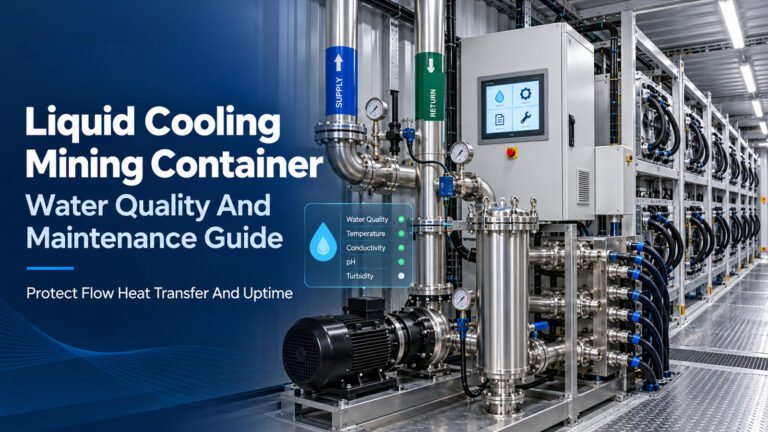
A coolant distribution unit sits between the miner-side cooling loop and the facility-side heat rejection system. In a liquid cooling mining container, it usually manages several critical jobs:
It circulates coolant through the miner loop.
It transfers heat through a plate heat exchanger or integrated cooling interface.
It controls supply temperature.
It monitors pressure, flow, alarms, leakage, and pump status.
It separates the clean miner-side loop from the outdoor facility loop.
It protects miners from unstable water quality and field installation mistakes.
Go smaller on the CDU only if you are also willing to go smaller on uptime.
In AI and HPC data centers, liquid cooling is expanding because power density is rising faster than air cooling can handle. The same logic applies to ASIC mining, only the business model is harsher. A data center may calculate performance per rack. A miner calculates revenue per kilowatt per day. If the CDU causes throttling or downtime, the loss appears immediately.
Step 1: Size The CDU By Heat Load, Not Miner Count
Miner count is a convenient starting point, but it is not the engineering basis. The correct basis is IT load.
Use this simple framework:
Required CDU Capacity = Total ASIC Power × Heat Capture Ratio × Safety Margin
For hydro ASIC miners, almost all electrical input becomes heat. If you plan 200 miners at 5.5 kW each, your IT load is 1,100 kW. A practical CDU design should not be selected at exactly 1,100 kW. You need a margin for overclocking, high ambient temperature, pump aging, fouling, and future miner replacement.
For mining farms, a 10% to 20% engineering margin is usually more realistic than a “perfect match” design. If the farm will run overclocked miners, or if the site is in a hot climate, the margin should be closer to the higher end.
Кәсіби кеңес:
If the quote only says “supports 200 miners” but does not list cooling capacity in kW, flow rate, temperature conditions, and pressure range, do not treat it as a technical proposal.
Step 2: Match Flow Rate To The ASIC, Not Just The Container
A CDU can have enough theoretical cooling capacity and still fail in the field if the flow distribution is wrong.
Flow rate decides how quickly heat is carried away from the miner. Pressure decides whether that flow can actually reach every miner through manifolds, hoses, quick connectors, filters, and cold plates. In a containerized mining farm, this matters because miners are not installed on a clean laboratory loop. They are installed in rows, racks, manifolds, and long pipe runs.
A strong CDU selection process should ask:
What is the required flow per miner?
What is the total loop flow rate?
What is the pressure drop across miners, manifolds, filters, and hoses?
Can the pump maintain flow when the filter starts to load?
Is pump speed variable or fixed?
Does the system give flow alarms per loop or only at the main pipe?
The cheapest CDU often looks acceptable until the farthest miners in the loop receive less flow than the closest miners. That is where hashrate instability begins.
Қысқа ереже:
cooling capacity is the headline. Flow balance is the truth.
Step 3: Decide The Supply Temperature Strategy
Supply temperature is not just a cooling number. It affects dry cooler size, pump energy, condensation risk, miner stability, and total facility PUE.
Lower supply temperature gives more thermal headroom, but it may require larger heat rejection equipment and more energy. Higher supply temperature can improve efficiency and make free cooling easier, but only if the miners, coolant, cold plates, hoses, and control logic are designed for it.
Recent liquid-cooled supercomputing research shows why flow rate and supply temperature should be optimized together, not treated as fixed values. A 2026 digital twin study of liquid-cooled supercomputer infrastructure found that co-optimizing flow and supply temperature can produce significant cooling energy savings compared with flow-only optimization. Mining farms do not operate exactly like supercomputers, but the lesson transfers well: a CDU should be selected as part of a full thermal control strategy, not as a standalone pump box.
For ASIC farms, the practical question is simple:
Can the CDU hold stable outlet temperature during load changes?
Mining loads may look constant, but real farms see restarts, firmware changes, curtailment events, batch commissioning, power interruptions, and seasonal changes. A CDU with weak control logic may overshoot or undershoot during these events.
Кәсіби кеңес:
Ask for the CDU control range under partial load. Many systems are sized for full load but behave poorly when only 30% to 50% of miners are online during phased deployment.
Step 4: Choose Redundancy Based On Revenue Risk
Redundancy is not a luxury feature. It is an insurance calculation.
If one pump fails, what happens?
If one sensor fails, does the system shut down unnecessarily?
If one heat exchanger side fouls, can the farm keep running at reduced load?
If a control board fails, is there a manual bypass or service mode?
For small pilot farms, a single-pump CDU may be acceptable if the operator can tolerate downtime. For commercial farms, especially above several hundred kilowatts, N+1 pump redundancy becomes much easier to justify. The cost of an extra pump can be lower than the lost revenue from one avoidable outage.
Here is the ROI framing:
Downtime Loss = Farm IT Load × Mining Revenue Per kWh Equivalent × Downtime Hours
Even without a perfect revenue model, operators understand the logic. A 1 MW liquid cooling farm offline for 12 hours is not just a maintenance event. It is a direct revenue interruption, and it may also trigger restart labor, miner inspection, and customer SLA pressure if the site hosts third-party machines.
Go redundant when the farm is revenue-critical. Go simple only when downtime is acceptable.
Step 5: Check Water Quality Before You Check Price
Water quality is one of the most underestimated CDU selection factors.
A mining farm is often deployed in locations chosen for cheap power, not perfect water. That means the site may have high hardness, dust, unstable maintenance practices, freezing risk, or poor filtration. The CDU has to survive the real site, not the sales meeting.
Key water-side questions:
Does the miner loop require purified water or glycol mixture?
What filtration level is required?
What corrosion inhibitors are approved?
Is the plate heat exchanger serviceable?
Are strainers easy to access?
Can the system support automatic makeup water or pressure compensation?
What is the freeze protection strategy?
DroLin Box’s own site already lists purified water system integration as a solution direction, which is important because water treatment is not separate from CDU reliability. It is part of the cooling system.
Кәсіби кеңес:
In cold regions, do not treat antifreeze as an afterthought. Glycol changes heat transfer performance and pump behavior. If glycol is required, the CDU must be sized with that fluid in mind.
Step 6: Integrate The CDU With Dry Coolers And Site Climate
A CDU does not reject heat into the sky by itself. It needs a facility-side system: dry cooler, cooling tower, chiller, hybrid cooler, or another heat rejection path.
For mining farms, dry coolers are common because they are simple, modular, and easier to deploy with containers. But dry cooler performance depends heavily on ambient temperature. A dry cooler that works well at 25°C ambient may not maintain the same supply temperature at 40°C ambient. This is why many mining container specifications mention cooling capacity at a stated ambient condition.
When comparing CDU proposals, always connect the CDU to the heat rejection design:
Дизайнның қоршаған орта температурасы қандай?
What is the approach temperature between coolant and outdoor air?
How many dry coolers are needed at peak load?
What happens during dust buildup or fan failure?
Can the CDU communicate with dry cooler fan controls?
Is there enough space around the dry cooler for airflow?
The mistake is buying the CDU and dry cooler separately, then discovering on site that the CDU can move heat but the outdoor system cannot reject it fast enough.
For container farms, the best design is not the most powerful single component. It is the cleanest match between miner load, CDU flow, heat exchanger capacity, dry cooler performance, and site climate.
Step 7: Look At Controls, Monitoring, And Maintenance
A CDU should make the operator calmer, not busier.
At minimum, the system should monitor:
Supply and return temperature
Supply and return pressure
Ағын жылдамдығы
Сорып алу қондырғысының күйі
Дифференциалды қысымды сүзгілеу
Leak alarm
Tank level or system pressure
Conductivity or water quality indicators where applicable
Дабыл тарихы
Remote communication interface
For overseas mining sites, remote monitoring is not optional. Many farms are built far from the owner’s office. If the CDU only shows data on a local screen, the operator may learn about problems too late.
The best CDU for a mining farm is not necessarily the one with the most sensors. It is the one that turns sensor data into useful action: alarm thresholds, pump speed control, automatic protection, clean fault codes, and easy maintenance access.
Кәсіби кеңес:
Ask whether filters, pumps, sensors, and valves can be serviced without draining the entire loop. Maintenance ergonomics directly affect downtime.
Step 8: Build A CDU Buying Scorecard
Before signing a purchase order, score each CDU supplier across these categories:
Cooling capacity at your real ambient condition
Miner-side flow and pressure capability
Насостың резервтік көшірмесі
Heat exchanger design
Water quality and filtration support
Control logic and remote monitoring
Compatibility with Antminer Hydro and Whatsminer Hydro models
Dry cooler integration
Spare parts availability
Service access inside the container
Documentation quality
Total installed cost, not just CDU price
This scorecard prevents the most common procurement mistake: choosing the lowest quoted CDU price while ignoring installation, downtime, water treatment, maintenance, and future miner upgrades.
A CDU is a long-life infrastructure component. ASIC models change quickly. The CDU should be selected with enough flexibility to support future machines with higher power density.
2026 жылға орналастыру бойынша соңғы шешім
Choose the CDU that protects revenue, not the one that looks cheapest per kW.
For a small test farm, a compact CDU with basic controls may be enough. For a commercial liquid cooling mining farm, especially a containerized site running hundreds of hydro ASIC miners, the CDU must be evaluated as part of the full thermal chain: miners, cold plates, manifolds, pumps, heat exchanger, dry coolers, water quality, controls, and service access.
The right CDU will not just lower temperature. It will stabilize hashrate, reduce downtime, protect miner lifespan, and make the farm easier to operate.
That is the real buying standard.