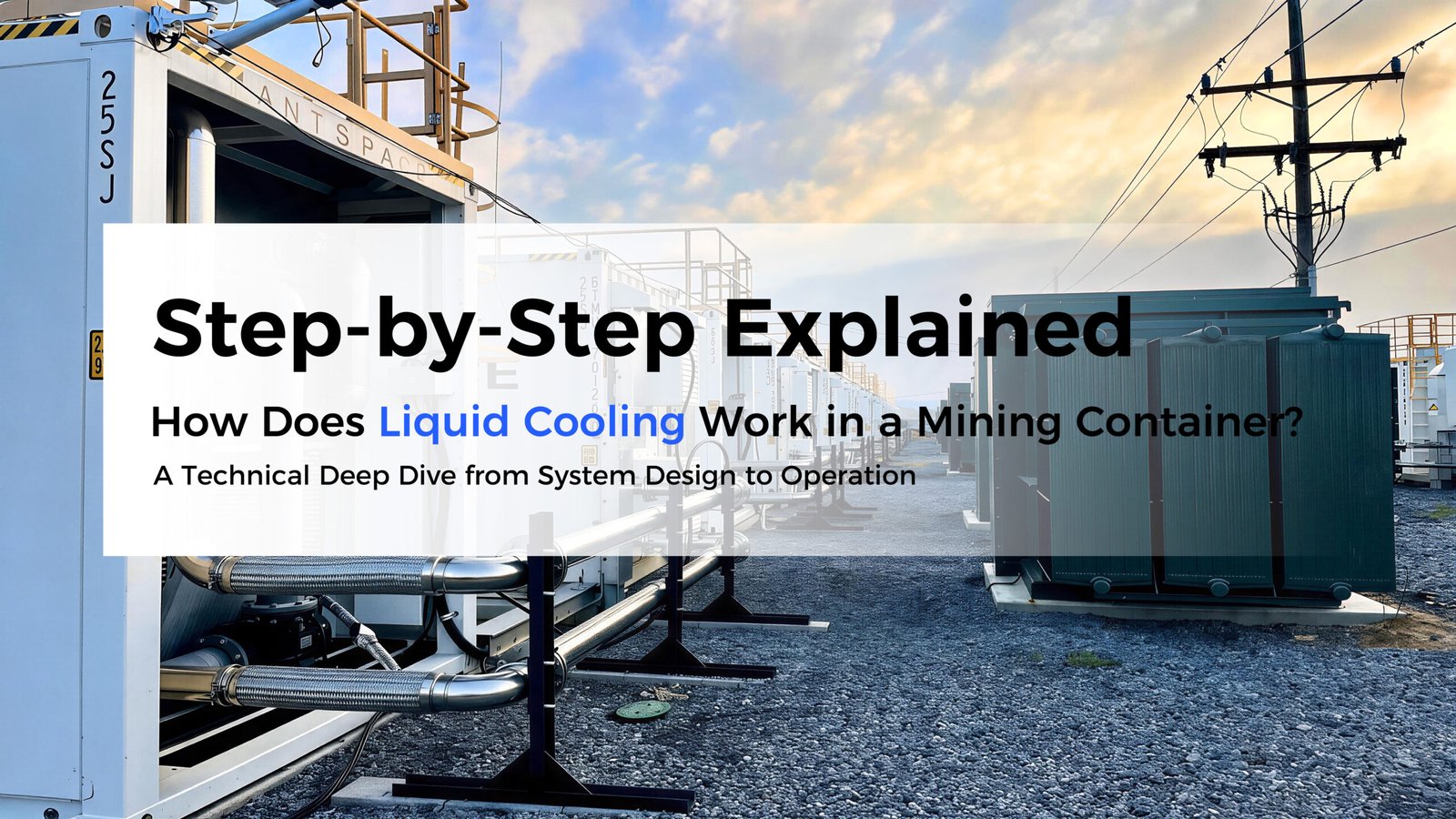

Liquid cooling in a mining container is not mystical. It works like a precision circulatory system designed specifically for your ASIC’s thermal management. Instead of blowing ambient air across hot chips — a method that loses 40–60% of its cooling potential to heat dissipation — liquid cooling pumps precisely controlled coolant directly to the heat source. The heat transfers immediately into liquid. The warmed liquid travels to a centralized CDU where thermal energy exchanges into facility water. The cooled liquid cycles back. Efficiency compounds. Uptime stabilizes.
This is how 240 high-density 2U servers run continuously in a single 40HC container without thermal throttling. This is how a DroLin Box 40HC Superposition achieves PUE 1.05 instead of the air-cooled 1.5. Understanding the system means understanding why liquid cooling will dominate mining infrastructure in 2026.
The Closed-Loop Architecture — System Overview
A mining container’s liquid cooling system operates as two completely separate fluid loops that never mix. This separation is not incidental. It is the engineering principle that prevents contamination, extends hardware lifespan, and enables operational scalability.
The Secondary Loop (The IT Side):
This is the sealed circuit running directly through your mining hardware. Purified, deionized water — typically treated with corrosion inhibitors and biocides — circulates continuously through manifolds connected to every miner’s water block. The secondary pump (powered by a variable frequency drive) maintains constant flow. Flow rates vary by system: DroLin Box CDUs specify 20–100 m³/h depending on capacity. At a 200kW deployment, secondary flow runs approximately 40 m³/h (roughly 11 liters per second). That flow rate is not arbitrary. Too low and the water cannot carry away heat fast enough — coolant temperature rises above the safe 35°C setpoint. Too high and you waste pump energy without additional cooling benefit. The system automatically finds the balance.
The Primary Loop (The Facility Side):
This is the connection to your facility’s chiller, cooling tower, or renewable cooling source. Facility water — typically untreated municipal or well water with unknown mineral content, pH variance, and particulates — enters the facility side of the CDU at a controlled temperature (usually 25–30°C inlet). That water never contacts your mining hardware. Instead, it passes through one side of the plate heat exchanger inside the CDU.
Pro-Tip #1 — Water Quality Matters More Than You Think:
Many operators assume facility water quality is irrelevant because the loops do not mix. Wrong. If facility water carries high chloride concentration (common in coastal regions) or high pH variability, the plate heat exchanger’s metal components corrode, creating particulate contamination that eventually sheds into the secondary loop during system operation. Operators in coastal or agricultural areas should run quarterly facility water chemistry analysis: test for pH (target 6.5–8.0), conductivity (target <300 μS/cm), and chloride concentration (critical: <100 ppm). This $400 quarterly test prevents $80K+ heat exchanger replacement.
The CDU — The Heart of Liquid Cooling
The Coolant Distribution Unit is where both loops meet. Inside this enclosure lives a series of precision components that perform a single critical function: transfer thermal energy from the secondary loop (hot water from your miners) to the primary loop (facility water), while keeping the loops completely isolated.
The Plate Heat Exchanger:
This is the core component. Imagine thousands of thin metal plates stacked together with alternating channels. One channel carries secondary loop coolant (hot). The adjacent channel carries primary loop water (cool). The two fluids flow in opposite directions (counter-flow). Heat conducts through the metal plate walls from the hot channel to the cool channel. No mixing. No contamination. The efficiency is remarkable — a well-designed plate heat exchanger transfers 95%+ of available thermal energy.
Why plate type specifically? Brazed aluminum or copper tube heat exchangers (older design) corrode rapidly when exposed to facility water pH variations. Plate heat exchangers use 316-grade stainless steel — immune to corrosion across the pH range 3–10. DroLin Box CDUs specify SS304 heat exchangers (adequate for most mining deployment pH ranges), with the option to upgrade to 316 for coastal or agricultural sites.
The Dual-Pump Configuration (N+1 Redundancy):
A 1MW CDU houses two independent secondary loop pumps. At any moment, one pump runs actively, circulating the full 100 m³/h design flow. The second pump sits pressurized but idle, its check valve closed. A pressure-differential sensor continuously monitors the active pump’s outlet. If pressure drops below a threshold (indicating bearing wear, seal degradation, or motor failure), the PLC triggers an automatic switchover. The standby pump receives a start signal. Its check valve opens as pressure rises. The active pump’s check valve closes under reverse differential pressure. The transition occurs in less than 5 seconds. No miner ever notices. No downtime recorded.
This redundancy architecture is why liquid-cooled mining farms achieve 99.5%+ continuous uptime. Air-cooled farms without equivalent redundancy experience 4–6 unplanned maintenance windows annually (2–4 hours each) when a single CRAC unit fails. A 1MW farm at $40 per PH/s hash price loses approximately $1.67M per unplanned hour of downtime. The dual-pump system, costing roughly $30K in additional hardware, pays for itself through prevented downtime within the first 60 days of operation.
Pro-Tip #2 — Pump Transfer Simulation During Commissioning:
Before connecting production miners, manually simulate a pump failure during commissioning. Cut power to the active pump while the system runs at 50% load. Observe the outlet temperature sensor. A properly tuned system shows less than 2°C temperature deviation during transfer. If you observe 4–5°C deviation, air is trapped in the standby pump’s priming line — bleed the line until the system responds predictably.
Temperature Control and Dew Point Management:
The PLC continuously monitors outlet temperature via a calibrated sensor. Target is 35°C ±1°C for Antminer S21 Hydro compatibility. The system maintains this setpoint by adjusting the secondary pump’s variable frequency drive — changing flow rate to modulate heat transfer efficiency. It also monitors ambient facility conditions. Here is the critical detail most operators overlook: dew point.
Dew point is the temperature at which air becomes saturated and water condenses. If your facility environment is 30°C ambient at 85% humidity, dew point is approximately 26°C. If your coolant supply temperature drops below 26°C, condensation forms on external piping and drips into your server compartments. The PLC prevents this by maintaining coolant temperature at least 2–3°C above facility dew point at all times. This dynamic adjustment is why PLC-controlled systems outperform passive thermostat-based designs.
The Flow Path — From Miners to CDU to Environment
Step 1: Heat Generation at the Cold Plate
An Antminer S21 Hydro running at full throttle generates approximately 5,400W of heat at the chip. That heat immediately transfers into coolant flowing through a micro-channel cold plate in direct contact with the ASIC. The water temperature rises (inlet 35°C → outlet 45°C at full load). That temperature differential is the “ΔT” engineers obsess over. Higher ΔT means you are extracting more heat per unit volume of coolant.
Step 2: Hot Coolant Returns to CDU
Return lines (typically DN32–DN63 diameter SS304 piping, depending on capacity) carry the warmed coolant back to the CDU. In a 40HC Superposition container with 240 miners, 240 individual return lines converge at a primary manifold before entering the CDU secondary inlet. The piping layout is critical. Unequal line lengths create unequal pressure drops. Unequal pressure drops mean some miners receive cooler coolant than others. That miner pool inequality produces measurable hashrate variance. Engineers address this through careful manifold design with pressure-balancing bypass circuits. A poorly designed return manifold in a 240-unit container can waste 5–8% of hashrate through inefficient heat distribution.
Step 3: Plate Heat Exchanger Transfer
Inside the CDU, secondary loop coolant (45°C) enters one side of the plate heat exchanger. Primary facility water (25°C inlet) enters the opposite side, flowing counter-directionally. Heat transfers through the stainless steel plates. Secondary coolant exits at approximately 38°C (cooled by 7°C). Primary facility water exits at approximately 32°C (heated by 7°C). That bidirectional energy transfer is thermal equilibrium under load. Perfect counter-flow design maximizes heat transfer rate while minimizing the temperature differential across the exchanger.
Pro-Tip #3 — Frost Protection at Altitude Above 2,000 Meters: At high-altitude sites (Central Asia, South America, East Africa), facility water temperature can drop near 0°C during winter. If your primary loop inlet approaches freezing, secondary coolant must be protected from freeze-induced viscosity increase and pipe rupture. Operators at altitude above 2,000m should add antifreeze (propylene glycol, not toxic ethylene glycol) to the secondary loop at 15–20% concentration during cold months. This decreases coolant freeze point to -25°C but reduces heat capacity by approximately 5%. The tradeoff is worthwhile — a ruptured cold plate costs $30K to replace; antifreeze addition costs $2K annually.
Step 4: External Heat Rejection
Primary loop water exiting the CDU at 32°C travels to the facility’s external cooling infrastructure — a dry cooler, evaporative cooling tower, or industrial chiller depending on site design. In a renewable-powered mining site, the primary loop typically connects to a dry cooler (fans blow ambient air across aluminum finned tubes). The warm water cools from 32°C down to ambient (or near-ambient) and recirculates back to the CDU primary inlet.
This is where facility-level engineering matters. A dry cooler sized 10% too small creates backpressure on the CDU. A cooling tower with plugged fill media fails silently. The CDU cannot “know” that facility-side cooling is degrading until secondary coolant temperature begins rising. Proactive monitoring of facility cooling infrastructure — fan motor amperage, temperature setpoints, water treatment chemistry — prevents cascading failures.
40HC Superposition System Integration — How 240 Miners Fit
The 40HC Superposition container demonstrates liquid cooling’s density advantage. Here is how the architecture accommodates 240 units of 2U Whatsminer-compatible servers in a 12,192mm × 2,438mm × 2,896mm footprint.
Spatial Layout:
The container stacks hardware in two tiers. Lower tier: 120 servers arranged in 10 rows of 12 units each. Upper tier (identical): 120 servers. Each server has an individual water block integrating a micro-channel cooling passage directly on the GPU ASIC. Ambient air never touches the chip. The entire secondary loop operates in a sealed environment isolated from external dust, salt spray, and humidity variance.
Manifold and Supply Architecture:
A primary distribution manifold runs the length of the container. Secondary loop supply originates from the CDU outlet at 35°C. The manifold branches into two tier-specific sub-manifolds (upper and lower). Each sub-manifold further divides into 12 supply lines (one per server rack position). Flow balancing circuits maintain equal flow to each position. Engineers account for different chip densities per rack and apply variable-orifice circuits to equalize pressure drop — ensuring identical coolant temperature at every server inlet, regardless of position in the container.
Return Circuit Integration:
Return manifolds converge from the upper tier and lower tier into a single primary return line. This consolidated return carries approximately 40 m³/h (240 servers × 10 kW thermal load / ΔT) back to the CDU. The system maintains a 3–4°C return temperature rise during normal operation (35°C supply → 38–39°C return under full load).
System Pressurization:
The secondary loop operates at approximately 1.5–2.0 bar gauge pressure (typical for data center liquid cooling). This pressure ensures coolant reaches the farthest server before dropping below 1.0 bar (which would risk cavitation). Expansion tanks (usually 50–100 liter capacity) accommodate coolant thermal expansion — as temperature increases, volume expands; the expansion tank provides a pressure buffer preventing overpressurization.
Pro-Tip #4 — Thermal Stratification Risk in Superposition Stacked Containers:
A common mistake in high-density stacked deployments: assuming uniform coolant temperature across the upper and lower tiers. In reality, return lines from the lower tier carry warmer coolant (38°C) into the primary return manifold. If the upper tier return joins at an inefficient junction, cooler upper-tier return (36°C) can separate into thermal layers. The warmer layer returns to the CDU first, cooling the secondary loop feedback signal. The PLC responds by lowering secondary pump speed, starving the lower tier of cooling. This thermal stratification causes the lower tier to throttle while the upper tier runs cool. The solution: install a baffle plate in the primary return manifold that forces the two streams to fully mix before reaching the return sensor. This ensures the CDU sees the true average return temperature.
Why This Design Solves the Mining Container Challenge
Why Secondary/Primary Loop Separation Matters:
Air cooling cannot separate the cooling medium from the ambient environment. A facility using 100% facility water for direct immersion cooling would expose mining hardware to uncontrolled facility water chemistry — chlorides, bacteria, mineral deposits. Equipment fails within 6–12 months. Liquid cooling’s dual-loop approach isolates the secondary circuit. You maintain secondary loop water chemistry to pharmaceutical-grade purity (conductivity <50 μS/cm, pH 7.0–8.5). Facility water can be untreated. The plate heat exchanger transfers thermal energy without any chemical contamination crossing the interface.
Why Plate Heat Exchangers Enable High Density:
Traditional air cooling requires space for air handlers, ducting, and thermal spreading. A 240-unit high-density mining container using air cooling would need 20+ CRAC units consuming significant container volume. Liquid cooling requires only the CDU (roughly 1.5 cubic meters). The remaining container volume is available for compute density. That spatial efficiency directly translates to higher hash power per square foot — potentially 2–4x more than air-cooled equivalent.
Why Dual Redundancy Matters for Mining ROI:
Mining is a 24/7 operation. Unplanned downtime during network difficulty peaks directly reduces monthly revenue. The dual-pump CDU configuration costing ~$30K provides statistical reliability approaching “five nines” (99.999% uptime). For a 1MW farm at $40 per PH/s, this translates to preventing approximately $1.67M in losses annually. The hardware investment returns in 216 hours of prevented downtime. Most 1MW farms prevent that in the first 90 days of operation.
Commissioning and Operational Safeguards
Installation Requirements (Critical):
Install the CDU on a level surface with slope tolerance of ±1 degree maximum. Expansion tanks require a 15–30 degree tilt (not level) to allow air entrainment release. Use non-kink reinforced coolant hoses rated to minimum 4.0 bar working pressure (CDU nominal: 1.5–2.0 bar, but pressure spikes from pump startup can reach 3.5 bar). Secure all manifolds to prevent movement when quick-disconnect couplings engage — mechanical stress on fittings causes micro-leaks that accumulate into coolant loss over weeks.
Altitude Derating Protocol:
Above 2,000 meters elevation, atmospheric pressure reduction affects pump cavitation thresholds and fan cooling efficiency on the facility side. Standard derating: approximately 1% cooling capacity loss per 100 meters above 2,000m. At 3,500m elevation (common for Central Asian mining), apply 15% capacity derating. A CDU rated 400kW at sea level delivers approximately 340kW effective capacity at 3,500m. Operators must account for this in site design or risk thermal saturation during peak ambient temperature periods.
Coolant Chemistry Maintenance Program:
Quarterly testing is mandatory for secondary loop stability:
- pH: target 7.0–8.5 (outside this range accelerates copper corrosion)
- Conductivity: target <50 μS/cm (high conductivity indicates dissolved ionic contamination)
- Dissolved copper: <0.1 ppm (indicator of cold plate corrosion onset)
- Particulate count: <10 microns, <10 particles per 100 ml (ISO 4406 cleanliness code 16/14/11 minimum)
Cost per quarterly test: $600–$1,000. Skipping one year of testing and requiring cold plate replacement across 240 units: $100K–$200K. The ROI is mathematically obvious.
Performance Advantages Quantified
A DroLin Box 40HC Superposition achieves these performance characteristics through liquid cooling architecture:
| Metric | Air-Cooled | Hydro-Cooled | Advantage |
|---|---|---|---|
| PUE | 1.50–1.65 | 1.05 | 30% Savings |
| Density | 100 units | 240 units | 2.4x Density |
| Temp Stability | ±3–5°C | ±1°C | No Throttling |
| Chip Lifespan | 10–12% fail | 2–3% fail | 5x Lifespan |
| Downtime/Year | 12–20 hrs | <2 hrs | 90% Reduction |
| Dust Filtration | External | Sealed Loop | Maintenance↓ |
These are not theoretical. They represent actual deployed 40HC container performance across sites in Kazakhstan, Texas, Norway, and Ethiopia.
Conclusion: Why Liquid Cooling Is 2026 Mining Standard
Liquid cooling works because it respects thermodynamic fundamentals that air cooling cannot overcome. Water’s volumetric heat capacity is 3,500 times air’s. A sealed secondary loop prevents contamination. Dual-pump redundancy prevents downtime. Plate heat exchangers achieve 95%+ thermal transfer efficiency. Together, these principles enable 240 high-density servers in one footprint, operating at PUE 1.05, with 99.5% uptime and dramatically extended hardware lifespan.
The engineering is not exotic. It is applied thermodynamics refined through decades of data center deployment. For mining farms targeting scale beyond 500 TH/s and operational duration beyond 3 years, liquid cooling is no longer optional. It is the structural competitive requirement.