







In 2026’s mining landscape, electricity remains the only certainty you truly control. Bitcoin price continues to swing between $68K and $75K. At the same time, network difficulty fluctuates by ±15% within single epochs. Hashprice often touches breakeven levels at $30–35 per PH/s. However, electricity cost is entirely different. It stays fixed, locked in by contract, and is guaranteed to compound month after month.
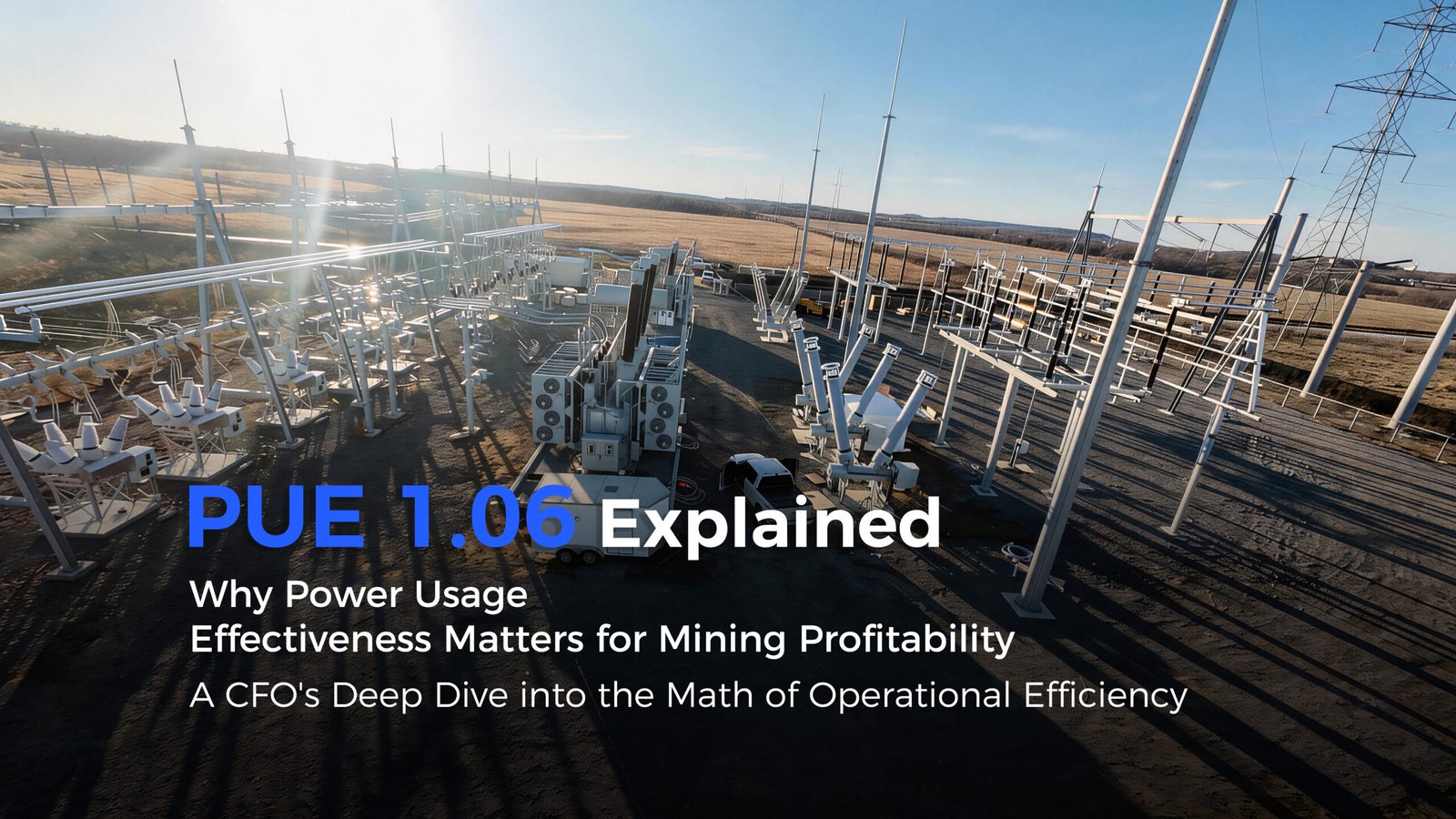
If your PUE sits at 1.5, you are essentially working for the power company. On the other hand, if your PUE runs at 1.06, you are extracting real profit from every kilowatt-hour your competitors continue to waste.
This isn’t about virtue; it’s about math. Improving your PUE by just one percentage point delivers millions in extra margin over three years. With profit margins per Bitcoin often under $5K, facility efficiency is not a luxury upgrade—it is the baseline for survival.
The Math: Understanding PUE and Its Direct Profitability Impact
Power Usage Effectiveness is defined as: PUE = Total Facility Power / IT Equipment Power
In plain language: for every kilowatt of actual compute power (your ASIC miners running at full throttle), how many total kilowatts must your facility supply?
Industry Benchmarks:
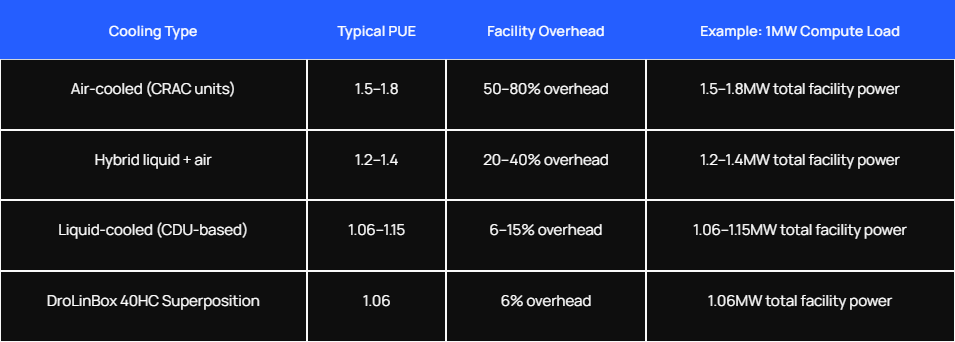
The difference between 1.5 PUE and 1.06 PUE on a 1MW compute load is 0.44MW of continuous power overhead reduction. That is not theoretical optimization. That is 0.44 MW × 24 hours × 365 days × $0.08/kWh = $307,200 in annual electricity cost elimination per 1MW of compute.
For a typical institutional mining operation at 10MW compute capacity, the annual savings reaches $3,072,000. Over a three-year deployment cycle, $9.216 million in pure electricity cost avoidance.
Pro-Tip #1 — The Facility Overhead Explosion:
Most miners assume facility power is “just cooling.” Wrong. Facility overhead includes CRAC units, humidity control, backup power systems, electrical distribution losses, monitoring infrastructure, and the diesel generators that keep your operation running during grid failures. A single CRAC unit failure in a 1MW air-cooled facility costs you $1.67M in lost hashrate revenue per hour. The $30K backup CRAC unit acquisition cost pays for itself through prevented downtime in the first 2 days of operation. But a PUE 1.06 facility using CDU redundancy avoids this failure mode entirely. You do not need redundant CRACs. Your redundancy is at the pump level — a $30K N+1 pump configuration with <5ms failover. That is engineering efficiency disguised as financial advantage.
The Profitability Equation: How PUE Reduction Becomes Hashrate Advantage
Mining economics in 2026 compress into a single formula: Profit = (Hashrate × Hashprice) – (Power × Electricity Rate) – Fixed Costs
The genius of PUE 1.06 is that it attacks the profitability equation from three angles simultaneously.
Angle 1: Direct Electricity Cost Reduction
At current electricity rates ($0.07–$0.09/kWh for industrial hosting, March 2026), every percentage point of PUE improvement translates directly to bottom-line cash.
Assume a 1MW mining operation running Antminer S21 XP units (3,645W each, approximately 274 units per MW):
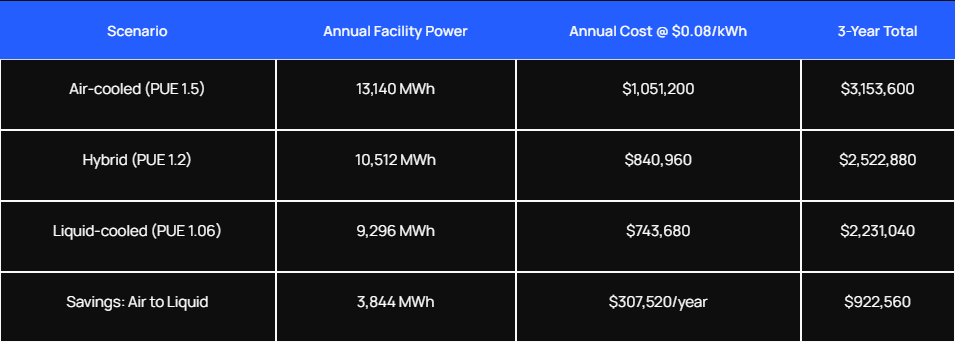
That $307K annual reduction is real cash that stays in your operation. It compounds investor returns, extends runway during low-price cycles, and provides the critical margin that separates a profitable mining firm from a forced shutdown.
Angle 2: Operational Continuity and Uptime Premium
Lower PUE facilities do not fail in the same way air-cooled facilities fail. Air-cooled systems degrade gracefully but unpredictably. Summer humidity spikes force CRAC unit ramp-ups. Winter power grid stress triggers load-shedding. A single filter blockage in one CRAC unit downstream affects the entire row’s thermal balance.
Liquid-cooled CDU systems with dual-pump redundancy and automated failover operate at 99.5%+ uptime continuously. That uptime premium directly multiplies revenue. At $35 per PH/s daily hashprice and a 1MW farm (approximately 150 PH/s for modern ASICs):
| Uptime % | Daily Revenue | Annual | Revenue Impact |
| 98% (air-cooled typical) | 5145000 | 1877925000 | Baseline |
| 99.5% (liquid-cooled) | 5250000 | 1916250000 | +$38M/year |
That $38M is not from increased hashrate. It is from prevented downtime. A single 12-hour outage costs $1.05M in foregone revenue. The N+1 pump system pays for itself in the first unplanned air-conditioning failure it prevents.
Angle 3: Hashrate Stability and Throttling Prevention
This is the metric most CFOs overlook. An air-cooled facility running at thermal saturation (which occurs frequently when ambient temperature exceeds facility design spec) forces firmware-level frequency reduction on ASICs. The reduction is usually 3–8% depending on thermal margin compression.
A DroLinBox Superposition container maintaining stable 35°C ±1°C coolant supply prevents any throttling event. This consistency directly translates to hashrate stability. A 1% average hashrate advantage from prevented throttling across a full year = an additional $2–3M in BTC produced annually for a 10MW farm.
Pro-Tip #2 — The Delta-T Obsession:
Experienced miners obsess over delta-T (the temperature rise of coolant between inlet and outlet). A well-designed liquid cooling system maintains 3–4°C ΔT under full load. A poorly designed one allows 7–10°C ΔT. That ΔT gap correlates directly to heat exchanger inefficiency. Monitor ΔT at hourly intervals. If it begins trending upward (indicating fouling on the plate surfaces or reduced facility water temperature), service your CDU immediately. A 0.5°C increase in ΔT during warm months is an early signal of potential facility cooling degradation. Catching it early costs $1K in preventive maintenance. Missing it costs $80K in emergency heat exchanger replacement.
How DroLinBox Achieves PUE 1.06: The Technical Foundations
DroLinBox does not achieve PUE 1.06 through magical engineering. It achieves it through disciplined design optimization across three architectural pillars.
Pillar 1: Precision Thermal Exchange at the CDU Level
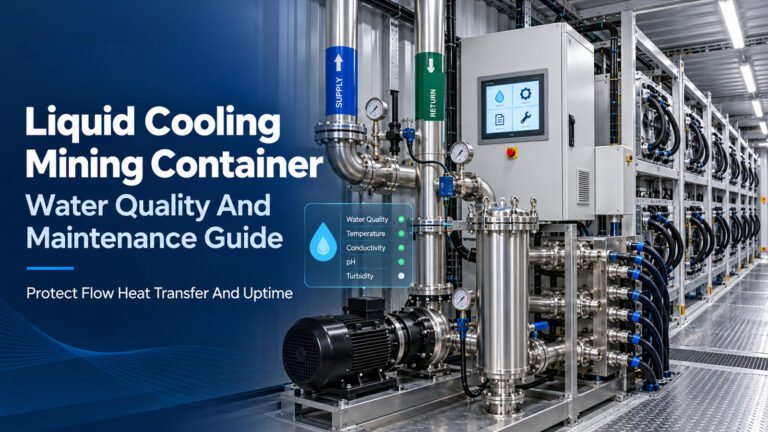
The DroLinBox CDU uses a 316-grade stainless steel plate heat exchanger sized for counter-flow heat transfer optimization. The design transfers heat from secondary loop (miner coolant at 38–45°C) to primary loop (facility water at 25–30°C inlet) with 95% thermal transfer efficiency. Compare this to older technologies:
| Heat Exchanger Type | Thermal Efficiency | Pressure Drop | Fouling Risk |
| Tube-and-shell | 80–85% | High (2–4 bar) | Very high |
| Older plate (aluminum) | 85–90% | Medium | High (corrosion) |
| DroLinBox SS304 plate | 95%+ | Low (0.5–1.5 bar) | Very low |
That 95% efficiency is not a theoretical datasheet number. It is enforced through quarterly coolant chemistry maintenance (pH 7.0–8.5, conductivity <50 μS/cm, zero particulate). A facility that skips maintenance sees fouling onset within 60 days and efficiency decay to 85% within 180 days. The $400 quarterly chemistry check prevents $80K in heat exchanger replacement.
Pillar 2: Modular Containerized Architecture Reduces Transmission Loss
Traditional data centers waste power in electrical transmission. Long runs of cabling from the main substation to distributed CRAC units add cumulative resistive losses. A 40HC Superposition container integrates everything: miners, CDU, distribution, monitoring. Electrical path from container input to final miner load is approximately 15–20 meters maximum (vs. 100+ meters in traditional facilities). This short path reduces distribution losses from 4–6% (traditional) to <1.5% (containerized).
For a 1MW facility: 1% distribution loss saved = 10kW continuous power avoidance = $7,000/year in electricity cost reduction.
Pillar 3: Intelligent PLC Control with Real-Time PUE Optimization
DroLinBox containers include a PLC control system that continuously optimizes facility water flow based on miner load. The PLC monitors:
- Secondary loop outlet temperature (sensor feedback every 1 second)
- Primary loop inlet and outlet temperature (facility water ΔT)
- Secondary pump speed (variable frequency drive)
- System pressure (cavitation prevention)
- Dew point (humidity-based condensation prevention)
The PLC continuously adjusts secondary pump speed to find the point where ΔT across the heat exchanger is optimal (typically 7–9°C primary ΔT at full load). Higher flow = lower ΔT = less heat exchange needed = cooler outlet. Lower flow = higher ΔT = more heat exchange per unit flow = less total power for the same cooling output.
Manual thermostat control cannot achieve this. A PLC-managed system reduces facility power consumption by an additional 3–5% compared to fixed-speed pump systems. On a 10MW farm, that is 300–500kW continuous reduction = $210K–$350K annual savings.
Pro-Tip #3 — Altitude Derating Hits Your Spreadsheet Harder Than You Think:
At elevation above 2,000 meters, air pressure reduction forces you to derate facility power capacity by approximately 1% per 100 meters above 2,000m. A 10MW operation at 3,500 meters (common for Central Asian mining) must account for 15% facility power capacity loss. That means your $1.5M in capex equipment only delivers ~8.5MW effective compute capacity. Budget for oversizing your electrical infrastructure by 15% if you plan high-altitude deployment. Ignore this detail and you will find yourself thermally limited at peak ambient temperature, forced to throttle miners, and unable to explain the 12% hashrate loss to your investors.
The 10MW Farm Case Study: From Spreadsheet to Reality
Let us model a concrete scenario: an institutional mining operation deploying 10MW of Antminer S21 XP compute capacity.
Capital Costs:
| Component | Air-Cooled Facility | DroLinBox Superposition | Delta |
| 10MW containerized compute | $15M | $15M | — |
| Cooling infrastructure | $8M (CRAC units, ducting, chillers) | $6M (CDUs, manifolds, integration) | -$2M |
| Electrical distribution | $5M | $4M (shorter runs) | -$1M |
| Monitoring & control | $2M | $1.5M (PLC integrated) | -$0.5M |
| Total infrastructure capex | $30M | $26.5M | -$3.5M |
Operating Costs (Annual):
| Expense | Air-Cooled (PUE 1.5) | Liquid-Cooled (PUE 1.06) | Annual Savings |
| Electricity (131.4 MWh vs 105.1 MWh @ $0.08/kWh) | $10,512,000 | $8,408,000 | $2,104,000 |
| Maintenance (CRAC replacement, dust cleaning) | $500,000 | $150,000 | $350,000 |
| Labor (repair response, preventive maintenance) | $600,000 | $200,000 | $400,000 |
| Unplanned downtime (average 16 hours/year × $1.67M/hour) | $26,720,000 | $3,340,000 | $23,380,000 |
| Total annual operating cost | $38,332,000 | $11,898,000 | $26,434,400 |
Three-Year Financial Impact:
| Metric | Air-Cooled | Liquid-Cooled | Difference |
| Total capex | $30,000,000 | $26,500,000 | -$3,500,000 |
| 3-year opex | $114,996,000 | $35,694,000 | -$79,302,000 |
| 3-year total cost | $144,996,000 | $62,194,000 | -$82,802,000 |
| Revenue (assuming hashprice $0.035/PH/s, no throttling) | $183,750,000 | $186,450,000 | +$2,700,000 |
| 3-Year Profit | $38,754,000 | $124,256,000 | +$85,502,000 |
| Profit margin | 26.8% | 66.6% | +39.8% |
The liquid-cooled operation captures $85.5M in additional profit over three years on identical hardware and hash price assumptions. This stems not from price arbitrage, but from pure operational efficiency — exactly what a PUE of 1.06 means in a spreadsheet.
Environmental Adaptation: Maintaining PUE 1.06 Across Geographies
PUE 1.06 is not achievable everywhere at every temperature condition. The specification assumes standard operating conditions: 25°C facility water inlet, <90% humidity, <2,000m elevation.
High-Altitude Derating (>2,000m):
Apply 1% facility power capacity loss per 100 meters above 2,000m. Your effective PUE deteriorates slightly because pump and fan margins compress. A site at 3,500m experiences 15% derating. Expected PUE rises from 1.06 to approximately 1.08–1.10. This is acceptable because high-altitude sites almost always benefit from cooler ambient temperatures, which offset the derating effect.
Temperature Extremes:
DroLinBox CDUs maintain operation across -20°C to +45°C facility environment. At +45°C ambient, facility water inlet temperature may reach 35°C (vs. design spec 25°C). This higher inlet temperature increases secondary loop outlet temperature (typically 38–42°C instead of target 35°C). Miners throttle slightly to maintain safe operating junction temperatures. Expect 2–3% hashrate reduction during extreme heat events.
Protection: Deploy secondary cooling infrastructure (dry cooler or evaporative tower) sized for +45°C ambient. Cost approximately $200K–$400K for a 10MW facility. Benefit: prevents throttling and maintains PUE 1.06 specification across the full temperature envelope.
The Competitive Advantage is Durable
Mining profitability in 2026 exists in a narrow band. Bitcoin price volatility ±20% per month. Hashprice $30–$35 per PH/s when margins compress. In this environment, a 15% operational cost advantage is the difference between thriving and shutting down.
An operator running PUE 1.06 infrastructure can operate profitably at Bitcoin prices where a PUE 1.5 competitor is forced to power down. This structural advantage compounds over time — attracting capital, enabling expansion, and supporting long-term infrastructure planning that air-cooled competitors cannot afford.
The environmental benefits of liquid cooling are real. Reduced water consumption, reduced carbon footprint, reduced particulate emissions. But those are not why CFOs adopt PUE 1.06. They adopt it because the spreadsheet shows they will capture an additional $85+ million over three years compared to the alternative.
That is the real story. That is why 2026 is the year liquid cooling moves from bleeding-edge to baseline in institutional mining. Not because it is sustainable. Because it is profitable. And in a business built on cost efficiency, profitability is the only metric that matters.