







At 5MW, the expensive mistake is no longer buying the wrong mining container. It is treating five megawatts as five copies of a 1MW project.
A 5MW mining farm is a power-and-heat management system with containers attached to it. The containers matter, but the project succeeds or fails on usable electrical capacity, transformer planning, airflow control, site logistics, maintenance access, and how safely the farm can scale after the first miners come online.
For a mining operator, the goal is simple: convert available power into stable hashrate with the lowest practical PUE, the fewest avoidable shutdowns, and a layout that can still be serviced in the middle of summer.
This guide explains how to plan a modular mining farm around 5MW of ASIC load using air-cooled containers, with practical notes on power distribution, cooling, container layout, operating costs, and phased deployment.
Start With Usable Kilowatts, Not Container Quantity
“5MW” can mean two very different things:
5MW IT load: Power consumed by ASIC miners.
5MW facility load: Total site power, including miners, fans, lighting, network equipment, pumps, controls, and auxiliary systems.
For a real project proposal, these numbers must be separated.
If your ASIC load is 5MW and the site operates at a planning PUE of 1.05, the total facility load is approximately:
5MW x 1.05 = 5.25MW
That extra 250kW is not a rounding error. It affects transformer sizing, switchgear capacity, cable selection, monthly electricity cost, and whether your utility connection has enough headroom for hot-weather operation.
نصيحة من الخبراء: Ask the utility for the continuous available power, not only the transformer nameplate rating. A site may have a 6MVA transformer but still face operating restrictions, power-factor requirements, or seasonal limits.
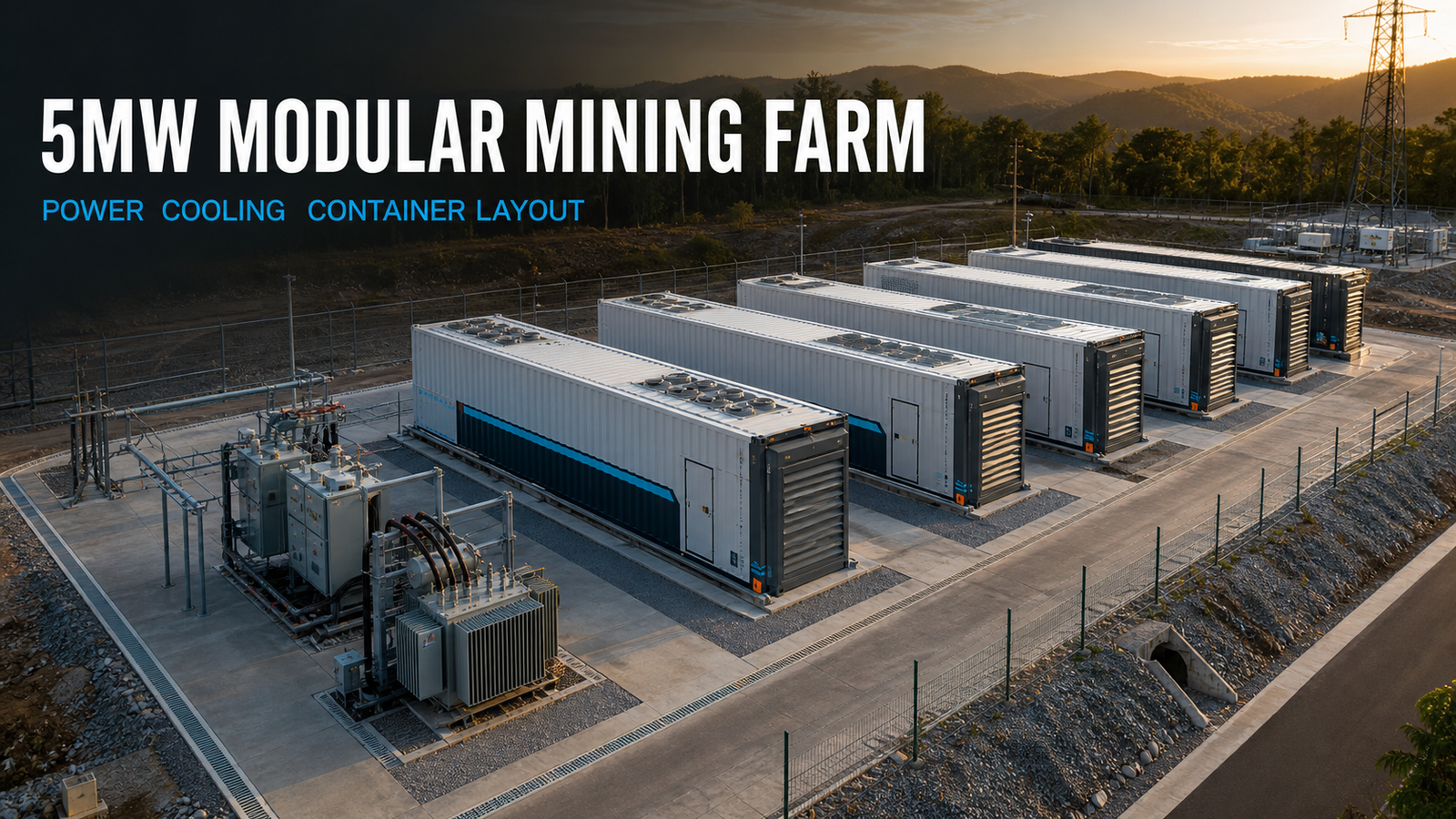
A Practical 5MW Modular Mining Farm Layout
For many 3MW to 5MW mining operators, the most balanced configuration is five 40HC air-cooled mining containers operated at approximately 1MW of ASIC load per container.
DroLin Box 40HC air-cooled mining containers are reference-configured for up to 1,300kW operating power, with 16 high-volume exhaust fans and capacity for up to 336 S19/S21-class miners depending on the actual miner model and site conditions. Running a modular mining farm below the absolute maximum reference capacity creates more room for thermal stability, maintenance access, and future upgrades.
| Layout Option | تكوين الحاوية | Approximate IT Load | الخيار الأمثل |
|---|---|---|---|
| Balanced Layout | 5 x 40HC air-cooled containers | 5MW | Most 5MW greenfield projects |
| Compact Layout | 4 x 40HC containers near full load | 5MW | Sites with limited footprint and strong cooling conditions |
| Flexible Layout | 6 x 40HC containers at lower load | 5MW | Operators prioritizing redundancy and phased expansion |
| Staged Layout | 20HC and 40HC mixed containers | 1MW to 5MW | Projects building capacity in phases |
The first option is usually the easiest to manage. Five 40HC containers create clear electrical blocks, predictable maintenance zones, and a practical path for expansion. One container can be isolated for service without making the entire mining farm difficult to operate.
A compact four-container layout may look attractive on paper, but it leaves less room for airflow margin, cable routing, and future equipment changes. A layout that looks dense in a quotation can become fragile in August.
How Many ASIC Miners Can a 5MW Mining Farm Support?
The correct answer depends on miner wattage, firmware mode, and the power reserve you want to keep.
Use this calculation:
Miner Quantity = Available IT Load / Single Miner Power
Here is an illustrative planning example:
| ASIC Type | Example Single-Miner Power | Approximate Quantity at 5MW IT Load |
| S19-Class ASIC | 3.25kW | About 1,538 miners |
| S21-Class ASIC | 3.50kW | About 1,428 miners |
| Higher-Power ASIC | 3.65kW | About 1,369 miners |
These figures are for early planning only. Final miner count should be calculated after confirming the exact model, firmware mode, inlet temperature, voltage range, and container electrical configuration.
نصيحة من الخبراء: Do not fill every PDU outlet just because it is available. Reserve electrical and thermal margin for fan aging, voltage fluctuation, high ambient temperature, and future ASIC upgrades.
Power Architecture for a 5MW Mining Farm
A modular mining farm needs an electrical architecture that divides risk instead of concentrating it.
A typical power path looks like this:
Utility or Substation Connection -> Medium-Voltage Switchgear -> Transformer -> Main Low-Voltage Distribution -> Container Feeders -> Container PDU -> ASIC Miners
For a 5MW ASIC load with a 1.05 planning PUE, early-stage engineering often evaluates a transformer envelope around 6.3MVA. This is only a preliminary planning reference. The final transformer size must be confirmed by a licensed electrical engineer based on local voltage, power factor, utility requirements, altitude, code compliance, and expansion plans.
Key electrical planning items include:
Available voltage and frequency at the site
Utility connection capacity and demand charges
Transformer rating and redundancy requirements
Main switchgear and feeder protection
Container-level power meters
PDU outlet quantity and current rating
Grounding grid and lightning protection
Emergency shutdown strategy
Remote electrical monitoring
The best modular mining farm layouts use container-level metering. You should be able to see the power consumption, voltage, current, temperature alarms, fan status, and network condition of each container without walking across the site.
Cooling a 5MW Air-Cooled Mining Farm
Every kilowatt consumed by an ASIC miner becomes heat. A 5MW mining farm therefore needs to reject roughly 5MW of heat continuously.
That is why cooling design cannot be added after the containers arrive.
For air-cooled mining containers, the layout should consider:
Prevailing wind direction
Hot-air exhaust direction
Distance between container rows
Exhaust recirculation risk
التعرض للغبار والرمل
Rainwater drainage
Noise boundaries
Service-road access
Crane and forklift access
Space for future containers
The common layout mistake is placing container exhausts toward each other. Hot air then circulates back toward the intake side, raising inlet temperatures and forcing fans to work harder. The result is lower miner efficiency, more thermal alarms, and higher auxiliary power consumption.
A simple rule helps: position containers so hot exhaust air has a clean path away from the cold-air intake zone.
For difficult climates, operators may also need dust filters, water-curtain systems, seasonal operating strategies, or lower container loading during extreme heat.
نصيحة من الخبراء: Design the roads and maintenance lanes before finalizing container spacing. A container layout is not truly modular if a forklift cannot safely reach a failed fan, PDU, or miner rack.
PUE and Monthly Electricity Cost at 5MW
PUE is one of the fastest ways to understand whether a mining farm is efficiently designed.
Using a planning PUE of 1.05:
| البند | Planning Value |
| ASIC IT Load | 5.00MW |
| Estimated Facility Load | 5.25MW |
| Daily Energy Consumption | 126,000kWh |
| Monthly Energy Consumption | 3,780,000kWh |
Illustrative monthly electricity costs:
| Electricity Rate | Estimated Monthly Electricity Cost |
| USD 0.05/kWh | USD 189,000 |
| USD 0.07/kWh | USD 264,600 |
| USD 0.09/kWh | USD 340,200 |
Every USD 0.01/kWh difference in electricity price changes monthly operating cost by approximately USD 37,800 at this load level.
That is why a low container purchase price should never be evaluated by itself. The real project cost includes power availability, electrical losses, cooling energy, downtime exposure, local labor, spare parts, logistics, and site construction.
Build the Farm in Phases
A 5MW modular mining farm does not need to go live in one weekend.
A staged deployment reduces capital pressure and allows the operator to validate power quality, airflow, network performance, and maintenance procedures before the site reaches full load.
A practical sequence is:
Site Feasibility: Confirm utility capacity, electricity rate, climate, land condition, local regulations, and logistics route.
Engineering Design: Define container quantity, miner type, transformer, switchgear, PDU, cable routes, grounding, drainage, and container orientation.
Factory Manufacturing and Testing: Build containers, complete wiring checks, test controls, inspect fans and PDU systems, and verify shipping readiness.
Civil and Electrical Site Work: Prepare foundations, access roads, transformer pad, cable trenches, drainage, fencing, and network connection.
Container Delivery and Installation: Position containers, connect feeders, commission controls, and verify airflow direction.
Load Ramp-Up: Bring miners online by container or by electrical block, then monitor voltage balance, inlet temperature, exhaust temperature, and fan performance.
This sequence gives operators a chance to solve small problems while they are still small.
What DroLin Box Needs Before Designing Your 5MW Mining Farm
A serious project proposal starts with site data, not a generic container quotation.
Prepare these details before requesting a modular mining farm design:
بلد المشروع والموقع الدقيق للمشروع
Available continuous power capacity
Utility voltage and frequency
Target electricity rate and billing structure
Planned ASIC model and quantity
Preferred air cooling or liquid cooling approach
Ambient temperature range, humidity, dust, altitude, and wind conditions
Available land size and site access route
Transformer and switchgear status
Required deployment schedule
Required certifications or local compliance standards
Future expansion target beyond 5MW
With this information, DroLin Box can recommend a more realistic container quantity, power architecture, cooling strategy, and delivery plan.
Final Verdict: Design the System Before Ordering the Containers
A 5MW modular mining farm should be designed as an operating system for power, heat, and uptime.
For most projects, five 40HC air-cooled mining containers operated near 1MW each provide a strong balance of deployment speed, container-level control, maintenance access, and expansion flexibility. The final configuration should always be adjusted for the local grid, climate, ASIC model, and operating strategy.
The container is the visible part of the project. The real value is in the engineering behind it.
Explore DroLin Box Air-Cooled Mining Containers or contact our team for a site-specific 1MW to 5MW mining farm proposal.