






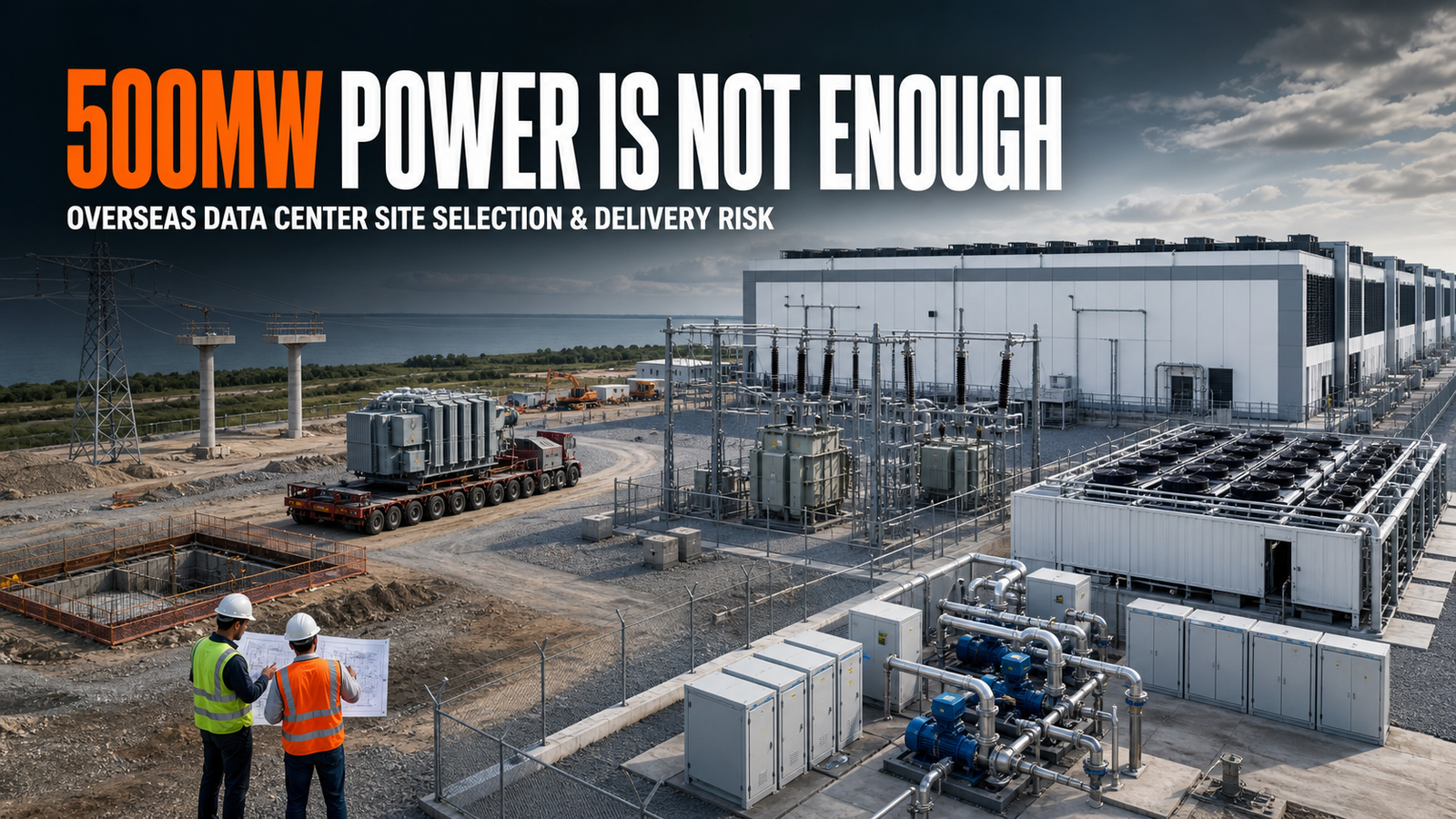

A 500MW power promise can be commercially worthless if the first usable megawatt arrives after the GPU generation has changed.
That is the conflict behind many overseas compute-center projects. A developer is shown a substation, a generation asset or a utility letter containing a large number. The site is then described as “powered.”
In reality, the land may not be entitled and the transmission upgrade may not be funded. The transformers may not be ordered, the cooling system may not be permitted, and the connection may remain conditional on future network work.
Do not buy the headline capacity. Buy an executable delivery path.
For site-selection purposes, the capacity that matters is not the largest number in the presentation. It is the smallest verified capacity across the complete delivery chain:
Deployable IT Capacity = the minimum of grid import capacity, substation capacity, cooling capacity, permitted capacity, network capacity and equipment delivery capacity.
If one link supports only 80MW, a 500MW site is an 80MW site until that constraint is removed.
The Difference Between Power Nearby and Power Deliverable
“500MW available” can describe several very different commercial positions:
- Generation capacity: a nearby power plant or renewable project can theoretically produce 500MW.
- Transmission capacity: the regional grid can carry the additional load without unacceptable reliability risk.
- Connection capacity: the utility or system operator has studied and approved the load at a defined point of interconnection.
- Contracted capacity: the customer has an executed agreement, security obligations and an enforceable delivery schedule.
- Energized capacity: the substation, transformers, protection, meters and feeders are complete and can supply the site.
- Usable IT capacity: the facility can convert that supply into stable compute load after PUE, redundancy and operating limits are applied.
These numbers should never be treated as interchangeable. For example, a 500MW gross facility allocation at PUE 1.25 supports approximately 400MW of IT load before additional operating reserve or contractual curtailment is considered. At PUE 1.40, the same facility supply supports about 357MW of IT load.
Pro Tip: Ask every developer to label capacity as planned, studied, contracted, under construction, energized or operational. If the answer is only “reserved,” ask who reserved it, under which agreement, with what security payment and by what guaranteed date.
Risk 1: The Grid Connection Date Is Not the Construction Date
The International Energy Agency has warned that grid constraints could delay around 20% of global data-center capacity planned for construction by 2030. However, that does not mean every delayed project lacks generation.
In many cases, the real bottleneck is the network between generation and load. Transmission lines, substations, protection studies, stability requirements and connection queues can all postpone the first usable megawatt.
Large-load regions are already changing their rules. PJM in the United States has been developing reliability-focused processes for integrating data centers and other large loads. Ireland has also used specific connection policies for data centers and has introduced flexible-demand requirements in some connection arrangements.
The practical lesson is simple: a utility conversation is not an interconnection right.
Before accepting a site, request:
- Named utility, transmission operator and balancing authority
- Exact point of interconnection and voltage level
- Executed connection agreement or current study-stage evidence
- Firm capacity and interruptible or flexible capacity shown separately
- Required network upgrades and the party responsible for each cost
- Milestone dates for study, engineering, procurement, construction and energization
- Conditions that allow the utility to delay, reduce or withdraw capacity
- Curtailment, ride-through, ramp-rate and demand-response requirements
- Consequences if the customer does not reach agreed load milestones
Go/no-go rule: Do not value future megawatts at the same price as energized megawatts. Discount each phase according to its documentation, dependencies and schedule risk.
Risk 2: The Substation Can Become the Critical Path
A connection approval does not manufacture a transformer.
The U.S. Department of Energy describes large power transformers as expensive, difficult to transport, highly customized equipment with long manufacturing lead times. Recent U.S. reliability material has cited average transformer lead times of roughly 120 weeks in 2024, with large transformer ranges extending from about 80 to 210 weeks.
For a large compute campus, the critical path may include:
- High-voltage transformers and auxiliary transformers
- Gas-insulated or air-insulated switchgear
- Protection relays, breakers and instrument transformers
- Busduct, medium-voltage cable and harmonic equipment
- Factory acceptance testing and witness schedules
- Heavy-haul transport, bridge surveys and crane access
- Grid-code testing and final energization authorization
Ordering equipment before the design is stable creates change-order risk. Waiting for every permit before reserving production slots creates schedule risk. Therefore, the procurement strategy needs controlled release gates: approved basis of design, frozen ratings and interfaces, cancellation terms, manufacturing milestones and documented alternatives.
Pro Tip: Build the level-three schedule around the longest verified equipment lead time, not around the building handover date. A completed data hall without its primary transformer is not a revenue-producing asset.
Risk 3: Land Ownership Does Not Equal Development Permission
Cheap land beside a transmission line can still be undevelopable.
Overseas projects may require zoning approval, environmental review, building permits, electrical permits, wetlands or drainage approvals, road-access agreements, air permits for backup generation, fuel-storage approval, noise studies and public hearings. Each jurisdiction uses different terminology, but the commercial question remains the same: which approval can legally stop construction or operation?
Complete the following checks before the land deposit becomes non-refundable:
- Title, easements, rights of way and expansion rights
- Zoning classification and permitted use
- Maximum building area, height, setback and noise limits
- Flood, seismic, wildfire, storm and geotechnical risks
- Wetlands, protected species and cultural-heritage constraints
- Air-permit limits for generators or onsite generation
- Water withdrawal, discharge and stormwater requirements
- Heavy-haul road capacity and construction traffic restrictions
- Public-consultation process and known community concerns
- Tax incentives and the clawback conditions attached to them
A permit tracker should identify the authority, application date, owner, dependency, statutory review time, public-hearing risk and appeal risk for every approval. “Local government support” is useful, but it is not a substitute for a legally effective permit.
Risk 4: Cooling Architecture Can Invalidate the Site
Power is only useful when the heat can leave the site.
AI and HPC projects concentrate large heat loads into fewer racks. Therefore, the cooling decision affects site power, water demand, equipment footprint, noise, winter operation and permitting.
For example, a wet cooling tower may reduce electrical demand under some conditions. Yet it also creates water-supply, treatment, blowdown and plume considerations.
By contrast, a dry cooler reduces routine water dependence. Its capacity and fan power must still be checked at the site's actual summer design temperature.
The 2024 U.S. Data Center Energy Usage Report from Lawrence Berkeley National Laboratory specifically evaluates both energy and water use. The correct procurement response is not to choose “water-free” or “low-PUE” from a brochure. It is to compare complete annual performance at the candidate site.
Request a cooling basis of design that states:
- IT load and rack power-density profile
- Peak and part-load heat-rejection duty
- Design dry-bulb and wet-bulb temperatures
- CDU supply and return temperatures
- Approach temperature and design margin
- Annual fan, pump and water consumption model
- Water source, quality, treatment and discharge route
- Freeze protection, dust control and corrosion assumptions
- N, N+1 or 2N redundancy boundary
- Noise level at the property boundary
Decision rule: Compare PUE and WUE together. Saving pump or fan energy is not a complete win if the selected cooling method cannot secure a water permit or cannot reject full load during the hottest design hours.
Risk 5: Fiber Capacity Is Different From Fiber Proximity
A fiber route near the property does not prove that the project has diverse, low-latency and contractable network service.
For AI training, inference, cloud or colocation workloads, confirm:
- Carrier names and available service capacity
- Physically diverse entry routes and meet-me points
- Distance and measured latency to target exchanges or customers
- Route ownership and shared-conduit exposure
- Construction cost and lead time for lateral connections
- Cross-border data, cybersecurity and localization requirements
- Service-level terms and restoration commitments
A site can have excellent power economics and still fail its workload if the network design adds unacceptable latency or creates one physical point of failure.
Risk 6: The Project May Be Too Large to Finance as One Block
A 500MW campus is not one project. It is a sequence of commercial commitments, substations, cooling plants, data halls and customer ramps.
Developing all 500MW at once increases exposure to demand uncertainty, technology changes, permit delays and unused infrastructure. A phased modular plan converts those uncertainties into decision gates.
| Phase | Example Capacity | Evidence Required Before Release | Main Exit Question |
|---|---|---|---|
| Phase 0 | Development only | Land control, utility study, cooling concept, permit map, fiber plan | Can the site legally and technically support the first block? |
| Phase 1 | 20-50MW | Firm energization date, ordered transformer, permits, anchor load | Can first revenue start without depending on the full campus? |
| Phase 2 | 50-150MW cumulative | Proven operations, additional grid milestones, cooling expansion path | Did Phase 1 confirm the site assumptions? |
| Later phases | Up to 500MW | Customer demand, funded network works, equipment slots, permit amendments | Does each new block still meet the return threshold? |
Modular electrical rooms, containerized power and cooling systems, repeatable CDU blocks and scalable dry-cooler arrays can shorten onsite integration. However, modularity does not remove grid or permit risk. It only allows the project to release capital closer to verified demand and verified infrastructure.
Pro Tip: Design the first phase so it can operate independently. If Phase 1 requires a future 500MW substation, future water line and future fiber loop before earning revenue, it is not genuinely phased.
The Delay Cost That Site Models Often Hide
Land price is visible. Delay cost is usually buried.
Use a monthly delay model:
Monthly Delay Exposure = financing carry + land and development overhead + committed equipment storage or escalation + idle staff and contractor cost + lost operating contribution + technology-obsolescence risk.
For example, assume a 50MW first phase, PUE 1.25 and a planned 80% average IT utilization. That implies approximately 40MW of usable IT capacity and 32MW of average IT load.
Next, consider the commercial impact. If the business model expected a net operating contribution of only USD 20 per IT kW per month, the delayed operating contribution would be roughly USD 640,000 per month.
That figure still excludes financing carry, idle staff, equipment storage and hardware depreciation.
This is an illustration, not a universal revenue assumption. Replace it with the project’s real contracted margin, utilization ramp and workload economics.
A cheaper site that energizes 12 months later can be far more expensive than a higher-priced site with a defensible delivery path.
The Overseas Compute Center Risk Checklist
| Risk Area | Required Evidence | Red Flag |
|---|---|---|
| Power source | Supply structure, tariff basis, fuel or renewable conditions | Only a generation headline is provided |
| Grid connection | Study status, agreement, point of interconnection, delivery milestones | Capacity is described as nearby or reserved |
| Transmission upgrades | Scope, cost owner, permits, construction schedule | Upgrade cost and completion date are undefined |
| Substation equipment | Approved ratings, vendor slots, FAT and delivery dates | No transformer manufacturing slot is secured |
| Land and permits | Title, zoning opinion, permit matrix, environmental findings | Political support is presented as approval |
| Cooling | Site-specific annual model, CDU/dry-cooler duty, water strategy | Cooling capacity is stated without ambient conditions |
| Network | Carrier letters, diverse routes, latency and lateral schedule | A nearby fiber line is the only evidence |
| Logistics | Port route, bridge and road survey, crane and customs plan | Heavy equipment delivery has not been surveyed |
| Commercial terms | Milestone payments, remedies, security and termination rights | The buyer funds early works without delivery protection |
| Operations | Staffing, spare parts, remote monitoring and service response | The project ends at equipment delivery |
What to Put Into the Site-Control Agreement
Before committing major capital, connect commercial payments to evidence. Depending on local law and transaction structure, conditions precedent may include:
- Acceptable grid study and firm first-phase energization date
- Defined maximum customer contribution for network upgrades
- Zoning and critical permits becoming effective
- Cooling water rights or approval of the dry-cooling alternative
- Fiber service commitments from at least two routes or providers
- Transformer and switchgear production slots
- Heavy-haul and construction-access confirmation
- Right to resize, phase or terminate if a critical milestone fails
- Clear ownership of designs, deposits and long-lead equipment
The objective is not to transfer every risk to another party. It is to prevent the project from paying full price for capacity that is still conditional.
What to Send an Infrastructure Supplier Before Concept Design
To receive a useful modular power-and-cooling concept, send:
- Project country and exact candidate-site location
- Workload type and phased IT-load target
- Rack count, rack density and liquid-cooling architecture
- Available voltage, frequency, fault level and connection phase dates
- Required redundancy and target PUE/WUE
- Design temperature, altitude, dust, humidity and freeze conditions
- Water availability, quality and discharge restrictions
- Preliminary layout, logistics route and construction schedule
- Local certification, grid-code and commissioning requirements
DroLinBox supports modular compute infrastructure planning, containerized deployment, power-distribution integration, CDU and dry-cooler matching, manufacturing, logistics and commissioning coordination. Review our project services or contact the team with the first-phase IT load and the documented power-delivery schedule.
Final Verdict: Select the Delivery Chain, Not the Megawatt Headline
A 500MW opportunity is valuable only when the project can prove how the first block becomes operational and how later blocks expand without reopening every critical assumption.
Therefore, rank candidate sites by time to first reliable IT megawatt, not only by electricity price or announced capacity. Verify the connection stage. Map every permit. Reserve the critical equipment. Model cooling at real weather conditions. Confirm fiber diversity. Phase capital against evidence.
Power nearby is a site attribute. Power delivered on schedule is a bankable project.
Technical References
- International Energy Agency - AI and Energy Security
- International Energy Agency - Energy and AI Executive Summary
- PJM - 2025 Annual Report: Planning
- EirGrid - Demand Connections
- U.S. Department of Energy - Large Power Transformer Resilience Report
- Lawrence Berkeley National Laboratory - 2024 United States Data Center Energy Usage Report
Editorial Note: Project capacities and regulatory conditions can change. Treat announced, planned and reserved capacity as unconfirmed until supported by current agreements, studies and permits. Final investment and engineering decisions must follow local law, utility requirements, approved designs and site-specific professional advice.