







A steel mining shed may look cheaper on day one. That advantage can disappear once you add the foundation, ventilation, dust control, electrical distribution, drainage, fire access, maintenance labor and delayed revenue caused by a longer build schedule.
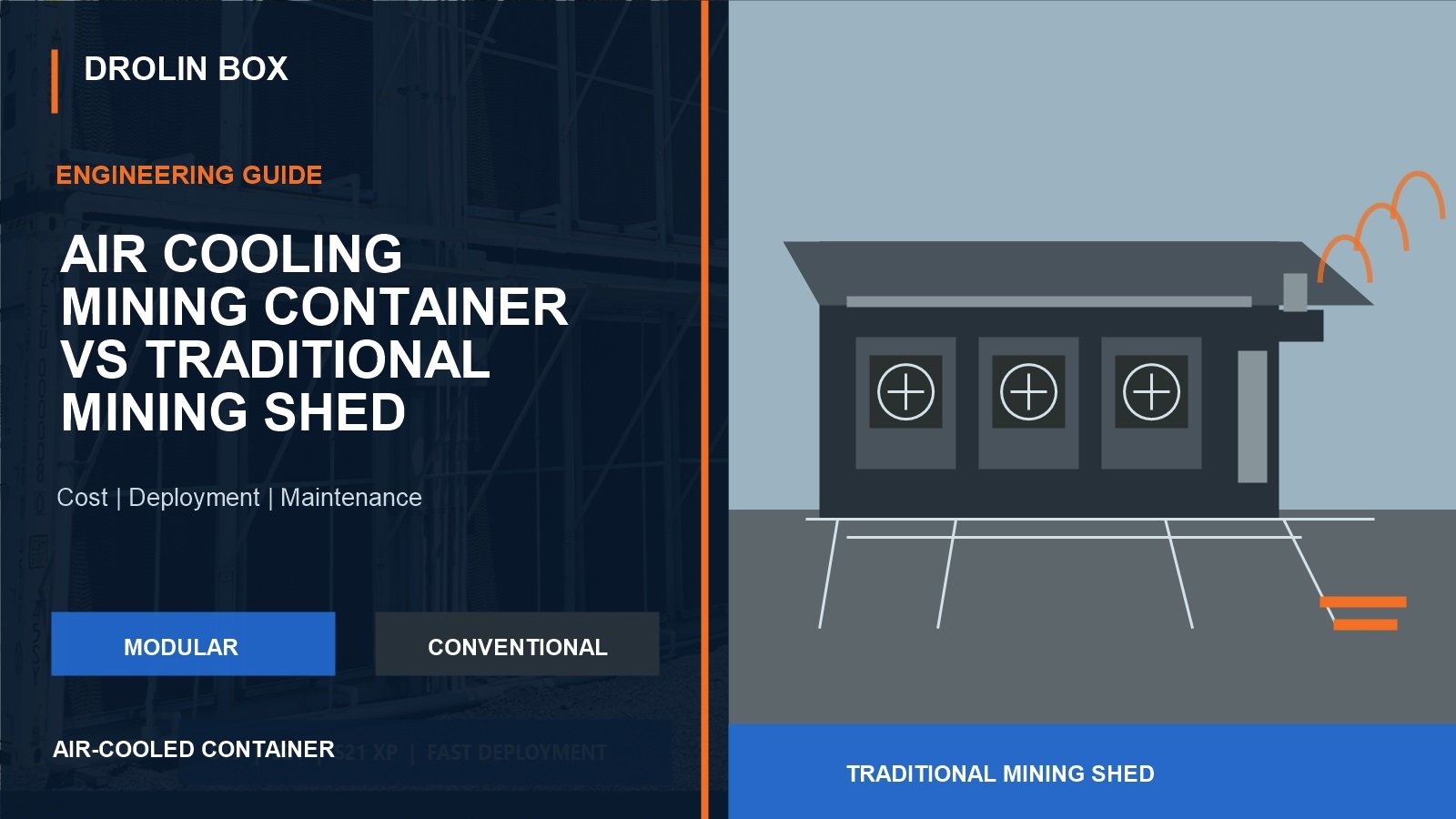
That is the real comparison between an air cooling mining container and a traditional mining shed. The decision is not simply about the price of the enclosure. It is about how quickly the site can go live, how consistently the ASIC miners can be cooled, and how much work is required every time the farm expands.
For a 3MW to 5MW mining farm, the right choice depends on the miner model, available power, site climate, land conditions, local construction cost and expansion plan. A mining container is not automatically cheaper in every country. A traditional shed is not automatically more flexible or easier to operate. The correct answer comes from comparing total deployment cost and operating risk.
What Is the Real Cost of a Traditional Mining Shed?
A traditional mining shed usually starts with a simple calculation: steel structure plus land. The actual project cost is much larger.
- Steel structure and exterior envelope
- Concrete foundation and floor reinforcement
- Air intake and exhaust ventilation
- Dust filters and weather protection
- Power distribution panels, busbars and cabling
- Transformer, switchgear and protection systems
- Drainage, stormwater control and fire access
- Lighting, network systems and security
- Construction labor and local permits
- Maintenance access and future expansion work
A shed may have a lower shell cost, especially when the buyer already owns a suitable industrial building. The calculation changes when the site is remote or when the building must be constructed from the ground up.
The largest hidden cost is often the time required to complete the supporting systems. If the miners are ready but the ventilation, transformer or electrical interfaces are not, the farm is still not producing revenue.
Air Cooling Mining Container vs Mining Shed: A Practical Comparison
| Decision Factor | Air Cooling Mining Container | Traditional Mining Shed |
|---|---|---|
| Initial Cost | More predictable when the container includes racks, fans, filtration and distribution | Potentially lower shell cost but highly dependent on civil and mechanical work |
| Deployment Speed | Fast after the foundation, power and site interfaces are ready | Usually requires more construction, coordination and on-site commissioning |
| Airflow | Designed around defined intake, rack and exhaust paths | Depends heavily on the quality of the building and ventilation design |
| Dust Control | Can integrate filters, louvers, screens and controlled air intake | Must be designed and maintained as a separate building system |
| Expansion | Scale by adding standardized modules | May require structural, electrical and ventilation modifications |
| Relocation | Possible when the site and transport route allow container handling | Generally fixed to the original site |
| Maintenance | Centralized equipment and repeatable module layout | More room for customization but more systems may be distributed across the building |
| Best Fit | Remote, phased, modular or fast-deployment mining projects | Existing industrial buildings or projects with strong local construction support |
The table shows why the phrase air cooled mining container cost should always mean total project cost, not only the factory quotation.
How Airflow Management Changes Mining Farm Performance
Every watt consumed by an ASIC miner eventually becomes heat. The cooling system must move that heat away from the miner intake and exhaust it without allowing hot air to recirculate.
A preliminary airflow estimate can be expressed as:
Required Airflow m3/s approximately equals Heat Load kW divided by 1.2 multiplied by 1.005 multiplied by Temperature Rise in degrees C
This is only an early planning formula. The final design must also consider miner fan curves, static pressure, filter resistance, louver geometry, altitude, outdoor temperature, humidity and the arrangement of the racks.
In a traditional shed, airflow problems often appear after installation. Common symptoms include hot spots near the end of a row, exhaust air returning to the intake side, overloaded fans and uneven miner temperatures.
An air cooling mining container can reduce this design uncertainty when engineers integrate the intake, rack spacing, exhaust direction, and filtration system into a single package. It does not eliminate the need for commissioning. Technicians must still perform air temperature measurements, differential pressure checks, and fan operation tests.
Cooling Must Be Designed Around the Miner List
Container capacity is not just a matter of floor space. A high-power S21-class miner can create a very different thermal and electrical load from an older S19-class unit.
Before selecting a container, buyers should confirm:
- Exact miner brand and model
- Rated and maximum input power
- Miner quantity by model
- Expected operating mode
- Required input voltage and frequency
- Target ambient temperature
- Altitude and dust conditions
- Future expansion load
For reference, the Drolin Box air-cooling product page lists a 40HC configuration with 1,000kW rated power and model-specific capacity references, including up to 336 S19-class units and approximately 270 to 290 S21 or T21 units depending on the configuration. These figures are product reference values. They should not be treated as a universal capacity promise because actual loading depends on miner power, rack spacing, airflow margin, electrical design and operating conditions.
Pro Tip: If your project includes different ASIC models, do not calculate the container quantity by average miner power. Separate the models first, then check heat load, PDU arrangement and airflow for each group.
Deployment Time and Site Preparation
The main advantage of a modular mining farm is not simply that the container arrives ready-made. The value comes from transferring a large part of the work from the remote site to a controlled manufacturing environment.
Drolin Box presents rapid deployment and global delivery references of approximately 15 to 30 days. The actual schedule still depends on the approved design, miner list, electrical specification, production queue, shipping route, customs process and site readiness.
A container project still needs proper preparation:
- Level and load-bearing foundation
- Transformer and switchgear location
- PDU and cable entry points
- Crane access and lifting clearance
- Container delivery route
- Drainage and stormwater planning
- Fire lane and emergency isolation access
- Internet and network connections
- Space for fan, filter and electrical maintenance
A container installed on an unprepared site is not a plug-and-play project. The box may be complete, but the farm can still be delayed by a weak foundation, an undersized transformer or a delivery route that cannot accept a loaded unit.
Dust Control and Daily Maintenance
Dust is not a cosmetic problem in an air cooled mining farm. It increases filter pressure drop, restricts airflow, coats heat sinks and places additional stress on miner fans.
A practical maintenance program should include:
| Maintenance Item | Why It Matters | Typical Action |
|---|---|---|
| Air Filters | Blocked filters reduce airflow and increase fan load | Inspect differential pressure and clean or replace as required |
| Fans | Fan failure can create local hot spots | Check noise, vibration, current and alarm status |
| Louvers and Screens | Obstructions restrict intake and exhaust flow | Remove dust, snow, leaves and other debris |
| Miner Heat Sinks | Dust buildup reduces heat transfer | Inspect and clean during planned maintenance |
| Temperature Sensors | Bad readings can hide real thermal problems | Compare sensor readings with field measurements |
| Power Distribution | Loose or overheated connections increase downtime risk | Perform scheduled inspection and thermal checks |
The Drolin Box air-cooled design references flame-retardant air filters, dust screens, direct-drive exhaust fans and an integrated water curtain. The exact configuration should be confirmed in the project quotation, especially when the farm is located in a desert, agricultural or high-dust environment.
When a Mining Container Has a Lower Total Cost
An air cooled mining container is more likely to have a lower total cost when the project has several of the following conditions:
- The site is remote and local construction labor is expensive
- The buyer needs to bring miners online quickly
- The farm will expand in phases
- The project requires repeatable layouts across multiple locations
- There is no suitable existing industrial building
- Dust control and maintenance access are important
- The operator wants to standardize spare parts and procedures
- Relocation or future site reuse is possible
Traditional construction may still be the better option when the buyer already owns a suitable building, local construction costs are low, the site requires unusual internal layouts or the project needs a large non-containerized service area.
Use this simple comparison model:
Total Deployment Cost = CAPEX + Site Work + Logistics + Installation + Energy + Maintenance + Expected Downtime Cost
Do not compare a container quotation with the price of a steel frame alone. Compare it with the complete cost of making the shed operational.
Which Solution Fits a 3MW to 5MW Mining Farm?
A 3MW to 5MW project should be planned as a group of electrical and cooling modules rather than as one oversized room.
- Define the IT load. Calculate the miner quantity multiplied by the actual operating power.
- Add facility loads. Include fans, lighting, controls, network equipment and distribution losses.
- Set an operating margin. Do not plan every container at its absolute nameplate limit.
- Divide the farm into blocks. Each block should have a clear power, cooling and isolation boundary.
- Plan the expansion sequence. Decide whether the project will start at 1MW, 2MW or another phase before reaching the final target.
- Check the site route. Confirm delivery, crane access and space between containers before ordering.
A 1,000kW-rated container is not automatically a 1,000kW continuous design point. Once operating margin, auxiliary loads and future maintenance requirements are considered, the practical container count may be higher than a simple MW division suggests.
For a 3MW to 5MW farm, some projects may use three to five 1MW-class modules, while more conservative layouts or smaller-loaded units may require six to seven containers. The final answer must be based on the exact miner model, total power, cooling margin and electrical architecture.
20ft vs 40ft Air Cooling Mining Container Use Cases
| Project Condition | More Suitable Option |
|---|---|
| Pilot deployment or limited utility capacity | 20ft air cooling mining container |
| Small mining farm with staged expansion | 20ft or 40ft depending on miner model |
| Higher density and fewer site interfaces | 40ft air cooling mining container |
| Large number of identical ASIC miners | 40ft modular deployment |
| Tight land area with smaller power blocks | 20ft modular deployment |
| 3MW to 5MW farm with repeatable blocks | Multiple 40ft or mixed-size modules after load calculation |
The larger container is not always the better choice. A smaller unit can reduce the size of each electrical block and make phased deployment easier. A 40ft unit may reduce the number of external connections and simplify management when the site has enough land and crane access.
Buyer Checklist Before You Request a Quote
To compare an air cooling mining container with a traditional mining shed, prepare the following information:
- Project country and exact site location
- Miner brand, model and quantity
- Rated and maximum miner power
- Total planned IT load
- Available utility capacity
- Transformer voltage and capacity
- Minimum and maximum ambient temperature
- Altitude, humidity and dust conditions
- Available land dimensions
- Foundation information or site photos
- Delivery route, road width and turning radius
- Crane and lifting restrictions
- Initial deployment and future expansion targets
- Preferred 20ft or 40ft container format
With this information, a qualified supplier can evaluate container quantity, power distribution, airflow, site interfaces and deployment risk before issuing a quotation.
Final Decision: Choose the Lower-Risk Infrastructure
A traditional mining shed can be the right answer when a suitable building already exists and local construction is efficient. An air cooling mining container is usually more attractive when the project values fast deployment, repeatable design, controlled airflow, easier expansion and predictable maintenance.
The best decision is not the option with the lowest enclosure price. It is the option that delivers the required hashrate with the lowest combined cost of construction, energy, maintenance and downtime.
For a project-specific recommendation, contact Drolin Box Air Cooling Mining Container and provide your miner model, miner quantity, expected power, project country, site temperature and preferred 20ft or 40ft format. You can also review the Mining Container Site Requirements Checklist before preparing your request.