







A low container price is easy to quote. A bankable mining infrastructure package is much harder to deliver.
Two suppliers may both offer a “40ft mining container,” yet the actual delivery scopes can be completely different. One quotation may cover little more than the enclosure, fans, racks and distribution panels. The other may include project-specific drawings, electrical calculations, cooling design assumptions, factory testing, shipping documents and commissioning support.
The first price may look lower. Once site rework, electrical mismatches, cooling shortfalls, delayed commissioning and miner downtime are included, it may become the more expensive option.
In this guide, “bankable” does not mean financially guaranteed. It means the solution can be technically reviewed, contractually defined, tested before shipment and accepted at the project site.
1. Verify Who Actually Owns the Engineering
Start by determining whether you are dealing with a mining container manufacturer, an engineering integrator or a sales company coordinating several subcontractors.
A reseller is not automatically a poor supplier. The real issue is accountability. Buyers need to know who is responsible for structural design, electrical engineering, cooling-system integration, production quality, factory testing and after-sales support.
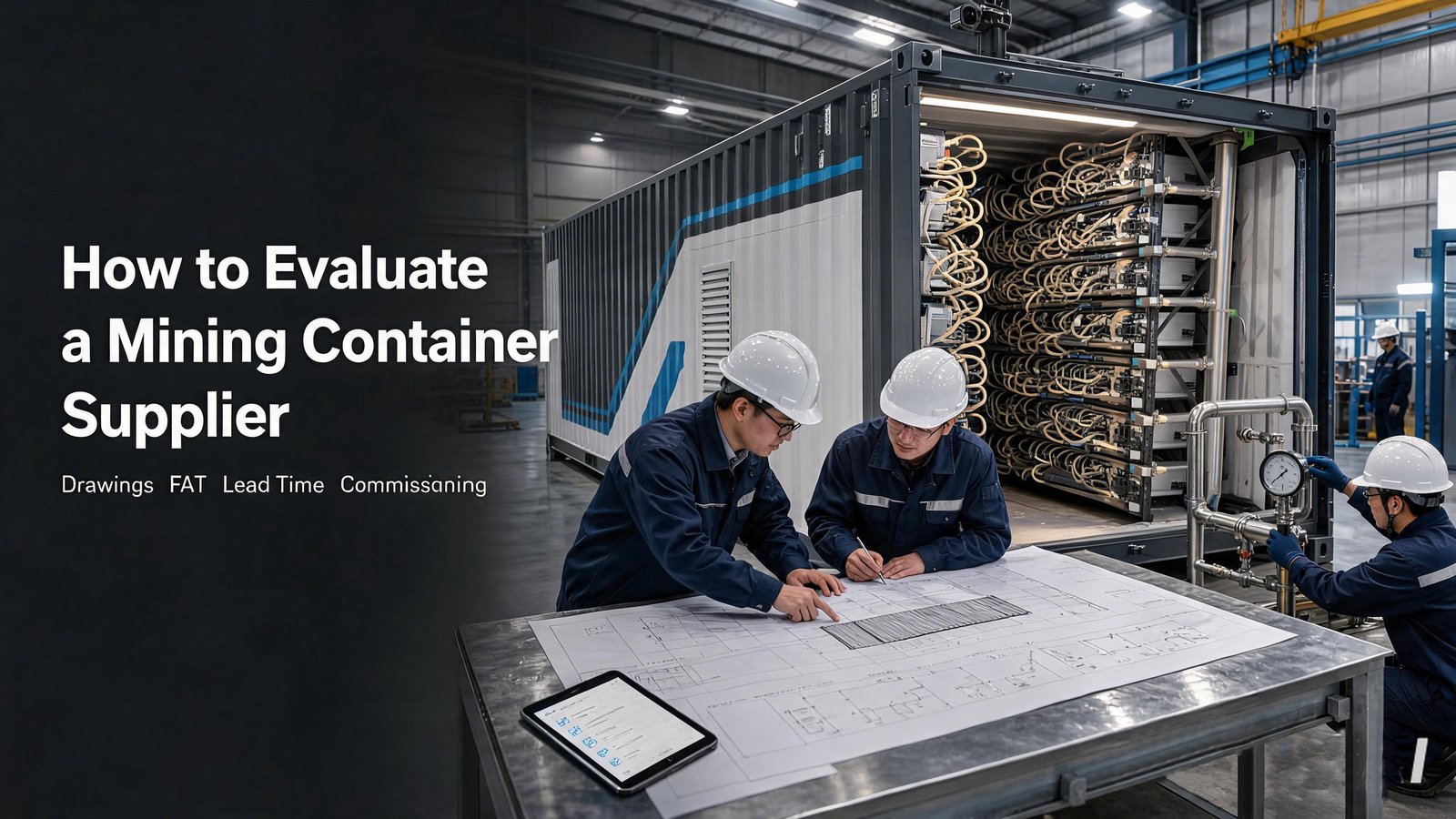
Request the legal company name, factory location, production responsibility, engineering contact and quality-control process. Where practical, arrange a live factory video inspection or an on-site visit. Ask the supplier to show the production area, electrical assembly, piping work, testing equipment and finished units.
An ISO 9001 certificate can support a supplier evaluation, but it should not replace project-specific evidence. A quality-management certificate does not prove that a particular container design matches your miners, voltage or climate.
Pro Tip: Ask one question during the factory review: “Who signs the final technical approval before production starts?” If nobody clearly owns that decision, design changes may be handled informally.
2. Compare Quotation Scope Before Comparing Price
Never compare two prices until both suppliers are quoting from the same design inputs.
The RFQ should identify the project country, site voltage and frequency, miner models, miner quantity, rated power, cooling method, maximum ambient temperature, altitude, transport route and expected delivery boundary.
A useful starting point is the Mining Container Quote Checklist.
The quotation package should clearly state what is included, excluded and optional. It should also identify which specifications remain provisional.
| Evaluation Item | What Buyers Should Request | Common Red Flag |
|---|---|---|
| Design basis | Miner model quantity power voltage climate and altitude | Capacity quoted before project inputs are collected |
| GA drawing | External dimensions doors access points lifting points and interfaces | Only a marketing rendering is available |
| Internal layout | Rack spacing aisles equipment zones and maintenance clearance | Miner count shown without service access |
| Electrical SLD | Incoming supply breakers panels PDU branches protection and grounding | A component list without power architecture |
| Cooling schematic | Air path or coolant flow equipment interfaces and control points | Cooling capacity stated without operating conditions |
| Technical report | Assumptions calculations equipment schedule and limits | Only brochure specifications |
| FAT plan | Test items methods acceptance criteria and responsibilities | “We test everything” without a written procedure |
| Test records | Results photos readings certificates and punch-list status | Edited video without measured data |
| Logistics documents | Packing list lifting plan dimensions weight and shipping scope | Freight responsibility remains unclear |
| Lead time | Design production FAT rectification and dispatch milestones | One delivery number without dependencies |
| Commissioning | Remote or on-site scope site prerequisites and acceptance boundary | “Technical support” is not defined |
| After-sales | Warranty exclusions spare parts response route and escalation | Verbal warranty only |
3. Request a Mining Container Technical Drawing Package
A qualified supplier does not need to release confidential manufacturing drawings during the first inquiry. However, buyers should request a document list, a redacted sample package or an agreed schedule for project-specific drawing submission.
GA Drawing
The general arrangement drawing should show the container dimensions, door positions, equipment zones, lifting or handling points, external connections and maintenance access.
The GA drawing is also the starting point for foundation design, crane planning, spacing between containers and site-road layout. A container that fits on the electrical plan may still fail at the site because the crane cannot reach it or service doors cannot open.
Internal Layout Drawing
Miner capacity is not simply a rack-count exercise. The internal layout should show miner orientation, rack spacing, cable routing, piping routes, electrical panels and maintenance clearance.
For air-cooled systems, inspect the separation between intake and discharge air. For liquid-cooled systems, inspect the CDU position, headers, branch piping, valves, filters, sensors and access required to replace pumps or service connections.
Electrical Single-Line Diagram
An electrical single-line diagram should explain how power moves from the incoming supply to the miners and auxiliary systems. It should identify major breakers, panels, PDUs, protection devices, grounding arrangements and design ratings.
Schneider Electric notes that accurate single-line diagrams support engineers, operators and maintenance personnel. For a mining project, this drawing also helps the site engineer coordinate transformers, cables, protection settings and energization procedures.
Cooling-System Schematic
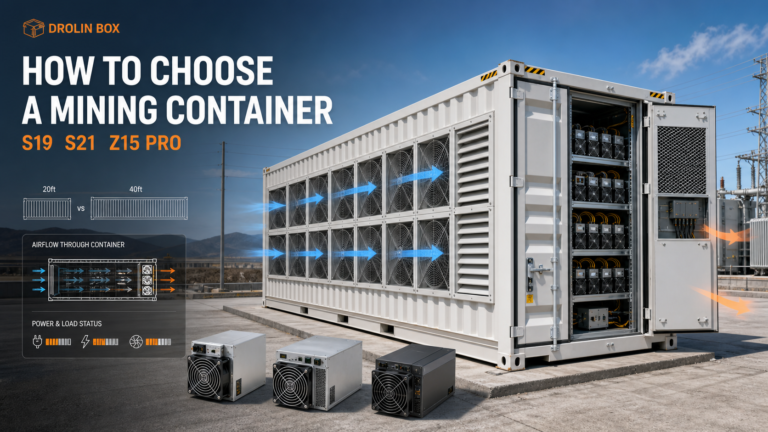
An air-cooled container should have a clear airflow concept covering air intake, filtration, fan arrangement, pressure loss and hot-air discharge.
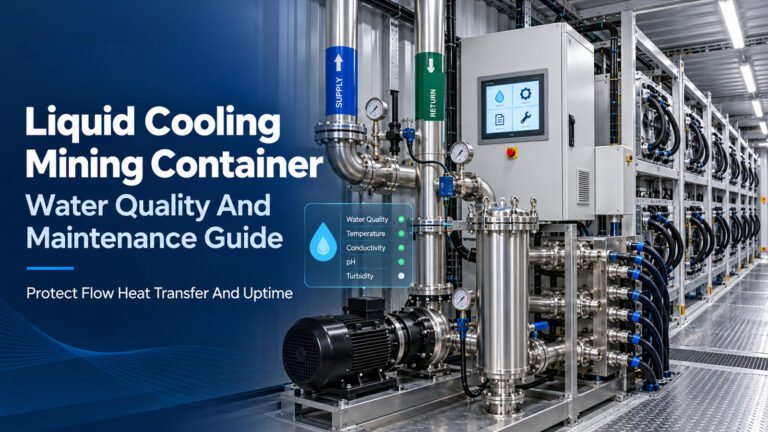
A liquid-cooled container requires a hydraulic schematic showing the CDU, pumps, heat exchangers, dry cooler or other heat-rejection equipment, supply and return headers, filtration, expansion arrangements, valves, sensors and control interfaces.
Go beyond the equipment list. Request the system logic.
4. Verify Miner Quantity Power And Thermal Balance
“Supports 300 miners” means little without a specific miner model and power assumption.
The supplier should calculate the IT load using the planned miner configuration:
IT Load = Sum of Miner Quantity × Miner Input Power
The electrical design must then account for auxiliary loads such as fans, pumps, controls, lighting and other container equipment. Breaker ratings, conductor sizing, operating margins and local electrical requirements must also be reviewed by the responsible project engineers.
Nearly all electrical power consumed by ASIC miners eventually becomes heat. Therefore, cooling capacity should be checked against the actual design heat load rather than the container’s physical miner count alone.
For air cooling, ask about airflow volume, fan operating point, pressure loss, filter condition and hot-air recirculation. For liquid cooling, ask about coolant flow, supply and return temperatures, pressure drop, CDU capacity, outdoor heat-rejection conditions and redundancy.
Pro Tip: Request calculations for both the planned miner model and the highest-power miner you may deploy later. A container with no electrical or thermal headroom can become obsolete after one equipment upgrade.
5. Ask What the Mining Container Technical Report Covers
A mining container technical report should make design assumptions visible. It does not need to be a hundred-page consulting report, but it should explain how the proposed configuration was selected.
Depending on the project, the report or technical submission should address miner compatibility, total IT load, auxiliary power, electrical distribution, cooling capacity, operating temperatures, flow or airflow requirements, pressure drop, equipment schedule, monitoring logic, alarms and site limitations.
Look closely at the operating conditions behind every capacity figure. A fan’s free-air rating is not necessarily its airflow after filters and louvers are installed. A dry cooler’s nameplate capacity may not be available at the project’s peak ambient temperature. A CDU capacity rating is incomplete without temperatures, flow rate and pressure-drop assumptions.
A strong report states both capability and limitation.
6. Require a Project-Specific Factory Acceptance Test
A mining container factory acceptance test should be agreed before testing begins.
IEC 62381:2024 is written for process-industry automation systems, not specifically for mining containers. Still, its core logic is useful: the owner, buyer and vendor should agree on test scope, responsibilities, acceptance criteria and documentation before delivery.
A project-specific FAT plan may include:
Visual inspection against approved drawings
Equipment and component verification
Cable termination and labeling inspection
Grounding-continuity and insulation-related checks where applicable
Breaker and protection-device verification
Fan and pump rotation checks
Sensor alarm and emergency-stop testing
PLC HMI and remote-monitoring function checks
Pressure testing and leak inspection for liquid circuits
No-load or simulated functional testing
Documentation and nameplate review
The exact procedure must be adapted to the design, applicable standards, available factory utilities and contract scope.
A FAT is not a substitute for site acceptance testing. It reduces preventable defects before shipping, when repairs are usually faster and less expensive.
7. Pressure Testing Leak Inspection And Energization
For liquid-cooled containers, buyers should request the pressure-test medium, test pressure, hold time, acceptance criteria, calibrated instrument information and final test record.
The applicable test method depends on the system design, fluid, materials, pressure class and governing code. ASME process-piping guidance is one reference for leak-testing principles, but buyers should not assume that every mining cooling loop automatically falls under ASME B31.3.
After pressure testing, the supplier should document leakage inspection, corrective work and retesting. The test record should identify the tested circuit rather than simply stating that “the container passed.”
Electrical energization testing should follow an approved and controlled procedure. Before power is applied, the responsible team should verify terminations, grounding, phase sequence, protection settings, emergency functions and safe access conditions.
Pro Tip: Ask for the serial number of the measuring instrument and a photograph showing the reading during the test. Evidence should connect the result to the actual unit being purchased.
8. Do Not Accept an Open Punch List Without a Closure Plan
Factory testing often identifies minor issues. That is normal. The risk begins when defects are discussed verbally and disappear from the delivery record.
The FAT package should include test results, deviations, corrective actions, retest status and approval signatures. Each open item should have an owner and a target closure date.
Buyers should define whether shipment can proceed with minor outstanding items and which defects must be closed before packing. Critical safety, electrical, structural or cooling defects should not be hidden behind a general “FAT passed” statement.
9. Separate Manufacturing Lead Time From Delivery Time
A mining container lead time should be presented as a milestone schedule, not a single optimistic number.
The schedule may include design-input confirmation, drawing approval, long-lead procurement, fabrication, electrical assembly, cooling-system assembly, software configuration, FAT, corrective work, packing and dispatch.
The supplier should also state which events can move the schedule. Late drawing approval, changes in miner models, voltage revisions and missing site data can all affect delivery.
Tie progress payments to verifiable milestones where commercially practical. Examples include drawing approval, completion of major assembly, FAT acceptance and release for shipment.
Production completed is not the same as ready to ship. Ready to ship is not the same as commissioned.
10. Review Packing Loading And Transportation Documents
Before dispatch, buyers should request an equipment packing list, loose-parts list, shipment dimensions, weights, lifting instructions, center-of-gravity information where needed, loading photographs and a document register.
The contract should identify whether transformers, dry coolers, external pumps, cables, hoses, spare parts or installation tools are shipped inside the container or separately.
ICC Incoterms clarify the tasks, costs and risks allocated between sellers and buyers during delivery. They do not define the technical product scope. “FOB” or “CIF” cannot tell you whether crane unloading, inland transport, customs clearance, foundations or site installation are included.
Where a modified unit will be handled and transported as an international freight container, buyers should also confirm the applicable container-safety approval and inspection requirements. The IMO Convention for Safe Containers covers testing, inspection, approval and maintenance for most internationally transported freight containers. Project-specific applicability should be confirmed with the supplier, carrier and relevant authorities.
11. Define Mining Container Commissioning Support
“Free technical support” is too vague for a project contract.
Mining container commissioning support should specify whether assistance is remote or on-site, how many service days are included, which language will be used, who pays for travel, what site prerequisites must be completed and what event marks final acceptance.
The commissioning plan may cover placement inspection, external electrical connections, piping connections, filling and venting, control checks, initial energization, pump or fan startup, alarm verification, miner loading and operator training.
The buyer should also define who is responsible when the container is ready but the transformer, network, water loop, dry cooler, crane or local contractor is not.
Use the Mining Container Installation Checklist to coordinate factory preparation and site commissioning.
12. Evaluate Spare Parts Warranty And Response Boundaries
Ask the supplier to identify recommended startup spares and operational spares. Typical categories may include sensors, contactors, breakers, fan components, pump seals, filters, valves, control modules and communication components, depending on the design.
The warranty should define its start date, duration, exclusions, claim process, required evidence, shipping responsibility and labor boundary. Buyers should also ask whether troubleshooting support is available across time zones and how unresolved cases are escalated.
A fast reply is useful. A documented response process is better.
13. Check Country And Site Customization
A mining container should not be treated as a universal appliance.
The supplier should review the destination country, grid voltage, frequency, climate, altitude, humidity, dust conditions, water or coolant quality, wind or snow exposure, local electrical practices, transportation restrictions and site-maintenance capability.
Air-cooled containers require special attention to ambient temperature, dust loading, prevailing wind and hot-air recirculation. Liquid-cooled systems require additional review of coolant selection, freeze protection, water quality, dry-cooler performance, pipe routing and outdoor winterization.
The final design may also depend on transformer capacity, cable distance, foundation level, drainage, fire access, crane space and road turning radius.
Drolin Box can review the project requirements and prepare the appropriate technical scope. Buyers can examine the mining container product range, review available site-planning and deployment services or submit project information through the Contact page.
14. Use a Weighted Supplier Scoring Matrix
Price should be one category, not the entire decision.
| Category | Suggested Weight |
| Engineering drawings and document control | 20% |
| Miner power and cooling compatibility | 20% |
| FAT procedure records and defect closure | 20% |
| Lead time logistics and delivery clarity | 15% |
| Commissioning warranty and after-sales support | 15% |
| Site customization and commercial transparency | 10% |
Score each category from 0 to 5: 0 means no evidence; 1 means a verbal statement; 2 means a generic sample; 3 means a project-specific draft; 4 means an approved deliverable; 5 means an approved deliverable supported by controlled test or handover records.
This score is an internal procurement tool, not a certification. A supplier with a lower initial price but weak engineering evidence may require a larger project contingency.
Final Verdict: Buy the Evidence Behind the Container
Do not select a mining container supplier only because the brochure looks professional, the factory video is impressive or the quoted miner count is high.
Select the supplier whose scope can be audited.
Before placing the order, verify the design inputs, drawing package, power and cooling calculations, FAT procedure, test evidence, shipping responsibilities, lead-time milestones, commissioning boundary and after-sales process.
A low container price is easy to quote. The real value lies in reducing redesign, site rework, commissioning delays and mining downtime.