






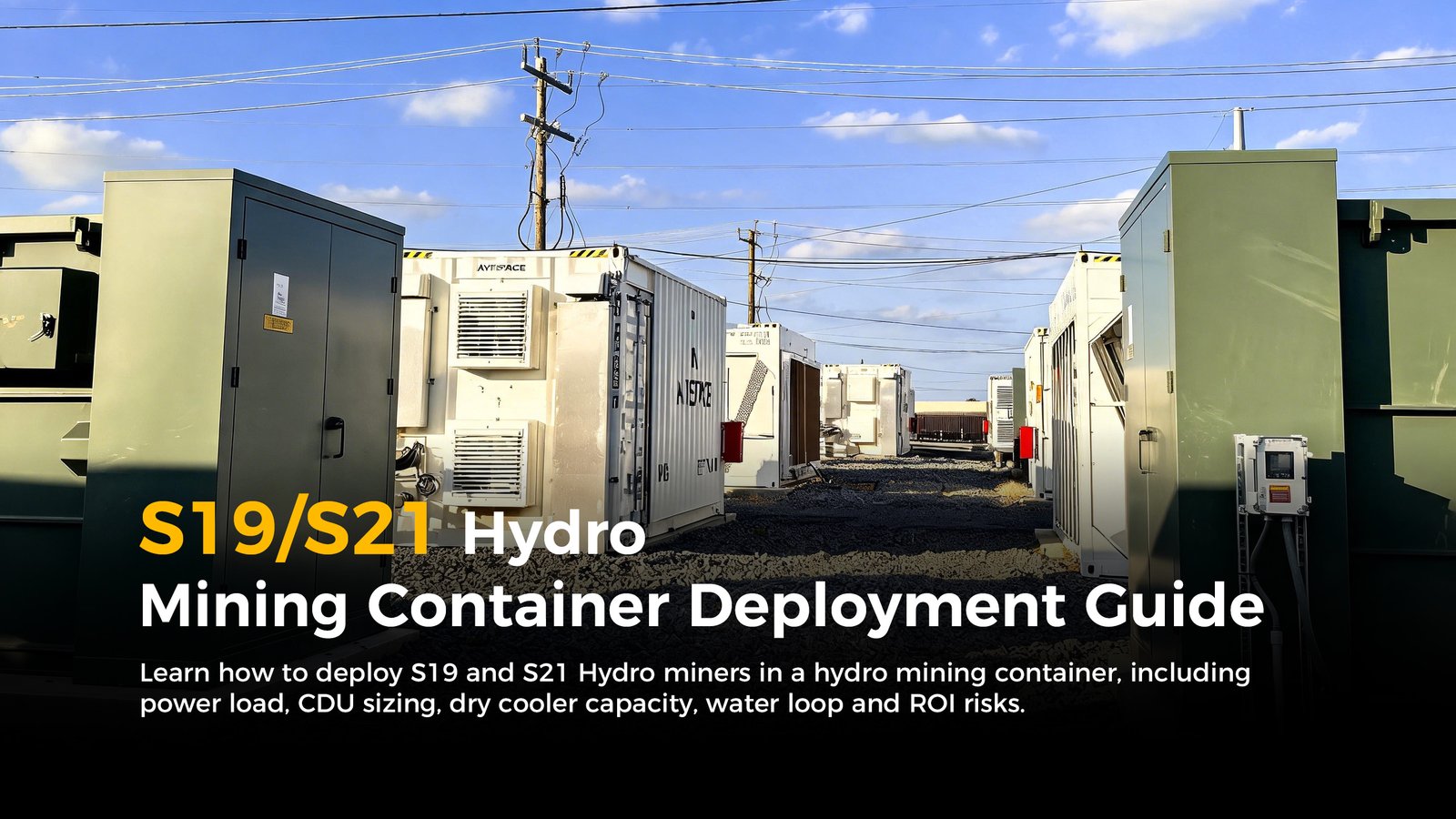

The container does not fail first. The heat balance does.
When a buyer says, “I want to deploy S19 Hydro or S21 Hydro miners in a container,” the first answer should not be a container price. It should be a power and heat calculation. One S21 Hyd at 335TH/s draws about 5.36kW. One S21 XP Hyd at 473TH/s draws about 5.676kW. Older S19 Hydro-class miners usually sit around the 5.4kW range. Multiply that by 192, 224 or 420 miners, and the project quickly moves from “container purchase” to “industrial thermal infrastructure.”
That is where many hydro mining projects lose money. The miners arrive. The container arrives. The site has power. On paper, everything looks ready. Then the outlet water temperature climbs, the dry cooler is undersized for local summer conditions, filters become a maintenance bottleneck, or the site discovers that the transformer and PDU plan was never matched to the real miner load.
Buy the deployment system, not only the steel box.
The Miner Load: S19 Hydro and S21 Hydro Are Not the Same Project
S19 Hydro and S21 Hydro miners may fit into similar rack envelopes, but their business value and electrical density are different.
Public miner specification databases list the Bitmain Antminer S19 Hydro 158TH at about 5,451W, the S19 Pro+ Hyd 198TH at about 5,445W, the S21 Hyd 335TH at about 5,360W, and the S21 XP Hyd 473TH at about 5,676W. The useful lesson is not just the wattage. It is the hashrate per container.
| Miner Model | Rated Hashrate | Rated Power | 192-Unit IT Load | 192-Unit Hashrate |
|---|---|---|---|---|
| Antminer S19 Hydro | 158TH/s | 5.451kW | about 1,046.6kW | about 30.3PH/s |
| Antminer S19 Pro+ Hyd | 198TH/s | 5.445kW | about 1,045.4kW | about 38.0PH/s |
| Antminer S21 Hyd | 335TH/s | 5.36kW | about 1,029.1kW | about 64.3PH/s |
| Antminer S21 XP Hyd | 473TH/s | 5.676kW | about 1,089.8kW | about 90.8PH/s |
The same 192 slots can create very different revenue potential. A container filled with S21 Hyd miners produces more than double the hashrate of a container filled with S19 Hydro miners, while the IT load remains in a similar 1MW band. This is why professional deployment planning starts with miner model, not with container length.
Pro Tip:
If the buyer has not selected the miner model yet, quote the deployment in scenarios: S19 Hydro, S19 Pro+ Hydro, S21 Hyd and S21 XP Hyd. A single “192 miners” capacity claim is not enough for ROI planning.
Matching Miner Quantity to Container Architecture
DroLinBox hydro mining container configurations are built around real electrical and cooling envelopes, not just miner count.
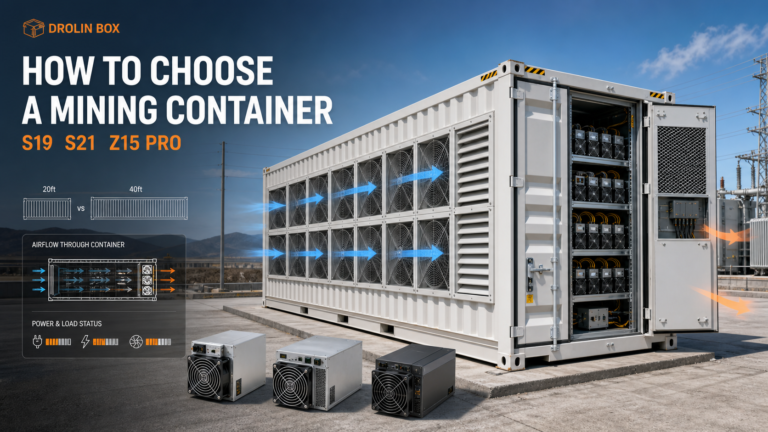
For a 40HC integrated liquid cooling container, the practical design supports 192 units of S19 or S21-class hydro miners, with 1,300kW heat transfer capacity at 25C ambient temperature. That gives a sensible margin for a 1.03MW to 1.09MW miner IT load, depending on the exact miner model.
For larger sites, a 45HC integrated design can support 224 units of S19 or S21-class hydro miners. When the site requires higher density and stronger project economics, the 40HC superposition solution can support up to 420 units of S19/S21-class miners with 2,400kW heat transfer capacity at 25C ambient temperature.
Run the math:
- 420 x S21 Hyd at 5.36kW is about 2,251kW IT load.
- 420 x S19 Pro+ Hyd at 5.445kW is about 2,287kW IT load.
- A 2,400kW heat transfer envelope gives engineering room, but only if the dry cooler, pump station, piping and ambient conditions are designed together.
Go integrated when the site wants a clean, compact 1MW-class deployment. Go superposition when the site is ready for higher density and has already confirmed power capacity, lifting conditions, outdoor heat rejection space and maintenance access.
CDU and Pump Station: The Heart of a Hydro Mining Container
In a hydro mining farm, the CDU is not an accessory. It is the control point between miner heat and outdoor heat rejection.
A serious S19/S21 Hydro mining container should define:
- CDU or heat exchange capacity
- primary and secondary flow rate
- supply and return water temperature
- pump redundancy
- filter precision and filter replacement method
- pH and conductivity monitoring
- pressure and temperature sensors
- alarm logic and remote monitoring
- pipe material and maintenance access
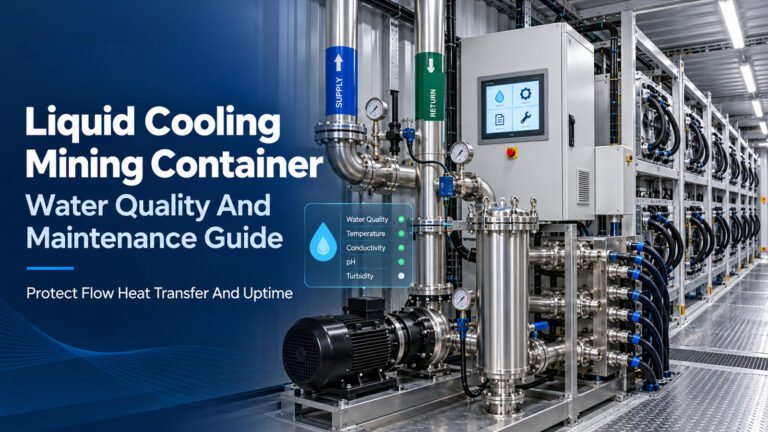
DroLinBox liquid cooling container designs use PLC control, touchscreen operation, pH and conductivity monitoring, fan frequency control, alarm functions and remote monitoring. The 40HC integrated liquid cooling container uses a pumping station flow rate of at least 100m3/h, while the 45HC integrated design uses at least 110m3/h. For 40HC superposition projects, the system is designed around at least 2 x 100m3/h flow, with filter replacement supported without shutting down the system.
That last detail matters. Downtime is not only caused by miner failure. It can also come from maintenance design that forces the whole loop offline for simple filter work.
Pro Tip:
If the proposal says “CDU included” but does not show flow rate, filter logic, pump redundancy, water temperature and monitoring points, the technical quote is not finished.
Dry Cooler Sizing: The Outdoor Side Decides the Real Performance
A CDU moves heat. A dry cooler rejects heat. Confusing the two is one of the fastest ways to underbuild a hydro mining farm.
For S19/S21 Hydro deployment, the outdoor heat rejection system must be sized against the real site climate. A dry cooler rated at 25C ambient will not perform the same way at 40C. Dust, altitude, coil cleanliness, antifreeze concentration and airflow obstruction all change the real capacity.
DroLinBox microchannel dry cooler data gives a useful benchmark: 1,200kW heat transfer capacity at 25C ambient temperature, SS304 DN100 piping, treated water loop, 35C +/- 1C outlet water temperature, PLC control and remote monitoring. For a 40HC integrated 192-miner hydro container, a 1.2MW to 1.3MW class heat rejection plan is the right conversation. For a 420-miner superposition site, the conversation moves to 2.4MW class heat rejection.
Do not approve the dry cooler by nameplate alone. Approve it by local summer temperature, outlet water target, required redundancy, maintenance space and coil-cleaning access.
Power Distribution: A 1MW Hydro Container Is an Industrial Load
Power planning is where many mining ROI spreadsheets become real or collapse.
A 192-unit S21 Hyd deployment is about 1,029kW of miner IT load before auxiliary loads. Pumps, dry cooler fans, monitoring, lighting, network equipment and power margin must be added. A 192-unit S21 XP Hyd deployment is closer to 1,090kW of miner IT load. A 420-unit S21 Hyd superposition deployment is already above 2.25MW of miner IT load.
That means the buyer must confirm:
- transformer capacity
- available voltage and frequency
- distribution cabinet rating
- PDU current and connector compatibility
- breaker and cable sizing
- grounding and lightning protection
- backup power strategy, if needed
- local electrical code or certification needs
DroLinBox hydro containers are designed for 360-440V AC, 50/60Hz input. The 40HC integrated liquid cooling container uses a 2500A power distribution cabinet and 12 x 175A PDU configuration. The 45HC integrated container uses 2 x 1600A distribution, while the superposition solution uses 2000A x 2 distribution.
The point is not to memorize cabinet numbers. The point is to stop quoting miner capacity before confirming the electrical path.
Pro Tip:
For North America, Central Asia, the Middle East and Latin America, always ask for local voltage, transformer capacity, summer design temperature and site photos before finalizing a hydro container proposal.
Water Quality and Maintenance: Small Details That Decide Uptime
Hydro mining is not “fill the loop and run.” The water loop is a controlled operating system.
For long-term deployment, the buyer should plan for pure, softened or distilled water, corrosion inhibitor and antifreeze where required. The system should monitor pH, conductivity, flow, pressure and temperature. Filters must be accessible. Valves must be serviceable. Hoses and manifolds must be arranged so that one maintenance task does not become a full-site shutdown.
The best hydro mining container is not the one that looks the most impressive in a render. It is the one that a technician can maintain at 2 a.m. without guessing where the isolation valve is.
Deployment Workflow for S19/S21 Hydro Containers
A practical deployment sequence looks like this:
- Confirm miner model, quantity and target IT load.
- Calculate total heat load and select container architecture.
- Match CDU, pump station and dry cooler capacity.
- Confirm transformer, PDU, cable and breaker design.
- Review site temperature, dust, altitude, water quality and logistics route.
- Prepare layout drawings, piping diagrams and electrical drawings.
- Complete factory assembly, pressure test and electrical inspection.
- Ship, unload, connect power, connect the cooling loop and commission sensors.
- Start miners in batches, not all at once.
- Monitor outlet water temperature, flow, pressure, alarms and miner stability.
Batch startup is important. Starting 192 or 420 miners at once may hide problems until the system is already under stress. Bring the system up in stages and watch the water loop.
Final Verdict for 2026 Deployment
For S19 Hydro and S21 Hydro miners, the real buying question is not “How many miners can the container hold?” The better question is:
Can the system continuously power, cool, monitor and maintain those miners under my site conditions?
For 1MW-class sites, a 40HC integrated hydro mining container with 192 S19/S21-class miners offers a clean deployment model. For larger farms, a 40HC superposition system can push density higher, but only if the power, heat rejection, lifting plan and maintenance layout are ready. S21 Hyd improves hashrate density dramatically compared with S19 Hydro-class miners, but that advantage only becomes real when the container infrastructure can keep the machines stable.
Do the heat math first. The container decision becomes much easier after that.