






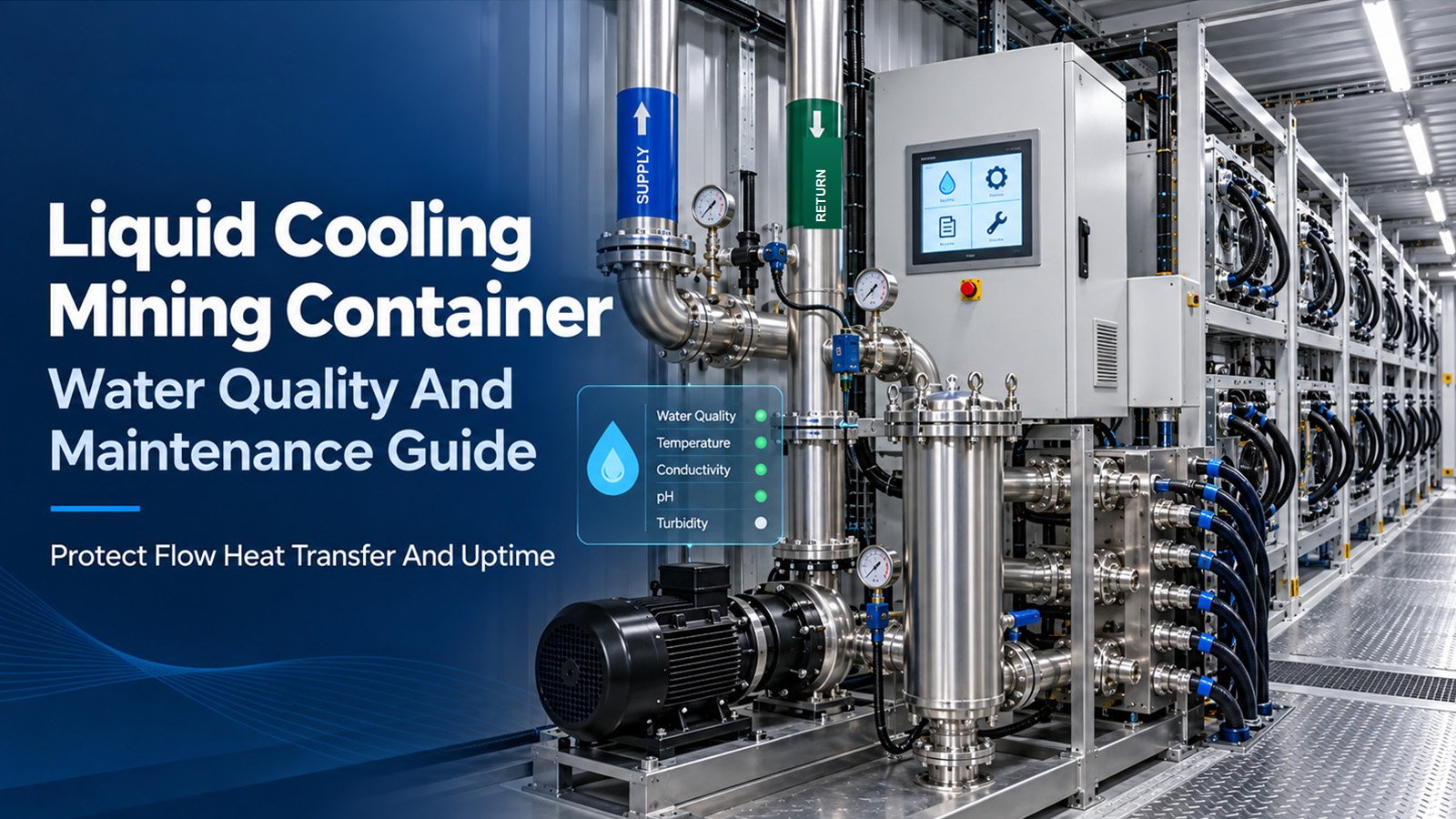

Liquid cooling can support higher mining density and more stable thermal performance than traditional air cooling. However, a liquid cooling mining container is not simply a container with water pipes and pumps. Its long-term reliability depends on coolant quality, filtration, corrosion control, pump operation, leak detection, and regular maintenance.
A cooling loop may appear to be operating normally while internal corrosion, scaling, contamination, or gradual flow reduction is already affecting the system. For this reason, water quality should be treated as part of the cooling system design, not as an afterthought.
This guide explains the key maintenance requirements for hydro mining containers, CDU systems, pumps, heat exchangers, manifolds, dry coolers, and monitoring systems.
Why Water Quality Matters in Hydro Mining
In a typical liquid cooling mining system, heat is transferred through a closed loop:
Hydro Miners → Supply And Return Manifold → Pump Station Or CDU → Dry Cooler → Cooling Loop
The liquid must transfer heat efficiently while remaining compatible with pumps, heat exchangers, filters, hoses, valves, manifolds, and piping.
Poor coolant quality may result in:
- Reduced heat transfer performance
- Higher pressure drop
- Blocked filters and narrow passages
- Pump seal wear
- Corrosion inside pipes and heat exchangers
- Unstable supply and return temperatures
- Sensor errors
- Leakage risk
- Unexpected miner shutdowns
A system can still have sufficient nominal CDU capacity but fail to maintain stable operation if the flow rate, pressure, fluid chemistry, or filtration condition is not properly controlled.
The correct water treatment program depends on the equipment material, coolant type, local climate, manufacturer requirements, and project design. Directly using untreated tap water should not be considered a universal solution.
Key Water Parameters: pH Conductivity and Hardness
pH
pH affects the corrosion behavior of metals and the performance of corrosion inhibitors.
A pH level outside the equipment supplier’s recommended range may increase the risk of:
- Metal corrosion
- Chemical instability
- Seal degradation
- Poor inhibitor performance
- Premature component failure
There is no single pH value that is suitable for every liquid cooling mining container. The correct target should be confirmed with the CDU supplier, miner manufacturer, piping material supplier, and coolant treatment provider.
Conductivity
Conductivity is an important indicator of dissolved ions and contamination in the coolant.
A sudden increase in conductivity may indicate:
- Contamination from make-up water
- Chemical imbalance
- Corrosion products
- Cross-contamination between loops
- Incorrect coolant preparation
Conductivity should be monitored as a trend instead of being checked only after a problem occurs. A sudden change from the project baseline should trigger an inspection.
Hardness
Hardness is mainly related to calcium and magnesium ions. High hardness can lead to scale formation on heat-transfer surfaces and inside narrow flow passages.
Scaling can reduce:
- Heat exchanger efficiency
- Flow area
- Pump performance
- Cooling stability
For this reason, treated water, softened water, deionized water, or a pre-approved coolant mixture may be required depending on the design. The final selection should be based on the full fluid chemistry, not only one water parameter.
Other Parameters To Monitor
A complete water-quality program may also include:
- Chloride concentration
- Total dissolved solids
- Corrosion inhibitor concentration
- Glycol concentration where applicable
- Fluid color and visible contamination
- Suspended particles
- Microbiological contamination in suitable systems
- Fluid temperature and pressure
The exact testing method and acceptable limits should be included in the project commissioning documents.
Filters Pumps and Heat Exchangers
Water quality management is closely connected to mechanical maintenance.
Filters
Filters protect pumps, manifolds, heat exchangers, and miner cooling plates from particles and installation debris.
A filter maintenance plan should consider:
- Filter type and micron rating
- Differential pressure across the filter
- Fluid cleanliness after commissioning
- Availability of replacement elements
- Whether the filter can be serviced without a full system shutdown
- Safe isolation and drainage procedures
A filter should not be replaced only according to a fixed calendar date. Differential pressure, flow reduction, contamination level, and manufacturer instructions should also be considered.
Some integrated liquid cooling container designs support filter replacement without shutting down the entire system. This can reduce maintenance interruptions, but the exact bypass and isolation procedure must be confirmed before operation.
Pumps
Pump inspections should include:
- Flow rate
- Suction and discharge pressure
- Motor current
- Vibration and abnormal noise
- Mechanical seal condition
- Bearing temperature
- Pump rotation and standby-pump status
- Alarm and automatic changeover functions
A pump may continue running while its performance is gradually declining. Comparing current operating data with the commissioning baseline can help identify early problems.
Heat Exchangers
Heat exchangers should be checked for:
- Fouling
- Scaling
- Corrosion
- Abnormal temperature difference
- Pressure drop
- Cross-contamination between circuits
- Signs of internal leakage
A reduction in heat-transfer performance may be caused by fluid quality, insufficient flow, air trapped in the loop, or external dry cooler conditions. Troubleshooting should evaluate the complete system instead of replacing one component immediately.
Freeze Protection and Coolant Selection
Managing Material Degradation
Several key factors influence material breakdown:
- Water chemistry
- Material combinations
- Temperature
- Flow velocity
- Oxygen exposure
- Inhibitor concentration
- Electrical conductivity
- Contamination
Stainless-steel piping does not eliminate all corrosion risks. Valves, fittings, heat exchangers, pump components, aluminum parts, copper parts, and mixed-metal connections may respond differently to the same coolant.
A qualified system design should define:
- Compatible materials
- Approved coolant chemistry
- Corrosion inhibitor type
- Sampling method
- Refill procedure
- Drainage and flushing procedure
Do not add a general-purpose chemical or automotive antifreeze without confirming compatibility with the miners, CDU, seals, pumps, heat exchanger, and monitoring sensors.
Freeze Protection
Projects in cold climates require special attention to the minimum ambient temperature and the outdoor cooling loop.
Freeze protection may involve:
- Approved glycol concentration
- Heat tracing
- Insulation
- Low-temperature alarms
- Minimum-flow protection
- Drainage strategy
- Automatic pump operation
- Seasonal commissioning procedures
Adding too much glycol can increase viscosity and reduce heat-transfer performance. Adding too little may not provide sufficient freeze protection. The final concentration should be calculated according to the lowest expected temperature and the coolant supplier’s data.
Leak Detection and Remote Monitoring
Leak prevention is important, but early leak detection is equally important.
A liquid cooling mining container should be evaluated for:
- Leak detection sensors
- High and low fluid-level alarms
- Pressure-loss alarms
- Abnormal-flow alarms
- Temperature deviation alarms
- Pump failure alarms
- Filter differential-pressure alarms
- Emergency shutdown logic
- Local and remote notifications
A PLC and touchscreen interface can provide local visibility for operators. Remote monitoring can help the project team review:
- Supply temperature
- Return temperature
- Flow rate
- Pressure
- pH
- Conductivity
- Pump status
- Fan status
- Alarm history
- Operating trends
Monitoring is most useful when it creates an action. For example:
- High conductivity should trigger a water-quality inspection.
- Low flow should trigger a pump, filter, or valve inspection.
- Rising pressure drop may indicate filter blockage.
- A supply-temperature increase may indicate insufficient heat rejection or reduced flow.
- A sudden pressure drop may indicate a leak or air ingress.
The alarm strategy should be agreed during the design and commissioning stage. A monitoring system without clear alarm thresholds and response procedures may provide data without improving uptime.
Liquid Cooling Maintenance Checklist
Before Startup
- Confirm the approved coolant type.
- Flush the loop according to the commissioning procedure.
- Remove installation debris and air pockets.
- Complete pressure and leakage tests.
- Confirm valve positions and flow direction.
- Record the initial pH and conductivity.
- Record supply and return temperature.
- Record flow rate and system pressure.
- Verify pump rotation and standby-pump operation.
- Test all alarms and emergency functions.
- Confirm remote monitoring access.
Daily Or Per Shift
- Check supply and return temperature.
- Check flow and pressure.
- Review pH and conductivity trends.
- Check fluid level and visible leakage.
- Confirm pump and fan status.
- Review active alarms.
- Check abnormal noise or vibration.
- Confirm the miner operating condition.
Weekly
- Inspect filters and strainers.
- Check filter differential pressure.
- Inspect visible piping, valves, manifolds, and fittings.
- Check for signs of corrosion or discoloration.
- Review alarm history.
- Compare operating values with the commissioning baseline.
- Confirm that spare filter elements are available.
Monthly Or According To The Project Plan
- Perform a documented coolant sample test.
- Inspect pump seals and accessible connections.
- Check sensors and calibration status.
- Review heat exchanger performance.
- Inspect dry cooler fans and coils.
- Check electrical connections and control cabinet alarms.
- Review remote monitoring data for abnormal trends.
Seasonal Or Before Winter Operation
- Confirm the lowest expected ambient temperature.
- Verify glycol or antifreeze concentration if required.
- Inspect insulation and heat tracing.
- Test low-temperature alarms.
- Confirm drainage and freeze-protection procedures.
- Recheck outdoor piping and dry cooler connections.
The actual maintenance interval should be adjusted according to the site environment, operating hours, coolant chemistry, water quality, manufacturer requirements, and historical data.
What Happens When Water Quality Is Not Controlled?
Poor water quality may not cause immediate failure. The risk often develops gradually.
Typical warning signs include:
- Increasing filter differential pressure
- Lower flow at the same pump speed
- Increasing pump current
- Higher return temperature
- Unstable miner temperatures
- Frequent sensor alarms
- Visible particles in the fluid
- Discoloration around fittings
- Repeated need for coolant top-up
- Increasing pressure fluctuations
If these signs are ignored, the system may eventually experience:
- Heat exchanger fouling
- Blocked cooling channels
- Pump failure
- Seal leakage
- Reduced miner performance
- Emergency shutdown
- Longer maintenance downtime
The total cost may be much higher than the cost of regular sampling, filtration, and preventive maintenance.
What Site Information Should Buyers Provide?
Before selecting a liquid cooling mining container, CDU, dry cooler, or pump station, buyers should prepare the following information:
- Project country and region
- Minimum and maximum ambient temperature
- Site elevation
- Available water source
- Water-quality test report
- Whether antifreeze is required
- Miner brand and complete model
- Miner quantity
- Single-miner power
- Expected total IT load
- Required CDU capacity
- Dry cooler configuration
- Pipe length and installation distance
- Indoor and outdoor equipment locations
- Elevation difference between equipment
- Required monitoring and remote access
- Local electrical standards
- Transportation and lifting conditions
- Required delivery and commissioning scope
This information helps the supplier evaluate heat load, flow rate, pump head, pipe sizing, heat rejection, fluid chemistry, and environmental risks before preparing a quotation.
How Drolin Box Approaches Liquid Cooling Maintenance
The exact configuration should always be confirmed for each project. However, the Drolin Box 40HC integrated liquid cooling reference manual includes several features related to operation and maintenance, including:
- PLC control with touchscreen operation
- pH and conductivity monitoring
- Fan variable-frequency control
- Remote monitoring and alarm functions
- Pump station flow of at least 85 m³/h in the reference configuration
- Replaceable filtration designed for service without a full shutdown
- SS304 DN100 piping in the reference configuration
- Liquid supply temperature of 35°C ±1°C under the stated design conditions
- Plate-fin dry cooler configuration
- Twelve 950 mm fans in the stated reference configuration
- Heat-transfer capacity of 1300 kW at 25°C ambient in the manual’s specified condition
These values are configuration-specific. The 1300 kW figure refers to heat-transfer or heat-rejection capability under the stated test condition. It should not be treated as the universal electrical IT load of the mining container.
The final design should be checked against the actual miner model, total heat load, ambient temperature, coolant chemistry, pipe route, redundancy requirement, and local installation conditions.
Conclusion
A reliable liquid cooling mining container requires more than a high-capacity CDU. Water quality, filtration, corrosion control, freeze protection, pump performance, heat exchanger cleanliness, leak detection, and remote monitoring all affect long-term uptime.
The best maintenance strategy begins before shipment:
- Confirm the coolant chemistry.
- Define the testing and sampling plan.
- Establish commissioning baselines.
- Configure alarms and remote monitoring.
- Prepare filters and critical spare parts.
- Match the cooling system to the site climate and miner load.
- Document the response procedure for abnormal readings.
Drolin Box can review your project requirements and help define the appropriate liquid cooling container, CDU, dry cooler, pump station, piping, monitoring, and commissioning scope.
To request a project review, prepare your country, minimum ambient temperature, miner model and quantity, expected power, water-quality information, pipe distance, and required monitoring functions.