







A container may have enough physical space for your miners and still fail the project.
The real limits usually appear later: the electrical system cannot support the full load, the PDU arrangement does not match the miner input, the exhaust fans cannot remove the heat, or different miner models create uneven airflow inside the container.
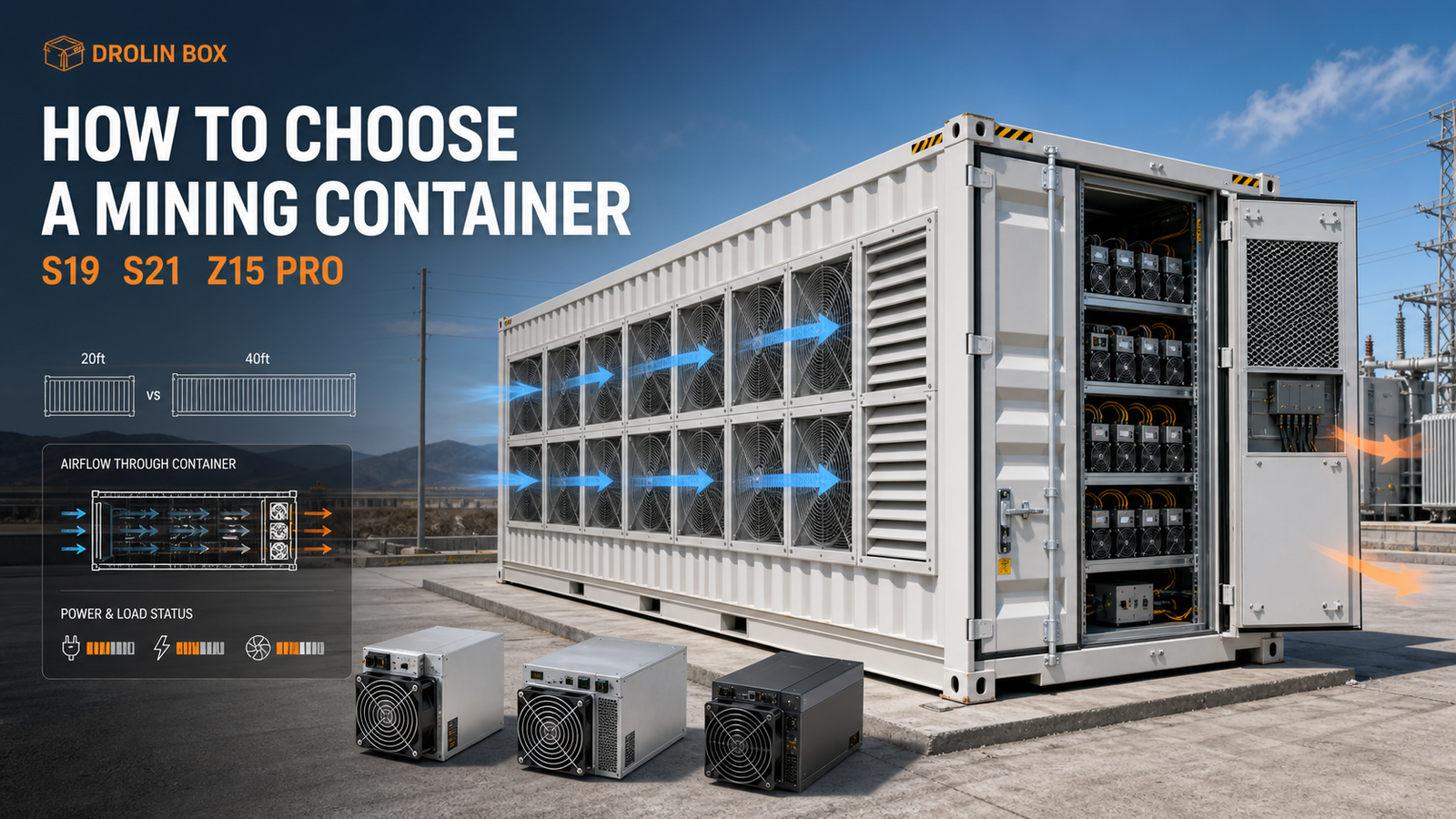
This is why choosing a mining container for S19, S21, or Z15 Pro miners should begin with the miner specification, not only with the container length.
The right selection must connect five factors:
Miner model and operating mode
Single-machine power consumption
Required airflow and heat rejection
PDU, cable and transformer capacity
Available container positions and maintenance space
The calculations below are planning references only. Final capacity must be confirmed according to the exact miner variant, firmware, operating mode, ambient temperature, altitude, PDU design and container configuration.
Why Miner Model Matters More Than Container Size
Search terms such as “40ft mining container” and “mining container for S19” often make buyers think that container capacity is mainly a space problem.
It is not.
A miner converts almost all of its electrical input into heat. A 3.5 kW ASIC miner creates approximately 3.5 kW of heat that must be distributed and exhausted continuously. If a container contains 270 machines, the IT heat load can approach 1 MW before counting fans, control systems, lighting, networking equipment and other auxiliary loads.
Two miners may have similar external dimensions but different:
Input voltage
Maximum current
Power consumption
Fan speed and airflow
Heat output
Noise level
Operating temperature range
Service clearance requirements
For example, a container that works well with standard S19 units may require a different power distribution design for S21 XP miners. A Z15 Pro is also air-cooled, but it uses the Equihash algorithm and has different power, size and input requirements.
Reference Miner Specifications
| Miner Model | Mining Algorithm | Reference Hashrate | Reference Power | Cooling Type | Key Planning Point |
|---|---|---|---|---|---|
| Antminer S19 Pro 110T | SHA-256 | 110 TH/s | 3,250 W | Air cooling | Confirm the exact S19 variant before calculating capacity |
| Antminer S21 | SHA-256 | 200 TH/s | 3,500 W | Air cooling | Higher power density than many S19 configurations |
| Antminer S21 Pro | SHA-256 | 234 TH/s | 3,510 W | Air cooling | Similar power to S21 but requires exact batch confirmation |
| Antminer S21 XP | SHA-256 | 270 TH/s | 3,645 W | Air cooling | Higher heat load and tighter electrical headroom |
| Antminer Z15 Pro | Equihash and ZEC | 840 KSol/s | 2,780 W | Air cooling | Different algorithm, voltage range and physical dimensions |
These figures are model references, not universal values for every S19 or S21 product. S19 Hydro, S21 Hydro and S21 XP Hydro are liquid-cooled models. They should be matched with a liquid cooling container and CDU system rather than a standard air-cooled mining container.
Pro Tip: Always ask the buyer for the complete model name, such as “S21 200T” or “S21 XP 270T”. “S19” and “S21” alone are not precise enough for electrical design.
S19 and S21 Power and Airflow Differences
The difference between S19 and S21 miners may appear small when looking at one machine.
A reference S19 Pro configuration uses approximately 3.25 kW. A standard S21 configuration uses approximately 3.5 kW. The difference is only about 250 W per miner, but it becomes significant at container scale.
With 300 machines:
300 S19 Pro miners create about 975 kW of IT load
300 S21 miners create about 1,050 kW of IT load
300 S21 XP miners create about 1,093.5 kW of IT load
The S21 XP difference is especially important. Compared with a 3.25 kW S19 Pro reference, 270 S21 XP miners require about 106.65 kW more IT power.
That extra load affects:
Main breaker selection
PDU quantity and circuit layout
Cable size
Transformer capacity
Fan and exhaust capacity
Container operating margin
Heat rejection at high ambient temperatures
A higher hashrate does not automatically mean better container utilization. The container must be able to remove the heat produced by the total electrical load.
Airflow Planning
For an air-cooled mining container, the basic heat-removal relationship can be expressed as:
Heat Load = Air Density × Specific Heat × Airflow × Temperature RiseA simplified planning formula is:
Required Airflow ≈ Heat Load ÷ 1.2 ÷ 1.005 ÷ Allowable Temperature RiseFor a 1 MW IT load with a theoretical 10°C air temperature rise, the required airflow is approximately:
1,000,000 ÷ 1.2 ÷ 1.005 ÷ 10 ≈ 82.9 m³/sThis is approximately 175,000 CFM before considering:
Filter pressure loss
Louvers
Water curtains
Container internal resistance
Fan efficiency
High-altitude derating
Dust accumulation
Uneven miner placement
The result should not be used as a final fan selection. The supplier should match fan curves, static pressure and container airflow paths to the actual miner configuration.
How to Estimate Miner Quantity Per Container
A practical mining container capacity calculator should use four separate limits:
Physical Limit = Available Miner Positions

Power Limit = Available IT Power ÷ Maximum Miner Input Power

Airflow Limit = Effective Container Airflow ÷ Required Airflow Per Miner

PDU Limit = Available PDU Outlets and Circuit Capacity
The final quantity is the lowest result:
Final Miner Quantity =
Minimum of Physical Limit, Power Limit, Airflow Limit and PDU Limit
Power-Only Planning Screen
The following table is only a mathematical screening tool. It does not represent a final guaranteed container capacity because it excludes fans, controls, cable losses, reserve margin and physical layout restrictions.
| Miner Model | Power Per Miner | 650 kW Power Screen | 1,000 kW Power Screen | 1,300 kW Power Screen |
|---|---|---|---|---|
| S19 Pro Reference | 3.25 kW | 200 units | 307 units | 400 units |
| S21 | 3.50 kW | 185 units | 285 units | 371 units |
| S21 XP | 3.645 kW | 178 units | 274 units | 356 units |
| Z15 Pro | 2.78 kW | 233 units | 359 units | 467 units |
The difference between a mathematical power screen and a real quotation is critical.
For example, a current public DroLinBox air-cooled product configuration lists a 40ft container with approximately 1,000 kW rated power, 336 S19 units and approximately 270 to 290 S21 or T21 units depending on configuration.
An earlier project reference configuration uses approximately 1,300 kW with a larger fan and power-distribution arrangement.
These figures should not be merged into one universal specification. A quotation should clearly state:
Whether the rated power refers to IT load or total connected load
Whether auxiliary systems are included
Whether the miner quantity is based on rated power or maximum power
Which PDU configuration is being used
What operating reserve is retained
What ambient temperature and altitude are assumed
Using the S21 reference value of 3.5 kW:
270 × 3.5 kW = 945 kW IT Load
945 kW × 1.05 PUE = 992.25 kW Facility Load
This example shows why 270 S21 miners may already consume almost 1 MW at the facility level after auxiliary loads are considered.
Pro Tip: Never compare “336 miners per container” with “1,000 kW capacity” until you know whether both figures refer to the same miner model and the same definition of power.
Can Z15 Pro Miners Run in an Air-Cooled Container?
Yes, Z15 Pro miners are air-cooled and can be considered for an air-cooled mining container when the electrical and airflow systems are designed correctly.
The official Z15 Pro specifications list:
Equihash algorithm
ZEC mining compatibility
Approximately 840 KSol/s
Approximately 2,780 W power consumption
200 to 240 V AC input range
428 × 195 × 290 mm miner size
Operating temperature of approximately 0°C to 40°C
Maximum operating altitude of approximately 2,000 m
Approximately 75 dBA noise under the listed test condition
The Z15 Pro is not a direct one-to-one replacement for an S21.
Its key differences include:
Different Power Requirement
At approximately 2.78 kW per unit, the Z15 Pro has lower power consumption than a 3.5 kW S21. This may improve the power-based quantity calculation.
However, lower power does not automatically mean that more units can be installed. The actual limit may still come from:
Rack spacing
Airflow distribution
PDU outlet quantity
Input voltage
Network cabling
Maintenance access
Container control logic
Different Dimensions
The Z15 Pro dimensions differ from the standard S21 reference dimensions. A rack arrangement designed around S21 machines may need to be adjusted to maintain:
Front intake clearance
Rear exhaust clearance
Cable bending radius
Safe removal space
Consistent airflow through each row
Different Operating Profile
Z15 Pro deployment is usually associated with ZEC and Equihash mining rather than SHA-256 Bitcoin mining. The equipment can have a different operating profile, fan response and maintenance schedule.
A Z15 Pro mining container should therefore be designed as a ZEC mining solution, not simply marketed as an S21 container with different machines installed.
20ft vs 40ft Mining Container Selection
The choice between a 20ft and 40ft air-cooled mining container should be based on deployment scale, available power and expansion plans.
When a 20ft Container Makes Sense
A 20ft mining container may be suitable for:
Pilot projects
Smaller sites
One primary miner model
Projects with approximately 650 kW class power planning
Limited transportation or crane access
Phased deployment
Customers who want a smaller initial CAPEX
The main advantage is modularity. A buyer can deploy one container, validate site performance and then add additional modules.
The limitation is that a 20ft container reaches its electrical and airflow limits faster. High-power miners such as S21 XP may significantly reduce the practical quantity.
When a 40ft Container Makes Sense
A 40ft mining container is usually more suitable for:
1 MW-class deployment
3 MW to 5 MW mining farms
Larger quantities of the same miner model
Lower cost per installed kW
Centralized PDU and cable planning
Projects with future expansion requirements
A 40ft container may provide better layout efficiency, but it also requires more attention to:
Transformer capacity
Crane access
Foundation loading
Emergency routes
Exhaust discharge
Fire separation
Maintenance access
Local transportation restrictions
For a 3 MW to 5 MW site, buyers should first define the target IT load and operating reserve. The number of containers should then be calculated from the actual per-container IT allowance.
PDU Cable Transformer and Fan Planning
Miner compatibility is incomplete without infrastructure compatibility.
PDU Planning
Different miner models may use different input voltage ranges and circuit requirements.
For example:
S21 standard documentation lists a 220 to 277 V AC input range
Z15 Pro documentation lists a 200 to 240 V AC input range
S21 XP input requirements must be confirmed from the exact product batch
The PDU design should define:
Number of outlets
Branch circuit rating
Breaker rating
Phase balance
Cable type
Connector type
Redundancy
Monitoring method
Protection coordination
A three-phase distribution system can reduce current at the main feeder level, but the PDU branch design still needs to match the miner power supplies.
Cable and Transformer Planning
A simple transformer planning formula is:
Transformer Nameplate Capacity =
Facility Load ÷ Power Factor ÷ Target Transformer Loading
Illustrative example:
270 S21 miners × 3.5 kW = 945 kW IT Load
945 kW × 1.05 PUE = 992.25 kW Facility Load
992.25 kW ÷ 0.95 ÷ 0.80 ≈ 1,305 kVA
This does not mean every 270-S21 project requires a 1,305 kVA transformer. The final value depends on local electrical standards, transformer loading policy, power factor, auxiliary systems and expansion reserve.
The point is simple: a 1 MW mining container may require a transformer larger than 1 MVA once facility loads and design margins are included.
Fan and Exhaust Planning
Fan quantity should be selected according to:
Total heat load
Allowable temperature rise
Static pressure
Filter condition
Outdoor temperature
Altitude
Fan redundancy
Maintenance strategy
A container with enough fan quantity on paper may still underperform if the exhaust path is restricted or filters become blocked by dust.
For high-temperature or high-dust regions, buyers should request:
Fan performance curves
Design ambient temperature
Filter pressure-drop data
Alarm thresholds
Fan failure strategy
Replacement procedure
High-temperature derating assumptions
Mixed Miner Deployment Risks
Mixed deployment can improve flexibility, but it increases engineering complexity.
The most common risks include:
Uneven Heat Distribution
S21 XP miners generate more heat per unit than Z15 Pro miners. If both are placed in the same row without airflow balancing, some positions may operate at higher inlet temperatures.
Different Electrical Requirements
S21 and Z15 Pro miners may not use the same input voltage range or circuit arrangement. A shared PDU layout may create unused capacity or overload specific circuits.
Different Fan Curves
The miners may respond differently to changes in temperature. One model may increase fan speed earlier, changing the pressure balance for nearby machines.
Maintenance Complexity
Mixed fleets require different:
Spare parts
Firmware management
Fan replacement procedures
PSU replacement procedures
Monitoring rules
Operating temperature limits
Difficult Capacity Quotation
A supplier cannot accurately confirm the quantity of mixed miners using only the total number of machines. The quotation should include a row-by-row layout, power schedule and PDU schedule.
For a mixed deployment, ask for:
Miner position map
Total power by row
PDU allocation
Airflow direction
Temperature sensor locations
Maximum allowable inlet temperature
Recommended service clearance
What Buyers Should Send Before Requesting a Quote
To evaluate an ASIC mining container correctly, buyers should prepare the following information:
Miner brand
Complete miner model
Rated power per miner
Maximum input power
Miner quantity
Target hashrate or mining algorithm
Project country and grid standard
Available voltage and frequency
Available transformer capacity
Expected ambient temperature
Site altitude
Dust, humidity and weather conditions
Preferred 20ft or 40ft container
Expansion target
Whether the miners are air-cooled or hydro-cooled
Site photos or a basic layout
Transportation and crane limitations
Required monitoring and remote-control functions
A useful quotation request should not only say:
“Please quote one 40ft mining container.”
It should say:
“Please quote a 40ft air-cooled mining container for 180 S21 miners at 3.5 kW each, with a 1 MW-class electrical design, 400 V three-phase site power, a summer ambient temperature of 35°C, and expansion space for one additional container.”
That information allows the supplier to calculate a real solution instead of sending a generic product price.
Frequently Asked Questions
Can an S19 mining container run S21 miners?
Usually, the container concept can be adapted, but the electrical and airflow design must be checked again. S21 miners typically use more power than many S19 variants, so the original PDU and fan configuration may not be sufficient.
Can a Z15 Pro run in a Bitcoin mining container?
A Z15 Pro is an air-cooled ASIC miner and can run in an air-cooled mining container when the container is correctly configured. The PDU voltage, rack layout, airflow and monitoring settings must be confirmed.
Can S19 Hydro or S21 Hydro run in an air-cooled container?
No. Hydro models require liquid cooling connections and a compatible CDU or cooling loop. They should be planned as liquid-cooled mining equipment.
Is the number of miner positions the same as the usable capacity?
No. Physical positions are only one limit. Power, PDU, airflow, transformer capacity, service clearance and environmental conditions may reduce the final usable quantity.
Is a 40ft container always better than a 20ft container?
No. A 40ft unit is usually more efficient for larger projects, but a 20ft unit may be better for pilot deployment, limited site access or phased investment.
Request a Compatibility and Capacity Review
The safest way to choose a mining container for S19, S21 and Z15 Pro miners is to review the miner list and the site conditions together.
DroLin Box can review the project requirements and prepare an appropriate technical scope for an air-cooled mining container, including the container size, miner quantity, power distribution and cooling configuration.
For a project review, submit:
Miner brand and exact model
Quantity
Rated and maximum power
Project country
Available voltage and transformer capacity
Ambient temperature and altitude
Preferred container size
Expansion target
You can also review the Air Cooling Mining Container, use the Mining Container Quote Checklist, or submit the project through the Contact page.