







Water is not free once your mining farm is sitting in the wrong place.
A wet cooling tower may look attractive on paper because it can reject heat closer to wet-bulb temperature. That usually means lower coolant temperature and better peak cooling efficiency. But for a Bitcoin mining site, the real question is not only thermal efficiency. It is water access, maintenance labor, scale control, freezing risk, local regulation, and whether your operators can keep the system stable when the farm is running 24/7.
A microchannel dry cooler is less dramatic. No evaporation. No water plume. No tower basin. It rejects heat through an air-cooled heat exchanger, so its performance follows outdoor dry-bulb temperature. In hot weather, it may need more coil area or fan power. But it removes a large part of the water-management burden that can quietly damage mining ROI.
For liquid cooling mining farms, this is the real conflict:
Wet cooling tower wins on peak thermal approach. Microchannel dry cooler wins on operational simplicity and water risk.
The Real Job: Reject Heat From The CDU Loop
In a liquid cooling mining farm, the CDU moves heat from the ASIC miner loop to the facility-side heat rejection system. The dry cooler or wet cooling tower is where that heat finally leaves the site.
If this last step is weak, everything upstream suffers: CDU outlet temperature rises, miner inlet temperature rises, hashrate becomes unstable, and operators start blaming miners when the real bottleneck is heat rejection.
For a 1 MW ASIC farm, nearly all electrical power becomes heat. That means the cooling system has to reject roughly 1 MW of heat continuously, not only during a short test run.
Pro Tip:
Do not compare cooling equipment only by nameplate capacity. Ask for capacity at your design ambient temperature, coolant temperature, glycol ratio, altitude, and fan speed.
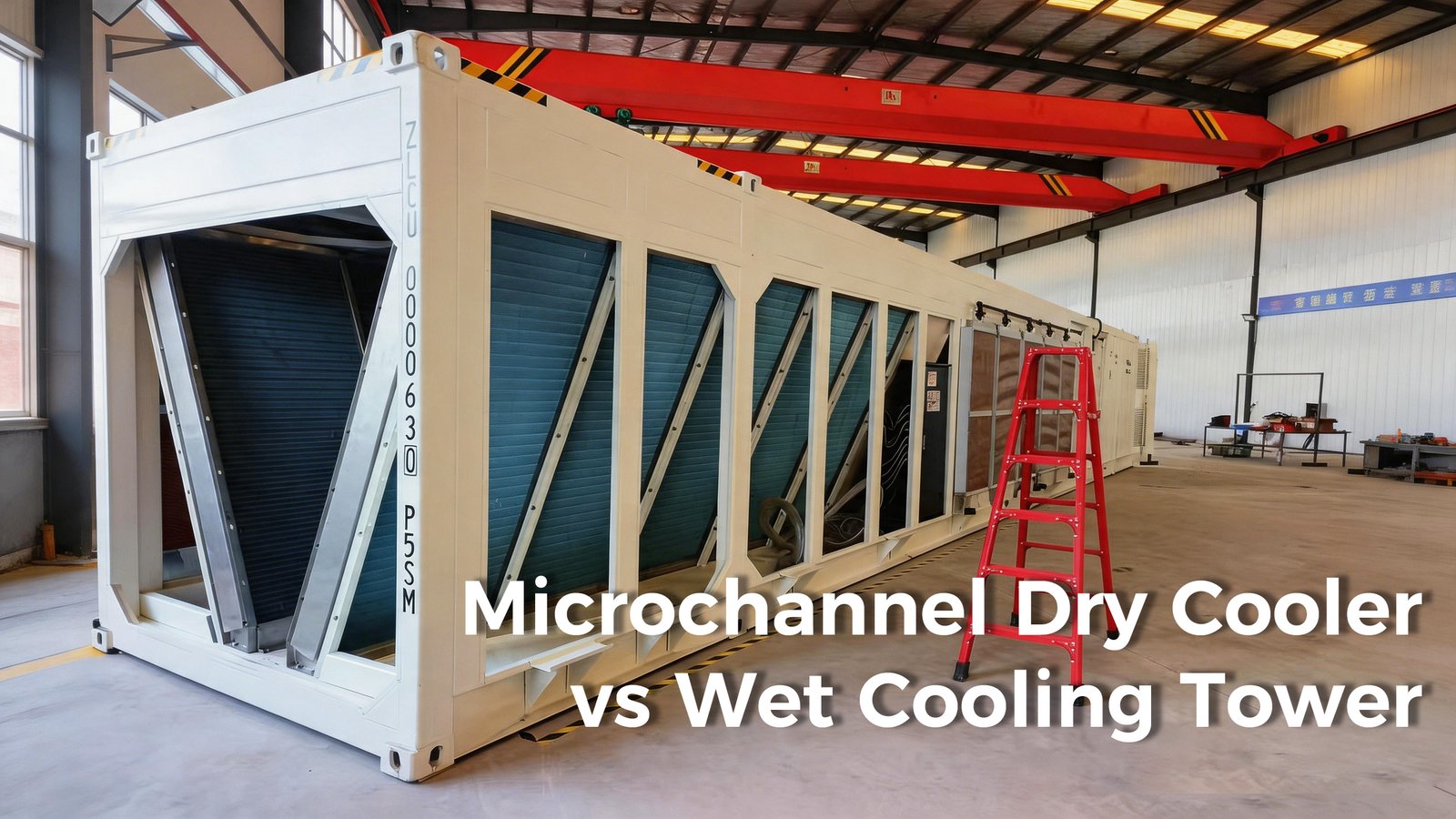
How A Microchannel Dry Cooler Works
A microchannel dry cooler uses ambient air to remove heat from coolant flowing inside compact heat exchanger channels. The coolant stays in a closed loop. Fans pull or push air across the coil, and heat moves from coolant to metal to air.
Its advantages are practical:
No evaporation water consumption
No cooling tower basin
Lower water treatment burden
No drift plume
Lower biological contamination risk
Cleaner integration with containerized mining farms
Easier deployment in remote or water-scarce locations
The tradeoff is also clear: a dry cooler cannot cool below ambient dry-bulb temperature. On very hot days, your coolant temperature will rise unless the system is oversized or supported by a hybrid/adiabatic stage.
Go dry when water is expensive, uncertain, regulated, or hard to maintain.
How A Wet Cooling Tower Works
A wet cooling tower uses evaporative cooling. Warm water contacts air, part of the water evaporates, and that evaporation removes heat. Because it follows wet-bulb temperature, it can often deliver lower cooling water temperatures than a dry cooler in hot and dry climates.
That sounds good for thermal performance. It is.
But the tower adds operational work:
Makeup water
Blowdown water
Water treatment chemicals
Scaling control
Biological control
Drift eliminator inspection
Basin cleaning
Freeze protection
Plume and local permitting concerns
In data centers and industrial sites with trained facility teams, wet towers can make sense. In remote mining farms where operators are focused on uptime and electrical infrastructure, the tower can become a hidden maintenance project.
Pro Tip:
If your site cannot reliably manage water quality, do not design the cooling system around perfect water treatment behavior.
Side By Side Comparison
| Cooling Technology Evaluation Matrix | ||
| Factor | Microchannel Dry Cooler | Wet Cooling Tower |
| Cooling Method | Air cooled closed loop | Evaporative cooling |
| Temperature Limit | Near dry bulb | Near wet bulb |
| Water Use | Very low | Continuous makeup water needed |
| Maintenance | Mainly fans coil cleaning glycol checks | Water treatment basin cleaning scale biological control |
| Site Risk | Lower water and health compliance burden | Higher water treatment and Legionella management burden |
| Peak Efficiency | Lower in very hot weather | Strong in hot dry climates |
| Winter Operation | Needs glycol or freeze strategy | Needs freeze protection basin control |
| Best Fit | Remote mining farms water scarce sites container deployment | Sites with cheap water trained maintenance team and strict water control |
| ROI Driver | Lower operational complexity | Lower coolant temperature potential |
Water Availability Changes The ROI Math
Wet towers are not just cooling equipment. They are water-consuming assets.
A tower needs makeup water to replace evaporation, drift, and blowdown. Blowdown exists because minerals concentrate as water evaporates. If the site water is hard, dirty, or inconsistent, treatment becomes more expensive and more important.
For mining farms, this matters because many sites are selected for low electricity prices, not good water infrastructure. Cheap power sites can be remote, dusty, cold, or dry. If water trucks, chemical dosing, or regular water testing become part of daily operations, the “cheap” cooling tower may not stay cheap.
A dry cooler shifts the cost profile. It may require more heat exchanger surface and fan power, but it avoids most evaporative water costs.
Short rule:
if the site has cheap power but expensive water, dry cooling usually deserves the first calculation.
PUE Is Not The Whole Story
A wet tower may help achieve a lower cooling energy number because evaporation is powerful. But mining operators should avoid chasing PUE without looking at uptime and maintenance.
A lower PUE that depends on perfect water treatment, frequent cleaning, and trained operators may not be better than a slightly higher PUE system that runs predictably.
For ASIC mining, downtime is brutal. If a cooling tower fouls, scales, freezes, or triggers water-quality issues, the lost hashrate can erase the theoretical energy advantage.
Pro Tip:
Compare annualized cost, not only PUE. Include fan power, pump power, water, chemicals, labor, filter replacement, downtime risk, and local compliance.
Climate Decides More Than Marketing Does
A dry cooler performs best when the ambient air temperature is moderate or cold. That is why it is attractive for sites in Canada, northern U.S. states, Kazakhstan, Russia, Northern Europe, and high-altitude regions.
A wet cooling tower performs well when wet-bulb temperature is favorable and water is available. Hot-dry regions can be thermally attractive for evaporative cooling, but those same regions may also have water scarcity.
Hot and humid regions are more complicated. Wet-bulb temperature is higher, so the cooling tower loses some advantage. Dry coolers also struggle because dry-bulb temperature is high. In those cases, a hybrid design may be more realistic.
The right question is not “Which technology is better?”
The right question is: What is the worst cooling day at this site?
Maintenance Risk: The Hidden Divider
A microchannel dry cooler still needs maintenance. Coils must stay clean. Fans, motors, sensors, and glycol concentration must be checked. Dusty sites need cleaning schedules.
But a wet tower adds water biology and chemistry. Scaling, corrosion, algae, and Legionella risk are real operational responsibilities. Public health agencies such as CDC emphasize water management programs for building water systems where Legionella can grow, and cooling towers are a known risk category when aerosols are present.
This is why many mining operators prefer closed-loop dry cooling for containerized deployments. It reduces the number of things that must go right every day.
Go wet when you have a real facility team. Go dry when the site will be operated lean.
Deployment And Logistics
Microchannel dry coolers are usually modular and easier to pair with container farms. You can place them beside the container, connect supply and return lines, integrate with the CDU, and scale by adding units.
Wet towers may require more site preparation: basin management, water supply, drainage, chemical storage, blowdown handling, freeze protection, and often stricter local review.
For international projects, this matters. A mining container may ship cleanly, but the cooling system still has to be installed in a real place with local water, local labor, and local rules.
A dry cooler is easier to explain to a new mining customer: connect coolant loop, power fans, clean coils, monitor temperatures. A wet tower requires more operational discipline from day one.
ROI Framework For Mining Farms
Use this simple buying model:
Total Cooling Cost = CAPEX + Fan Power + Pump Power + Water Cost + Chemical Cost + Labor + Downtime Risk + Compliance Cost
For microchannel dry cooler:
Focus on equipment cost, fan power, space, noise, high-temperature performance, and coil cleaning.
For wet cooling tower:
Focus on water cost, treatment cost, blowdown, chemical handling, maintenance labor, health compliance, and downtime risk.
For a professional data center, wet cooling may still win. For a remote mining farm with limited water and lean operations, dry cooling often produces better real-world ROI.
Final Verdict For Liquid Cooling Mining Farms
Choose a microchannel dry cooler when you need simple deployment, low water use, closed-loop stability, and lower maintenance complexity.
Choose a wet cooling tower when you have reliable water, trained operators, strong water treatment, and a site where lower coolant temperature directly improves ROI.
For most containerized ASIC farms, especially overseas projects where the buyer may be new to mining infrastructure, the safer default is usually:
Microchannel dry cooler first. Wet cooling tower only when the water and maintenance plan are truly ready.
That is not because wet towers are bad technology. They are excellent when managed well. The problem is that mining farms do not earn revenue from elegant cooling theory. They earn revenue from stable hashrate, low downtime, and equipment that local operators can actually maintain.