








The first mistake in a 1MW hydro cooling mining farm is counting containers before counting kilowatts. A container is only the shell. The real project is a controlled heat-transfer system: ASIC load, power distribution, water loop, CDU, outdoor heat rejection, monitoring, water quality, and service access. Miss one of those pieces and the farm may still run, but it will run like a margin leak.
For 2026 deployments, 1MW is the practical entry point for serious hydro cooling. It is large enough to justify a dedicated CDU and outdoor dry cooler, but still small enough to deploy as a single modular site. For investors, the goal is not to build the prettiest container. The goal is to turn every kilowatt into stable hashrate with the least downtime, the lowest avoidable energy loss, and a payback model that survives Bitcoin price swings.
Start With IT Load Not Container Size
A 1MW hydro cooling farm normally means about 1,000kW of ASIC IT load. It does not mean the utility service is exactly 1,000kW. Pumps, dry cooler fans, control systems, lighting, network gear, and safety margin all sit on top of the miner load.
Use this simple starting formula:
Miner quantity = Target IT load / Miner power
For example, ASIC Miner Value lists the Bitmain Antminer S21 Hyd at 335TH/s and 5,360W, and the S21 XP Hyd at 473TH/s and 5,676W. That gives a rough 1MW planning range:
| Miner Model & Power Performance Metrics | |||
| Modelo de minero | Power Per Unit | Approx Units For 1MW IT Load | Approx Hashrate |
| Antminer S21 Hyd 335T | 5,36 kW | 186 units | 62.3PH/s |
| Antminer S21 XP Hyd 473T | 5,676 kW | 176 units | 83.2PH/s |
| Older 5.4kW hydro ASIC class | 5.4kW | 185 unidades | Depends on |
Do not design the site at 100% theoretical load. In the field, I usually leave 5-10% headroom for miner batch variation, pump/fan power, ambient-temperature penalty, and future firmware tuning. A farm designed to survive August is worth more than one that looks efficient only in a spreadsheet.
Consejo de experto:
If the client asks for “1MW” but has not selected miners yet, do not quote only container price. Quote three scenarios: S21 Hyd class, S21 XP Hyd class, and a conservative mixed-fleet layout. The same 1MW electrical envelope can produce very different hashrate and payback.
The Core Architecture Of A 1MW Hydro Site
A reliable hydro cooling farm has four layers:
- ASIC layer: hydro miners, manifolds, hoses, quick connectors, rack layout, leak detection.
- Secondary loop: water or treated coolant circulating between miners and CDU.
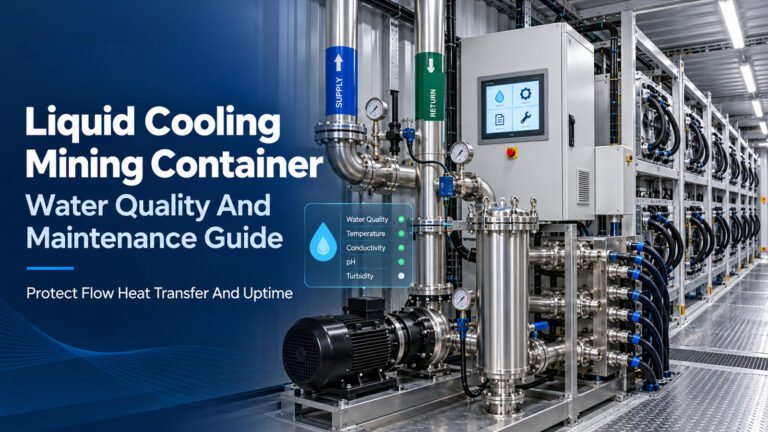
- CDU layer: plate heat exchanger, redundant pumps, filtration, PLC control, sensors.
- Primary heat rejection loop: dry cooler or cooling tower removing heat outdoors.
The CDU is the heart of the system. It separates the miner-side loop from the outdoor loop and keeps flow, temperature, filtration, and monitoring under control. For DroLinBox rack-mounted CDU specifications, a 1MW unit supports 1,000kW rated heat exchange capacity, 100m3/h primary flow, 100m3/h secondary flow, 35/45C primary supply and return water, 40/50C secondary supply and return water, 300 micron primary filtration, and 100 micron secondary filtration. That is the kind of engineering baseline a 1MW farm should be built around.
Go 1MW CDU for 1MW IT load only if the outdoor heat rejection side is also sized properly. If the dry cooler cannot reject the heat, the CDU will become a traffic controller in a traffic jam.
Size The Dry Cooler With Real Ambient Conditions
Many buyers under-budget outdoor cooling. They look at the miner power and assume the CDU alone solves the problem. It does not. The CDU transfers heat. The dry cooler rejects it.
For a 1MW hydro cooling mining farm, I would normally recommend at least 1.1MW to 1.2MW of heat rejection capacity, depending on site climate. DroLinBox microchannel dry cooler data gives a useful reference point: 1,200kW heat exchange capacity at 25C ambient, pure or softened water with corrosion inhibitor and antifreeze as required, SS304 DN100 piping, 35C +/- 1C outlet temperature, and operating range from -25C to 45C.
This margin matters. A dry cooler rated for 25°C will struggle at 40°C in hot climates, while cold climates demand proper antifreeze concentration and winter bypass control over mere nameplate capacity. In dusty mining regions, easy coil cleaning access matters as much as coil size.
Consejo de experto:
For North America, Central Asia, the Middle East, and inland South America, never finalize a dry cooler before checking summer design temperature, dust level, water quality, and altitude. The cheapest heat rejection package often becomes the most expensive part of the farm when derating starts.
Electrical Design Is Where ROI Gets Real
At 1MW IT load, power is no longer a simple plug-and-play question. You are building an industrial electrical load.
A practical power envelope looks like this:
| Data Center Facility Planning & Load Metrics | |
| Item | Planning Range |
| ASIC IT load | 1,000kW |
| Cooling auxiliary load | 30-80kW |
| Facility power | 1,030-1,080kW |
| Planning PUE | 1.03-1.08 |
| Daily energy use | 24,720-25,920kWh |
| Monthly energy use | 741,600-777,600kWh |
Electricity price is the hard line in the ROI model. The U.S. EIA Electric Power Monthly shows that industrial electricity prices vary dramatically by state, from low single-digit cents per kWh in some regions to much higher prices in coastal markets. A 1MW farm running 24/7 uses roughly three quarters of a million kWh per month. A one-cent difference in electricity price can move monthly OPEX by more than $7,000.
This is why miner profitability studies increasingly focus on electricity cost, hashprice, and curtailment behavior. A 2026 paper on Bitcoin mining demand response found that mining load reacts to electricity-sector costs, but the strength of that response depends on hashprice. In plain English: when mining revenue is strong, miners stay online longer; when revenue weakens, power price decides who survives.
Consejo de experto:
Before buying containers, ask the power provider for three numbers: firm capacity, interruptible capacity, and actual delivered industrial tariff including demand charges. Many mining projects fail because the “cheap power” number did not include demand fees, transformer losses, grid upgrade fees, or curtailment rules.
Water Quality Is Not A Small Detail
Hydro cooling does not forgive dirty water. The miner-side loop should be treated like industrial process cooling, not like a garden hose system.
For a stable 1MW farm, specify:
- Pure water, softened water, or distilled water according to the loop design
- Corrosion inhibitor
- Antifreeze where freezing risk exists
- Conductivity monitoring
- pH monitoring
- Filtration before sensitive components
- Stainless steel piping where contamination control matters
- Drain, vent, and maintenance ports
The goal is not just cooling. The goal is predictable cooling for thousands of operating hours. Scale, corrosion, biological growth, and particle contamination can reduce heat transfer, block filters, damage pumps, and cause miner alarms. A water loop that is cheap on day one can become expensive by month six.
Container Layout For 1MW Hydro Mining
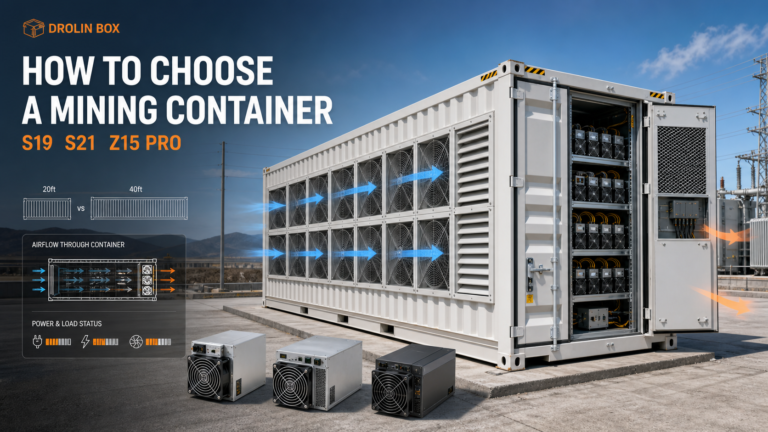
A 40HC liquid cooling mining container is usually the most practical format for a 1MW-class site. DroLinBox product data shows a 40HC integrated liquid cooling container can support about 192 S21 or S19 miners with 1,300kW heat exchange capacity at 25C ambient, using a 2500A power cabinet and multiple high-current PDUs. That gives enough physical and thermal room for a 1MW deployment without forcing every component to operate at its ceiling.
Layout should protect serviceability:
- Keep clear aisles for hose inspection and miner replacement
- Separate electrical cabinets from wet service areas
- Make pump and filter access front-facing where possible
- Reserve space for leak trays, sensors, and spare hose routing
- Place network and monitoring equipment away from splash risk
- Design lifting, unloading, and site entry before shipping
If the farm is remote, service access becomes an ROI item. Every extra hour spent replacing a miner or cleaning a filter is lost hashrate.
Consejo de experto:
A 192-miner layout may look less “maxed out” than a packed container, but it often wins in uptime. For hydro cooling, the best container is not the one with the most machines. It is the one where technicians can safely maintain the machines while the system keeps running.
Build Sequence For A 1MW Hydro Cooling Farm
Use this sequence:
- Confirm power availability. Verify voltage, transformer capacity, switchgear, grounding, protection, tariff, and demand charges.
- Select miner model. Decide whether the farm is optimized for lowest J/TH, lowest CAPEX, or fastest payback.
- Calculate IT load. Use real miner wattage, not brochure averages.
- Select container layout. Match rack count, manifold design, PDU count, service aisle, and ventilation for electrical rooms.
- Size CDU. Match heat load, primary and secondary flow, pump redundancy, filtration, control system, and maintenance access.
- Size dry cooler. Apply ambient temperature, altitude, dust, antifreeze, and derating margin.
- Design water treatment. Define water quality, corrosion protection, filtration, filling procedure, and maintenance schedule.
- Build monitoring. Track inlet/outlet temperature, flow, pressure, pH, conductivity, pump status, leak alarms, and power consumption.
- Commission in stages. Start pumps and water loop first, then energize small miner groups, then ramp to full load.
- Create O&M rules. Define filter replacement, coil cleaning, water testing, firmware control, emergency shutdown, and spare parts.
ROI Framework For A 1MW Farm
Do not evaluate the project only by container price. A serious ROI model should include:
| Mining Infrastructure: Cost and Revenue Factors | |
| Cost Or Revenue Item | Por qué es importante |
| ASIC CAPEX | The largest hardware line item |
| Inversión en capital (CAPEX) para contenedores | Structure, racks, power, manifolds, controls |
| CDU CAPEX | Heat exchange, pumps, filtration, PLC |
| Dry cooler CAPEX | Outdoor heat rejection and climate margin |
| Transformer and switchgear | Often underestimated |
| Shipping and installation | Remote sites can change total cost sharply |
| Precio de la electricidad | Main OPEX driver |
| Demand charges | Can damage ROI if ignored |
| Downtime rate | Directly reduces BTC output |
| Mano de obra de mantenimiento | More important in remote mining sites |
| Miner resale value | Affects refresh-cycle economics |
The operational calculation is simple:
Monthly power cost = Facility kW x 24 x 30 x electricity price
For a 1.05 PUE facility at 1MW IT load:
1,050kW x 24 x 30 = 756,000kWh per month
At $0.05/kWh, monthly power cost is about $37,800. At $0.07/kWh, it becomes about $52,920. That $15,120 monthly gap is not a rounding error. It can decide whether the farm scales or stalls.
Final Verdict For 2026 Deployment
Build the 1MW hydro cooling farm around heat and power, not around container marketing.
Opt for a 40HC hydro cooling container when you need fast deployment, controlled piping, integrated power distribution, and a clean service layout. Select a 1MW CDU when the miner IT load is truly close to 1MW and the outdoor heat rejection side has sufficient margin. For scenarios where water savings, low maintenance, and closed-loop operation matter more than the lowest initial quote, choose a 1.2MW-class dry cooler.
A good 1MW hydro mining farm should feel boring after commissioning. Stable inlet temperature. Stable flow. Clean filters. Predictable electricity cost. Technicians who can service the system without shutting down the whole farm.
That is what you are buying: not just hydro cooling, but operational control.