






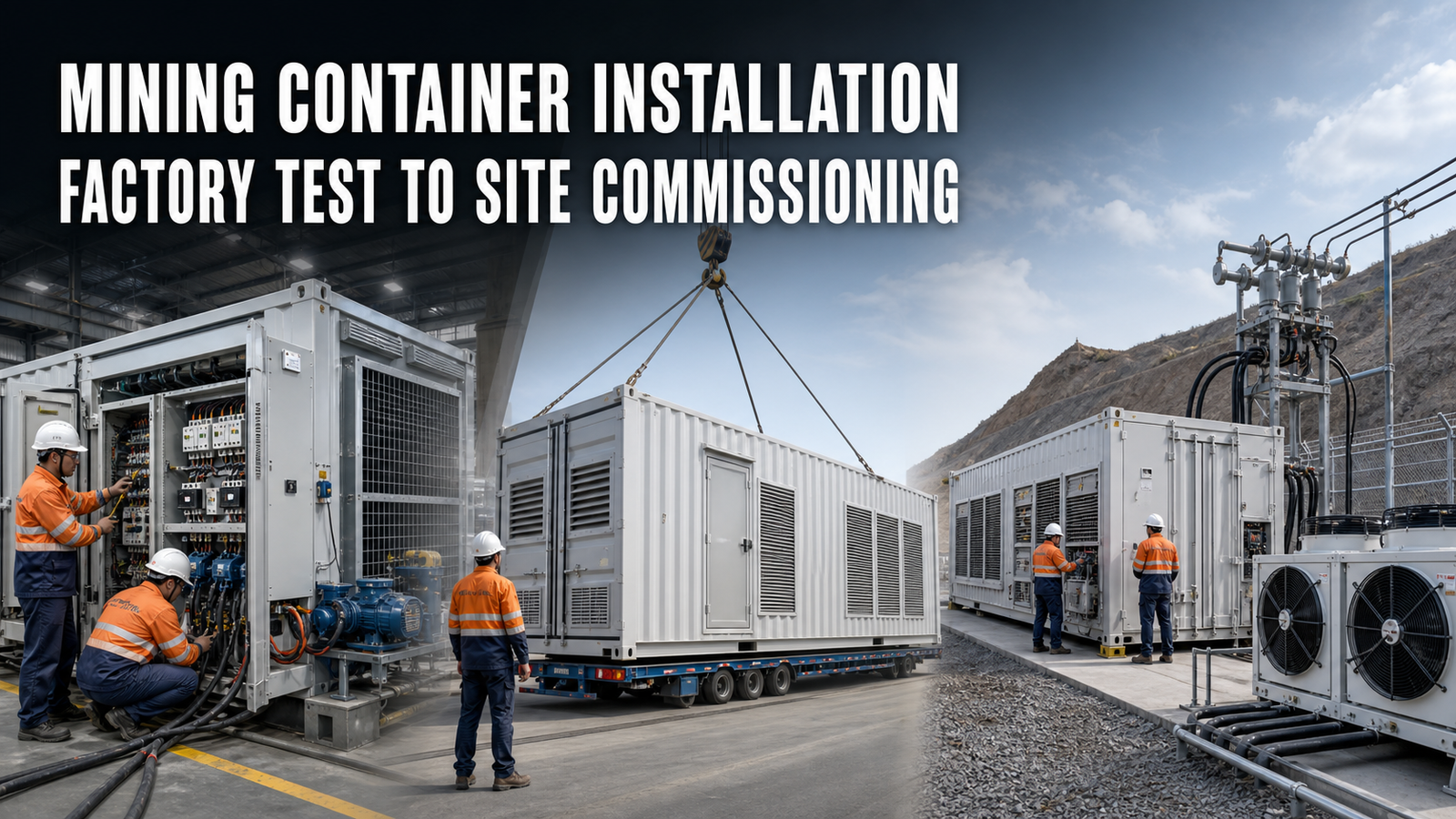

Тау-кен контейнерін орнату тексеру тізімі: зауыттық сынақтан нысанда іске қосуға дейін
A mining container installation is not complete when the unit lands on a concrete pad. It is not commissioned when the main breaker closes, either.
Instead, the project is ready only when the structural, electrical, cooling, control and operating interfaces have been tested together under the load and site conditions defined in the contract. For example, a loose cable termination, reversed coolant connection or blocked exhaust path can stop a megawatt-scale farm even when every individual component passed inspection at the factory.
Therefore, commission by gates. Record the evidence. Do not energize first and troubleshoot later.
The Handover Gap That Delays Mining Farm Projects
In practice, most installation delays are not caused by the container itself. Instead, they appear at the boundaries between parties:
- First, the supplier assumes the transformer and grounding system are ready.
- Meanwhile, the site contractor assumes internal cables were already torque-checked.
- Likewise, the cooling contractor assumes the required flow and water quality were confirmed.
- Finally, the operations team assumes miner IP planning and monitoring are included.
The result is a familiar scene: the container is physically installed, but commissioning cannot start because one drawing is outdated, the incoming voltage is wrong, the crane route is blocked, the dry cooler foundation is unfinished or nobody owns the coolant flushing procedure.
For that reason, the first installation document should be an interface responsibility matrix. Specifically, it must identify who supplies, installs, tests and signs off each item, including the transformer, main cable, grounding conductor, network connection, external piping, coolant, lifting equipment and startup labor.
Gate 1: Freeze the Design Before the Factory Test
First, factory acceptance testing is meaningful only when the approved design is clear. Before production is released for FAT, confirm:
- Container model, dimensions, weight and lifting points
- Miner brand, model, quantity and rated input power
- Operating load, diversity assumption and design margin
- Incoming voltage, frequency, phase arrangement and connection method
- Main switchgear, branch protection and PDU schedule
- Air-cooling or liquid-cooling architecture
- Fan, pump, CDU and dry cooler duty points
- Ambient temperature, altitude, dust, humidity and freeze risk
- Cable, pipe, trench and network interfaces
- Alarm list, PLC logic and remote monitoring requirements
- Local code, certification and inspection responsibilities
Therefore, do not approve the container from a brochure. Instead, approve the single-line diagram, general arrangement drawing, load schedule, cooling schematic, bill of materials and test plan.
Кәсіби кеңес: Put every site-specific assumption on one signed design-input sheet. If the miner model changes after FAT, recalculate branch current, total heat rejection and cooling flow before shipment.
Gate 2: Factory Acceptance Test Before Shipment
Next, the FAT should prove that the manufactured unit matches the approved design and that its subsystems can operate safely before logistics make corrections expensive.
Structural And Mechanical FAT
Check the frame, doors, seals, roof, floor, equipment supports, corrosion protection, lifting points and service access. Confirm that racks, fans, pumps, electrical cabinets and piping are secured for transport. Verify labels, equipment tags and flow-direction markings against the drawings.
Electrical FAT
Likewise, the electrical inspection should cover conductor identification, protective-earth continuity, insulation resistance, cable termination torque, breaker ratings, phase allocation and enclosure condition. In addition, functional tests should include the main disconnect, emergency stop, branch switching, fans, pumps, lighting, sensors, alarms and PLC interlocks.
Then, record the instruments used, calibration status, measured values and acceptance criteria. After all, a checkbox without a test value is weak evidence.
Air-Cooling FAT
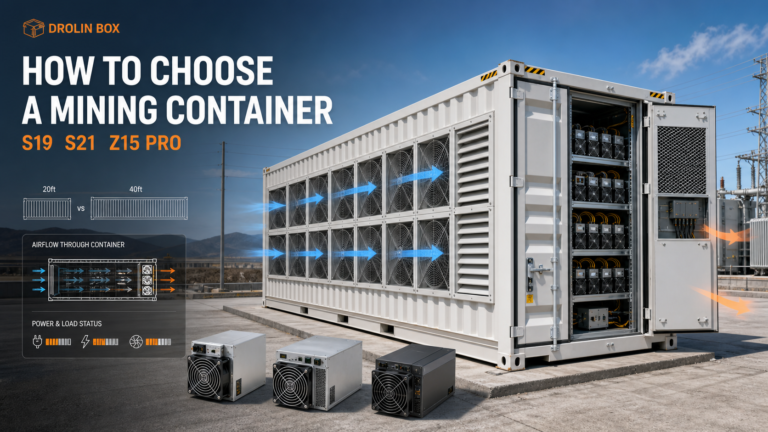
For an air-cooled mining container, verify fan quantity and rotation, louver operation, filter installation, intake-to-exhaust direction, control response and abnormal-temperature alarms. Temporary airflow measurement can identify an incorrect fan direction or a high-resistance section before the container leaves the factory.
Liquid-Cooling FAT
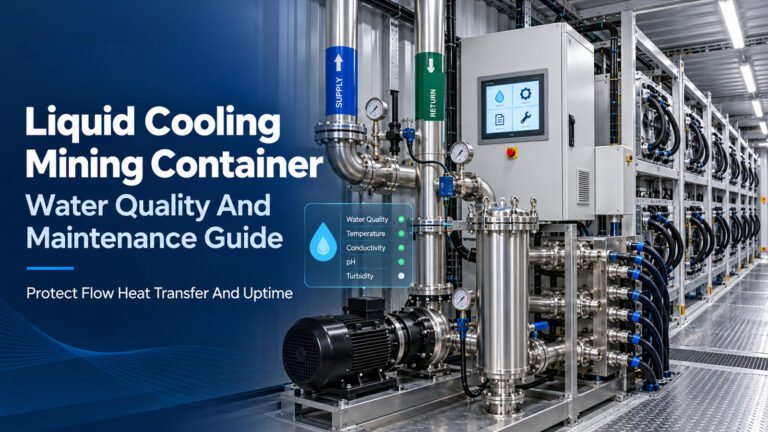
For a hydro mining container, inspect pipe supports, valve positions, hose connections, manifolds, pump rotation, CDU controls and dry cooler interfaces. Pressure-test the loop, check for leakage, flush fabrication residue and verify flow and pressure readings at agreed operating points.
BITMAIN states that Hydro miners should not use tap water directly; instead, deionized water or the specified antifreeze is required for internal circulation. The manufacturer also warns that correct inlet/outlet connection and suitable heat-rejection equipment are necessary for stable operation. Therefore, coolant specification is an acceptance item, not a purchasing afterthought.
FAT Deliverables
Before shipment, do not release the container until the buyer receives:
- First, signed FAT protocol and test records
- Next, approved drawings marked with final revisions
- In addition, the equipment and component list
- Electrical protection settings
- PLC program and alarm list, where included
- Cooling-loop pressure and leakage records
- Photos or video of key tests
- Open-item punch list with owners and deadlines
- Finally, the packing list and transport preparation record
Кәсіби кеңес: Remote FAT video is useful for international projects, but the camera should follow a written test script. However, a factory tour is not a substitute for measured results.
Gate 3: Shipping And Receiving Inspection
Even after FAT, transport can loosen connections, damage panels and shift internal equipment. For this reason, BITMAIN notes that crashing and bumping during shipment can cause miner faults, which is why receiving inspection must happen before racks are fully populated and energized.
At delivery:
- First, confirm the unit identity against the packing list.
- Next, photograph every side before unloading.
- Then, inspect doors, roof, corners, panels, louvers, piping and external connectors.
- Also, check shock or tilt indicators when specified.
- Verify that shipping braces and loose accessories are accounted for.
- Record damage on the carrier documentation before acceptance.
- Finally, keep the unit dry and isolated until electrical inspection is complete.
After the receiving inspection, use an approved lift plan. Next, confirm crane capacity, rigging, ground bearing conditions, lifting points, overhead clearance and exclusion zones. Never improvise lifting from an equipment support or decorative container feature.
Gate 4: Confirm Site Readiness Before Positioning
Because remobilization is expensive, the most economical crane is the one that visits once. Therefore, complete the site-readiness review before scheduling unloading.
Civil And Layout Readiness
- Foundation level and load capacity confirmed
- Anchor locations and container orientation checked
- Drainage prevents standing water around electrical and cooling equipment
- Maintenance doors and removable components have working clearance
- Crane, truck and emergency access routes remain open
- Intake air cannot short-cycle directly from hot exhaust
- Dry cooler or cooling-tower location has adequate airflow and service space
- Cable trenches and pipe routes are complete and protected
Utility Readiness
- Transformer rating, ratio, vector group and protection coordination confirmed
- Site voltage and frequency match the approved design
- Main cables, glands and termination hardware are available
- Grounding system and bonding points are ready for verification
- Network, fiber or wireless backhaul is available
- Makeup water, drainage and freeze protection are prepared when applicable
For air-cooled containers, land planning must protect the intake from dust sources and prevent exhaust recirculation. By contrast, for liquid-cooled systems, the pipe route, elevation difference, expansion capacity, drain points and freeze strategy should be reviewed before the container is fixed in place.
Кәсіби кеңес: Mark the final container, transformer, dry cooler, cable and pipe locations on one coordinated site drawing. Separate contractor drawings often look correct until they are overlaid.
Gate 5: Electrical And Cooling Connection
At this stage, qualified personnel must control the work under the applicable local electrical and safety rules. OSHA's hazardous-energy standard requires procedures that prevent unexpected energization or the release of stored energy during servicing and maintenance. Therefore, a project-specific lockout/tagout plan should cover electrical, hydraulic, mechanical and thermal energy sources.
Electrical Pre-Energization Checklist
- First, confirm isolation and lockout/tagout status
- Next, inspect incoming cable size, route, bend radius and gland sealing
- Then, verify protective-earth and equipotential bonding connections
- Recheck termination torque after transportation
- Measure insulation resistance and continuity as required
- Confirm phase sequence and phase-to-phase voltage
- Verify breaker and relay settings against the approved study
- Check control power, emergency stop and door interlocks
- Remove tools, temporary jumpers, shipping locks and debris
- Sign the energization authorization
Where the design allows it, energize the control circuit first. Then, confirm PLC status, sensors, alarms and communications before applying miner load.
Air-Cooling Startup Checklist
- Filters and weather screens installed correctly
- Intake and exhaust paths unobstructed
- Fans rotate in the intended direction
- Louvers or dampers travel fully
- Temperature sensors read plausibly
- Fan groups respond to manual and automatic commands
- Hot exhaust does not return to the intake
- Noise, vibration and panel movement are acceptable
Liquid-Cooling Startup Checklist
- Approved deionized water, coolant or antifreeze is available
- Loop has been cleaned and flushed
- Pipework and hoses pass the required pressure/leak test
- Pumps are primed and rotate correctly
- Air is vented from high points and miner branches
- Strainers are clean and differential pressure is checked
- Supply and return connections are correct
- Flow is balanced across manifolds and miner branches
- CDU, pumps, dry cooler and valves follow the control sequence
- Low-temperature and freeze-protection logic is proven
In particular, do not start Hydro miners without confirmed heat rejection. BITMAIN warns that operation without specialized cooling can damage the hashboard. In cold conditions, its support guidance also notes that Hydro miners may require inlet water above 20°C to start, so preheating or internal circulation may need to be included in the commissioning method.
Gate 6: Site Acceptance Test Under Staged Load
Once the connections are complete, SAT proves that the factory-tested container works with the real site transformer, cables, network, cooling equipment and operating team.
First, start with no load. Then, add miners by rack, zone or another agreed sequence. At every stage, record:
- Incoming and branch voltage
- Phase current and current balance
- Transformer and cable loading
- Fan or pump operating point
- Coolant supply/return temperature, pressure and flow where applicable
- Container intake and exhaust temperature
- Miner inlet temperature and hardware status
- Alarm, communication and monitoring status
- Visible leakage, abnormal noise or vibration
Similarly, Uptime Institute describes integrated systems testing as operating power and cooling together under simulated or real operating conditions, often using load banks, and testing maintenance or failure scenarios before operations begin. Therefore, a mining project should apply the same principle at the appropriate scale: test the interfaces, not only the components.
During this test, the SAT script should challenge applicable alarms and protective functions, including emergency stop, high temperature, fan or pump failure, communication loss, sensor failure and loss of a redundant branch when redundancy is included. In addition, confirm that alarms reach the people who must act on them.
Finally, run the agreed continuous-load period long enough to observe stable operation and relevant ambient changes. However, define the duration and acceptance limits in the contract instead of assuming that “powered on” means “passed.”
Кәсіби кеңес: Keep a defect log during staged loading. Record the symptom, timestamp, load level, measured values, corrective action and retest result. This turns commissioning experience into usable maintenance knowledge.
Gate 7: Documentation, Training And Final Handover
No signed evidence, no handover.
The final package should contain:
- As-built general arrangement and single-line drawings
- Final cable, breaker, PDU and miner allocation schedules
- Cooling schematic and final valve positions
- FAT, receiving, pre-energization and SAT records
- Protection settings and commissioning measurements
- Equipment manuals and certificates
- Spare-parts and consumables list
- PLC, HMI and monitoring backups where included
- Alarm-response matrix
- Standard operating procedures and maintenance procedures
- Lockout/tagout and emergency-response procedures
- Warranty boundaries and support contacts
- Operator training and acceptance signatures
Before final handover, training should cover normal startup and shutdown, alarm response, filter or strainer service, leak response, emergency isolation, miner replacement and escalation to the supplier. Finally, the operators who will run the farm should perform the demonstrations themselves.
Master Mining Container Installation Checklist
| Stage | Buyer Acceptance Question | Evidence Required |
|---|---|---|
| Design | Are miner quantity, total load and cooling duty frozen? | Approved design-input sheet |
| Design | Are supplier/site interfaces assigned? | Responsibility matrix |
| FAT | Does the unit match approved drawings and BOM? | Inspection record and photos |
| FAT | Are electrical safety and functional tests complete? | Measured FAT report |
| FAT | Are airflow or coolant-flow functions proven? | Airflow/pressure/flow records |
| Shipping | Is the lift and transport plan approved? | Lift plan and packing record |
| Receiving | Is transport damage documented before unloading? | Receiving photos and report |
| Site | Are foundation, drainage and clearances ready? | Site-readiness signoff |
| Қуат | Do voltage, frequency, grounding and protection match? | Pre-energization record |
| Cooling | Are air paths or liquid loops clean and correctly connected? | Cooling startup checklist |
| SAT | Has load been added in controlled stages? | Load-test log |
| SAT | Have alarms and failure responses been demonstrated? | Functional test record |
| Handover | Are as-built documents, training and spares complete? | Signed handover dossier |
Five Red Flags That Mean The Installation Is Not Finished
- The latest drawing revision cannot be identified.
- Breaker settings, cable torque or coolant specification are “known” but not recorded.
- The container has been energized at full load without staged measurements.
- Alarms appear on the HMI but no named person receives or owns them.
- The project is called complete while the punch list still contains safety, cooling or protection items.
What To Send The Supplier Before Installation Planning
To build a practical mining container installation plan, provide:
- Project country and exact site conditions
- Available utility voltage, frequency and power capacity
- Transformer and upstream protection information
- Miner brand, model, quantity and expected operating mode
- Preferred air or liquid cooling method
- Ambient-temperature range, altitude, dust and humidity conditions
- Water quality and winter freeze conditions for liquid cooling
- Preliminary site layout and logistics route
- Required delivery date and commissioning scope
Based on these inputs, DroLinBox supports mining farm site planning, container manufacturing, global logistics, installation guidance and commissioning coordination for air- and liquid-cooled deployments. Next, review our Тау-кен контейнер қызметтері or contact the project team with your miner list and available power capacity.
Final Commissioning Rule
In short, the factory proves the container was built correctly. By comparison, the site test proves the complete mining system can operate correctly where it will earn revenue.
Therefore, treat FAT, receiving inspection, pre-energization checks, staged loading and SAT as separate gates. When every gate has measurable acceptance criteria, an assigned owner and signed evidence, installation risk becomes manageable instead of mysterious.
Technical References
- OSHA 1910.147 - The control of hazardous energy (lockout/tagout)
- Uptime Institute - Lessons from Tier Certification and Integrated Systems Testing
- ASHRAE - Updated Commissioning Guideline
- BITMAIN Support - Find more about Hydro miners
- BITMAIN Support - S19/S19 Pro shelf installation precautions
Editorial Note: Final installation and commissioning requirements must follow the approved project drawings, equipment manuals, local electrical codes, safety rules and contractual acceptance criteria. Reference practices in this article are not a substitute for site-specific engineering approval.