
The Thermal Wall: 2026 High-Density Infrastructure Realities
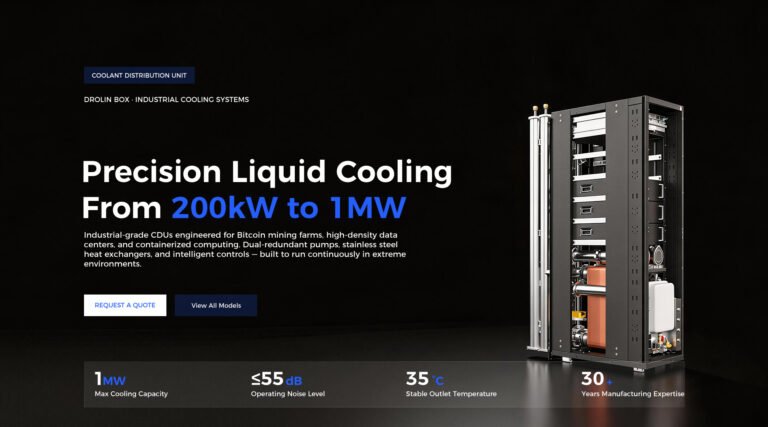
By 2026, the thermal design power (TDP) of flagship AI accelerators and cryptocurrency mining ASICs has exceeded the physical capacity of air-based heat rejection. We are seeing rack densities surpassing 100kW, rendering traditional CRAC systems obsolete. In this landscape, the Coolant Distribution Unit (CDU) is no longer a peripheral accessory; it is the central nervous system of the facility. Consequently, without a robust CDU to manage the interface between the Primary Loop (Facility Water System) and the Secondary Loop (Server-side manifold), high-performance chips face immediate thermal throttling or catastrophic failure. The DroLinBox rack-mounted CDU series addresses this specifically by acting as a high-precision heat exchange bridge, isolating sensitive server components from potentially contaminated facility water while maintaining strict temperature setpoints.
Redundancy Philosophy: Eliminating the Single Point of Failure (SPOF)
Beyond the basic thermal interface, the redundancy of the system dictates long-term profitability. In a liquid-cooled environment, the pump is the only mechanical component with a predictable wear cycle. If a single-pump CDU fails, the entire compute row goes offline. To mitigate this risk, DroLinBox utilizes a dual-pump redundancy architecture designed for mission-critical operational continuity.
Specifically, the system operates on a lead-lag or active-standby logic controlled by an integrated PLC. Pressure sensors at the outlet detect a drop below the operational threshold (e.g., < 0.5 bar delta). Within milliseconds, the controller triggers the standby pump. Furthermore, this transition is hydraulically smoothed by check valves to prevent backflow or water hammer.
In practical terms, this design permits “Online Maintenance.” Because the secondary pump maintains the loop pressure, technicians can isolate, drain, and replace the failed pump motor without shutting down the servers. In a 2026 compute environment where a 1MW cluster generates significant revenue per hour, the ability to service the cooling heart while “live” represents a massive reduction in Total Cost of Ownership (TCO).
Material Science: Protecting High-Value Silicon Assets
A liquid cooling loop is a complex chemical environment. The introduction of dissimilar metals—such as copper cold plates and aluminum radiators—creates a galvanic cell, leading to corrosion and ion leaching. DroLinBox mitigates this risk by utilizing 316L stainless steel for all internal piping and the primary plate heat exchanger (PHE).
The Protection Logic
Stainless steel provides a passive oxide layer that prevents the coolant from becoming a conductive electrolyte. Cheap alternatives like carbon steel or low-grade plastics introduce oxygen or particulates that eventually clog the micro-channels of server cold plates. Once a micro-channel (often only 0.2mm wide) is obstructed, the processor’s junction temperature spikes, leading to hardware degradation.
Filtration Integrity
Alongside material selection, DroLinBox integrates high-precision 50-micron filtration. This ensures that any installation debris or incidental scaling is captured before it enters the high-value server racks. Protecting the secondary loop’s chemistry is the most effective way to guarantee the 5-7 year lifespan required for institutional mining and AI deployments.
Scaling the Performance Curve: From 200kW to 1MW
Scaling liquid cooling is not a linear process of “adding more fans.” It requires managing the relationship between flow rate , pressure drop , and the temperature differential . DroLinBox provides a modular range from 200kW to 1000kW (1MW) to match varying deployment scales.
Performance Comparisons
* 200kW Units: Optimized for individual high-density racks or edge AI deployments. These units focus on high flow-to-footprint ratios.
1000kW (1MW) Units
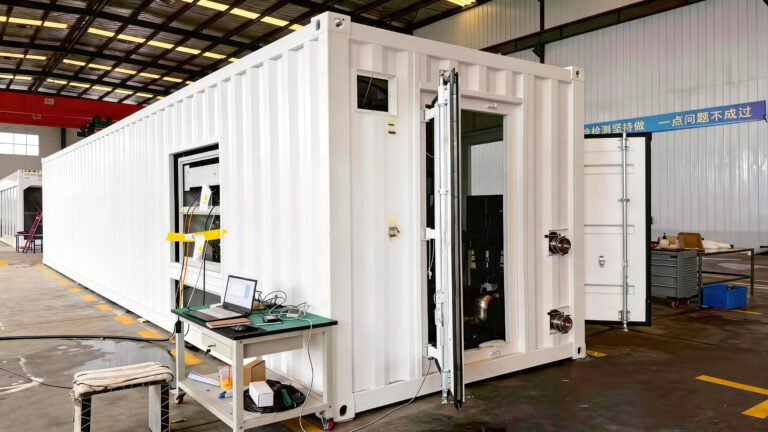
Engineered for row-level or containerized solutions, such as the DroLinBox 2.5MW liquid-cooled container. At the 1MW scale, the CDU must manage massive secondary loop volumes while maintaining a precise approach temperature (the difference between the facility water inlet and the coolant outlet).
Thermal Resistance Management
The plate heat exchangers in DroLinBox units are sized to maintain low thermal resistance. By maximizing the surface area within the PHE, these units allow data centers to use higher facility water temperatures (Warm Water Cooling), which significantly reduces the energy consumption of outdoor chillers and improves Power Usage Effectiveness (PUE).
Maintenance Insight
When scaling to 1MW, monitor the pressure drop across the internal filter. A delta increase of >0.8 bar usually indicates that the system has successfully captured initial commissioning debris and requires a filter element swap.
Intelligent Control: The PLC and Automation Logic
A CDU is only as good as its ability to react to load changes. DroLinBox units utilize industrial-grade PLCs that support Modbus/TCP and SNMP protocols for integration into Data Center Infrastructure Management (DCIM) software.
Automation Logic
The system employs a PID (Proportional-Integral-Derivative) loop to modulate pump speed via Variable Frequency Drives (VFDs). If server utilization drops, the heat load decreases. The sensors detect a lower and reduce the flow rate accordingly. This “cooling on demand” strategy minimizes parasitic power loss from the pumps, contributing to a lower OPEX.
Safety Interlocks
The control logic includes leak detection, over-pressure relief, and low-flow alarms. If a catastrophic leak is detected in the rack manifold, the CDU can automatically close motorized valves and shut down the pumps to prevent fluid damage to the electrical infrastructure.