
To deploy 240 high-density 2U servers in a conventional data center, an operator typically needs 18 to 36 months. This timeline covers site planning, civil construction, electrical installation, and commissioning. In contrast, the DroLin Box 40HC Superposition delivers the same server capacity. Moreover, it arrives pre-integrated, pre-commissioned, and liquid-cooled at 2,400kW. As a result, it can connect to site power within just 30 days of delivery.
That gap is not a marketing number. It reflects a structural difference in how compute infrastructure gets built. As a result, it has direct consequences for capital efficiency, time-to-revenue, and long-term operational risk.
The Physical Limits Driving the Architecture Shift
The rack density numbers from 2026 are no longer incremental. AI workloads push rack power from the traditional 5–10kW range to more than 30–100kW. This simultaneously strains both power and cooling systems. A Whatsminer M56S++ at full load pulls approximately 6,500W. Pack twenty units into a single rack. The thermal density exceeds what any air-handling unit can dissipate without significant auxiliary systems.
The fundamental problem is volumetric heat rejection. Air has a specific heat capacity of approximately 1.0 kJ/kg·K. Its density at standard conditions is 1.2 kg/m³. Water, however, sits at 4.18 kJ/kg·K with a density of 1,000 kg/m³. So water carries roughly 3,500 times more heat per unit volume than air. When server density climbs past 20kW per rack — the entry point for serious compute, not the ceiling — air cooling fails on two counts. It either generates unacceptable noise or requires a physical plant footprint that defeats the purpose of dense deployment.
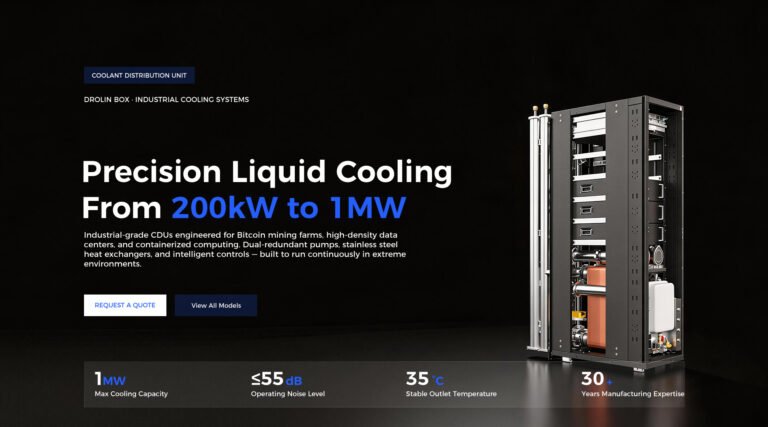
The answer is not a better fan. Instead, it is a fundamentally different thermal transport architecture. Liquid cooling distributes heat removal at the point of generation. A CDU system handles centralized heat rejection. The DroLin Box 40HC Superposition applies that architecture vertically. Two full 40HC containers stack in a superposition configuration. This addresses the second constraint that air cooling cannot solve: land.
Modular design changes the calculus fundamentally. Because capacity is added in discrete, standardized increments, operators can match investment to actual demand. The Superposition architecture applies that principle in the vertical axis. Two containers occupy the same footprint as one. The compute density per square meter of land doubles. The cooling infrastructure — 2,400kW of liquid heat rejection capacity — manages both tiers from an integrated system.
Engineer’s Insight
Before committing to a Superposition deployment, verify ground load capacity. The lower unit weighs approximately 13,500KG. The upper unit adds 17,000KG. Together, they require ground hardening for a 35-ton distributed load minimum. This is the most common pre-site oversight on first-time containerized deployments. Specifically, civil engineers familiar with traditional data center foundations understand point loads. Containerized stacks distribute load differently. The calculation must reflect that difference.
Structural Engineering and Space Efficiency
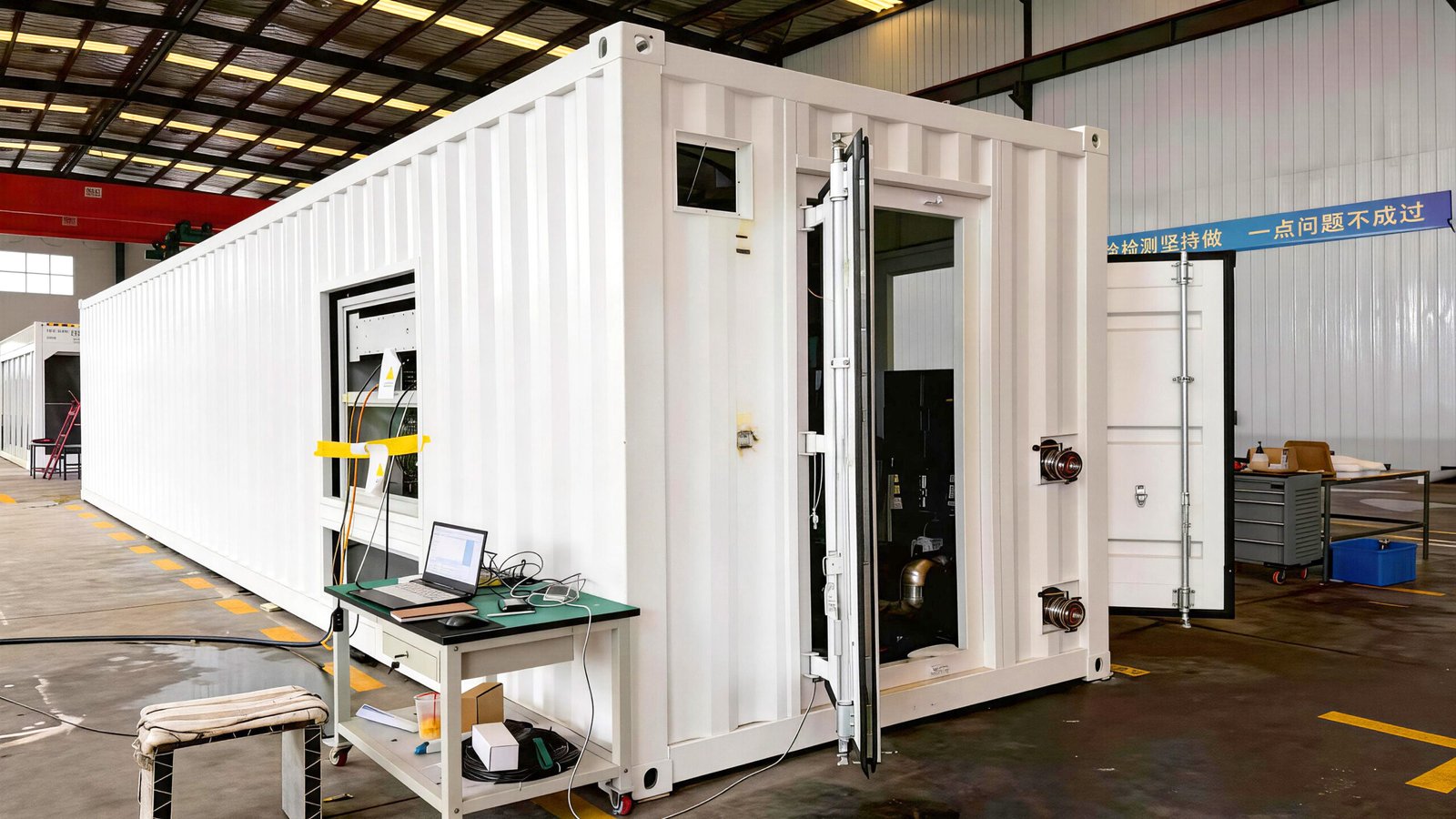
The 40HC Superposition base container measures 12,192mm × 2,438mm × 2,896mm. These are ISO standard dimensions. Because of this, the unit ships via standard flatbed rail or road transport. It integrates with existing site crane equipment. It can also relocate as operational requirements evolve. No foundation pour. No structural demolition if the deployment moves.
The upper container occupies the same footprint. Moreover, its structural interface uses engineered mounting points that transfer vertical load through the lower container’s corner castings directly to the ground. Crucially, this load path follows the exact same geometry as ISO maritime container stacking. Under this standard, each corner casting is required to sustain 86.4 metric tons of compressive force. Nevertheless, the DroLin Superposition stack totals just 30.5 metric tons, meaning it sits well within that structural envelope.
Inside the lower container — the server-capacity tier — the 40HC Superposition accommodates 240 units of 2U Whatsminer-compatible servers. At Whatsminer M56S++ TDP, that is approximately 1,560kW of installed computing load in one container tier alone. The thermal density management challenge is distributing liquid cooling manifolds to each server position while maintaining equal flow distribution across all 240 units. Unequal flow produces unequal cold plate temperatures, which produces unequal hash rates across the miner pool — a performance loss that is invisible until hashrate monitoring reveals systematic variance across positions.
The DroLin Superposition addresses flow distribution through a DN100-diameter SS304 stainless steel primary manifold running the full length of the container. Branch connections at fixed intervals serve server rows with calibrated flow resistance to equalize delivery pressure. The 2 × 2000A power distribution cabinets manage electrical load across the full 240-unit population. PDU configuration at 12 × 400A provides granular circuit protection — each 400A circuit segment covers a defined rack grouping, ensuring a single electrical fault isolates a minimum subset of compute units rather than cascading.
Engineer’s Insight
When planning manifold layout for a 240-unit high-density installation, design the secondary loop return headers to run in counter-flow to the supply headers. Counter-flow configuration equalizes the temperature gradient along the manifold length. Parallel-flow designs allow coolant returning from far-end positions to be several degrees warmer than near-end returns, which creates measurable differential in cooling performance across server positions. This is a detail that distinguishes a functional liquid cooling layout from an optimized one.
Certifications, Physical Protection, and Global Compliance
The 40HC Superposition’s core electrical components carry UL and CE certification. These designations work differently in practice. Operators planning multi-jurisdiction deployments need to understand the distinction.
CE marking is a manufacturer’s conformity declaration against European Union directives — primarily the Low Voltage Directive and the Electromagnetic Compatibility Directive. As such, it serves as the baseline requirement for equipment in any EU member state. Furthermore, CE certification on the distribution cabinets and control systems confirms that the equipment meets defined safety thresholds. Specifically, these cover insulation resistance, leakage current, and electro
UL certification operates through independent third-party testing by Underwriters Laboratories. UL listing is not a regulatory requirement in the US under federal law, but it is effectively mandatory for commercial deployment. Insurance underwriters for data center facilities routinely require UL-listed electrical equipment as a condition of coverage. Utility interconnection agreements at the service entrance level often reference UL standards. More concretely: a data center facility in North America with non-UL-listed distribution equipment faces practical barriers to permitting and insurance that can block operation regardless of technical performance.
For full-container UL and CSA certification — required for Canadian deployments — DroLin Box handles this through custom certification engagement on a per-project basis. This is standard practice for containerized systems: the container-level certification addresses the integrated system as a whole, which requires site-specific documentation of the installation configuration.
The physical protection systems address a different class of risk: particulate ingress, vibration, and detection response time. The PLC-integrated smoke detection system covers the server compartment volume continuously. Temperature sensors distributed throughout the enclosure provide zone-level thermal monitoring independent of the server management interface — if a server’s own thermal management fails silently, the container-level temperature sensors catch the rising ambient condition before it propagates. Emergency lighting and maintained illumination ensure service access under any power state.
The vibration tolerance of the container structure derives directly from ISO container construction standards, which specify performance under maritime transport conditions — sustained resonance at 2.5Hz, acceleration peaks of 2g, and random vibration profiles that far exceed any ground-mounted seismic specification applicable to commercial data center facilities outside of the highest seismic hazard zones.
Engineer’s Insight
For deployments in North American markets, initiate the UL/CSA custom certification process at contract signature — not at delivery. The certification timeline for full-container systems typically runs 8 to 12 weeks and runs concurrently with manufacturing lead time. Operators who wait until the unit arrives to engage certification face a gap between delivery and commissioning that negates the deployment speed advantage of the containerized approach.
Full-Lifecycle ROI: Compressed Timeline, Predictable Costs
Schneider Electric’s analysis shows a prefabricated 2MW AI data center costs $8M versus $14M traditionally, and deploys in 12 months versus 30 months. The DroLin Box 40HC Superposition operates at a different scale — 2,400kW rather than 2,000kW — but the capital efficiency relationship holds at every scale point and the deployment timeline compression is substantially larger for the containerized model.
The ROI mechanism has three components. The first is capital cost reduction. Traditional data center construction for equivalent compute capacity requires civil construction, purpose-built electrical rooms, cooling plant installation, and commissioning labor across all disciplines simultaneously on-site. Cost variability is high — labor market conditions, materials pricing, permitting delays, and weather interruptions all affect final cost. The DroLin Superposition delivers a factory-tested, pre-commissioned unit with a fixed price and a defined delivery timeline. Modular infrastructure consistently delivers 25–30% lower total cost of ownership compared to traditional builds.
The second component is time-to-revenue. A mining or HPC operation begins generating revenue the day its hardware connects to network and power. Every day between capital commitment and first hash — or first inference — is revenue foregone. Traditional construction timelines measure in months; the DroLin Superposition measures site-readiness requirements in days. Ground preparation, utility connection point, and network ingress. When those three conditions are met, the container connects and commissions within one week of arrival.
The third component is operational cost predictability. The integrated PLC control system provides continuous monitoring of coolant temperature, pressure, flow rate, pH, and conductivity without requiring dedicated on-site instrumentation personnel. Remote monitoring capability means a single operations team can manage multiple distributed Superposition deployments from a central location. Maintenance events — pump service, filter replacement, electrical inspection — occur on scheduled intervals defined by runtime hours rather than calendar time, and the online-serviceable filter and N+1 pump configuration ensure maintenance does not require production downtime.
The global modular data center market is expected to reach USD 75.77 billion by 2030, growing at a CAGR of 17.4% from 2025 to 2030. Operators who establish modular containerized infrastructure now position themselves to scale incrementally as compute demand grows — adding Superposition units to existing sites rather than repeating the civil construction cycle for each capacity increment.
Environmental Robustness and Multi-Region Deployment
The DroLin Box 40HC Superposition operates across an ambient temperature range of -25°C to 40°C. This range is not a laboratory specification — it reflects real deployment environments. Kazakhstan’s Astana, where Central Asia’s first Tier IV data center is under construction, sees winter ambient temperatures below -30°C and summer peaks above 35°C. Ethiopia’s Awash industrial zones, a growing location for renewable-powered mining, experience sustained ambient temperatures above 38°C for multiple months annually. The Superposition’s operating range spans both without auxiliary HVAC.
The altitude derating requirement deserves specific attention because it is a parameter that non-specialist vendors routinely omit from deployment planning. At elevations above 2,000 meters, atmospheric pressure reduction lowers the breakdown voltage of air gaps in electrical switchgear and reduces the cooling airflow mass rate at fixed volumetric fan speed. The standard derating rate applies: approximately 1% capacity reduction per 100 meters of elevation above 2,000 meters. A Superposition unit deployed at 3,500 meters — relevant for sites in the Andes, Tibetan Plateau, or Caucasus regions — requires 15% capacity reduction across both transformers and switching equipment.
This calculation must be performed by the equipment specifier before site selection, not during commissioning. A distribution cabinet rated at 2000A at sea level delivers 1,700A of usable capacity at 3,500 meters elevation. The compute load must be sized accordingly, or the electrical system operates outside its rated envelope — a condition that accelerates insulation degradation and increases fault probability.
Humidity control operates within the PLC system’s environmental monitoring envelope. The operating limit of 90% relative humidity (non-condensing) covers essentially all inhabited deployment geographies. The condensation warning for low-temperature conditions is a practical operational note: when ambient temperatures drop rapidly below the coolant loop dewpoint, external condensation on cold piping surfaces can introduce moisture into server compartments if container sealing is not maintained. This is a commissioning checklist item, not a design limitation.
Engineer’s Insight
For deployments in tropical coastal environments — Southeast Asia, West Africa, Caribbean mining sites — specify the corrosion inhibitor package for the secondary coolant loop based on local ambient chloride content. Coastal environments with high salt air concentration accelerate galvanic attack on copper cold plate connections even when the primary SS304 piping is unaffected. A quarterly coolant chemistry analysis program that includes dissolved copper monitoring will catch cold plate corrosion onset before it manifests as flow restriction or thermal performance degradation.
What the Superposition Architecture Actually Delivers
The 40HC Superposition solves three simultaneous constraints. First, land scarcity — two containers stack on one footprint. Second, thermal density requirements beyond air cooling physics — 2,400kW of liquid cooling manages what no fan array can. Third, deployment timelines traditional construction cannot meet — 30 days from delivery to operation.
The dual 2,000A distribution cabinets, N+1 pump redundancy, online filter serviceability, UL/CE certified systems, and PLC remote monitoring are not optional features. They are the minimum engineering standard for a system generating revenue continuously across multi-year cycles. These systems run in environments ranging from Arctic winters to equatorial heat.
Operators evaluating infrastructure expansion in 2026 face a straightforward calculation: 18 to 36 months of traditional construction, or 30 days to operational status with a factory-tested Superposition unit. The Superposition architecture does not close that gap slightly. It closes it completely.