







A mining container can have enough fans and still overheat. The failure usually starts with pressure, recirculation, or a filter that nobody planned to clean.
That distinction matters because an air-cooled ASIC farm does not earn revenue from the fan count printed on a specification sheet. It earns revenue when every miner receives air within its acceptable inlet conditions, hot exhaust leaves the site without returning to the intake, and dust is controlled without choking the system.
Good ASIC mining container ventilation is therefore a heat-balance and airflow-management system. It combines miner power, allowable air-temperature rise, fan performance under static pressure, intake geometry, exhaust separation, filter loading, local climate and maintenance access. Miss one of those variables and the nominal container capacity may not be sustainable in July, at high altitude, or after three weeks of dust accumulation.
Start with Heat Load, Not Fan Quantity
Nearly all electricity consumed by an ASIC miner eventually becomes heat inside the operating environment. A group of miners drawing 1,000kW creates approximately 1,000kW of heat that must be carried out continuously.
The first-pass sensible heat equation is:
Heat load = air density x specific heat capacity x airflow x temperature rise
For preliminary design:
Required airflow (m3/s) = IT heat load (kW) / [air density (kg/m3) x air specific heat (kJ/kg.K) x allowable Delta T (K)]
At approximately sea-level conditions, engineers often use about 1.2kg/m3 for air density and 1.005kJ/kg.K for specific heat as early calculation values. If a 40HC mining container carries a 1,300kW IT load and the design allows a 10C rise from intake to exhaust, the ideal airflow is approximately:
1,300 / (1.2 x 1.005 x 10) = 107.8m3/s
That equals roughly 388,000m3/h or 228,000CFM. If the allowable temperature rise is 15C, the theoretical requirement falls to roughly 259,000m3/h or 152,000CFM.
These figures are heat-balance references, not final fan selections. Real projects must account for filter resistance, louvers, weather hoods, rack restriction, fan-system effects, leakage, altitude, wind pressure, redundancy and safety margin. The actual miner load also needs to be calculated from the selected model and operating mode, not simply from the maximum container rating.
Pro Tip:
Ask a supplier for airflow at the system operating static pressure. A free-air CFM figure can look impressive while saying very little about the airflow that reaches the miners after filters and louvers are installed.
Build One Controlled Path from Intake to Exhaust
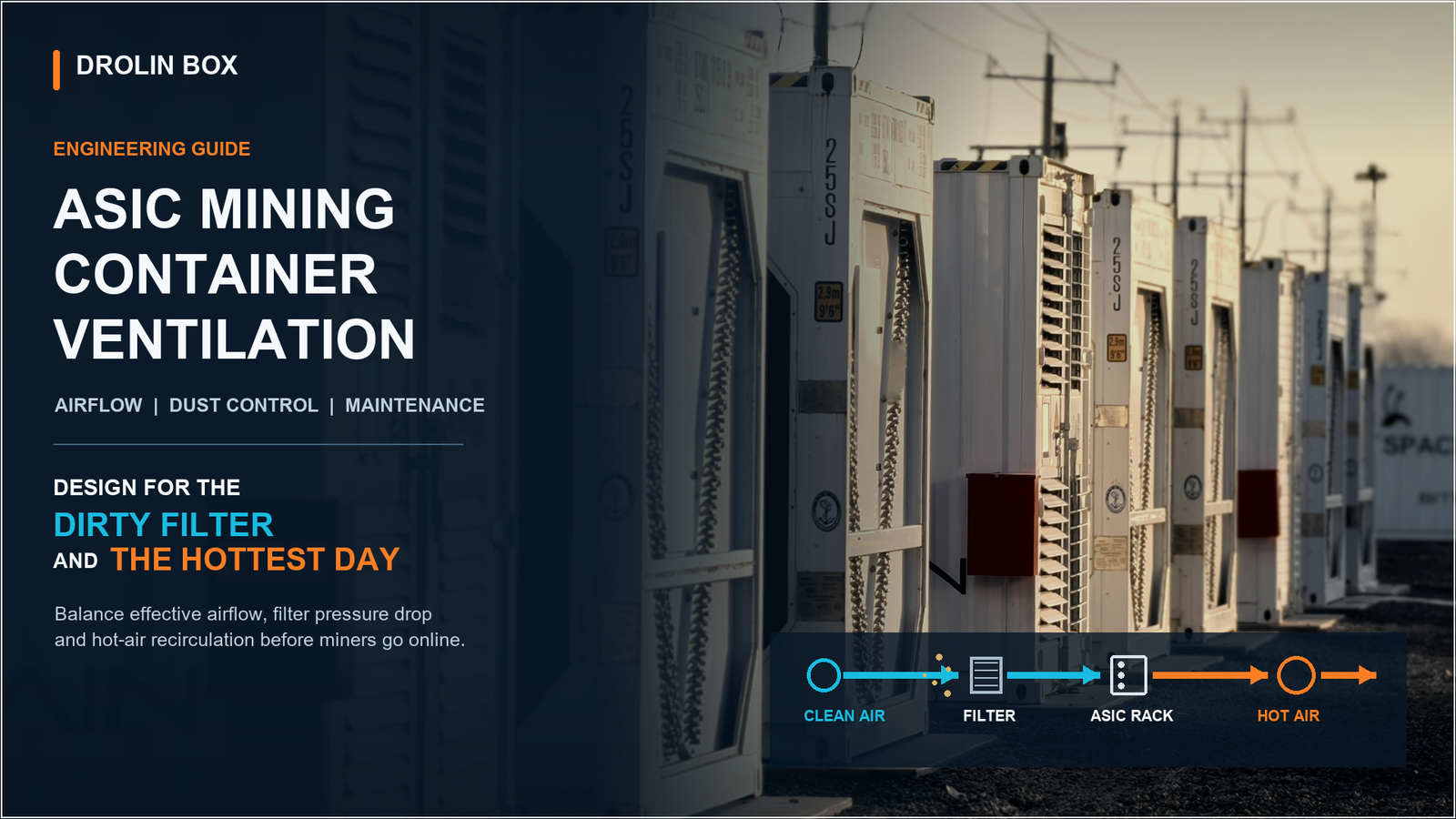
The shortest useful description of a reliable air-cooled container is simple: clean outdoor air enters one side, passes through every miner once, and leaves from the hot side.
The engineering work is in making that statement true.
Miner racks should align the ASIC fan direction with the container airflow direction. Open gaps around racks, unused miner positions, cable openings and poorly sealed partitions create bypass paths. Air follows the route with the lowest resistance, so part of the supply air may avoid the miners while a row farther from the intake receives too little cooling.
The exhaust side needs the same attention. Hot air should not build pressure behind the miners or be forced sideways into neighboring rows. Discharge openings, fan walls and external exhaust space should be sized as a system. Doors, louvers and protective mesh should not become hidden bottlenecks.
Useful commissioning measurements include:
– temperature at several miner inlets, not only one room sensor
– temperature rise across different rack positions
– static pressure before and after the filter
– pressure difference across the miner zone
– exhaust temperature and fan current
– miner fan speed, chip temperature and thermal alarms
An average inlet temperature can hide a bad rack. Map the container from front to back and from bottom to top.
Fan Curves Decide the Real Airflow
Ventilation fans do not deliver one fixed airflow. Their operating point changes with system resistance.
A fan may be rated at high airflow in a low-resistance test condition. Add a loaded filter, louver, insect screen, narrow plenum and miner racks, and the operating airflow moves along the fan curve. That is why fan selection should include the airflow-versus-static-pressure curve, motor efficiency, operating current and sound data.
Redundancy also needs a practical definition. If one fan stops, will the remaining fans maintain a safe reduced-load condition? Does the control system detect loss of airflow, high temperature or abnormal current? Can a failed fan be isolated and replaced without shutting down the complete container?
Variable-frequency or staged fan control can reduce auxiliary power during cool weather, but control logic should follow miner inlet temperature and pressure conditions rather than outdoor temperature alone. A cold day does not solve a blocked filter.
Pro Tip:
Define the failure mode before approving the fan count. A container with 16 fans is not automatically N+1 if losing one fan creates a hot zone that the remaining airflow cannot reach.
Dust Control Is a Pressure-Drop Decision
Running without filtration lowers initial resistance, but it sends airborne dust into miner heat sinks, fan blades, connectors and electrical compartments. Heavy dust narrows heat-sink passages, reduces heat transfer, increases miner fan speed and raises cleaning labor. Conductive or corrosive contamination can create more serious reliability problems.
Overly restrictive filtration creates a different loss. It can starve the miners of air, increase exhaust-fan power and shorten the interval between filter changes.
The correct question is not, “Do we need a better filter?” It is, “What particle control can this fan system support throughout the filter’s service life?”
DroLinBox’s available dust-filter assembly uses an aluminum-profile frame, polyurethane filter foam, aluminum-alloy mesh and 25 PPI foam. This is a practical coarse-filtration structure for mining environments, subject to site dust conditions and maintenance planning. PPI describes the pore density of foam. It should not be presented as a specific MERV or ISO filtration class unless the complete filter assembly has been tested to that standard.
For dusty projects, consider:
– a washable or replaceable coarse pre-filter
– enough filter surface area to keep face velocity and initial pressure drop manageable
– sealed frames that prevent air from bypassing the media
– differential-pressure measurement across the filter bank
– safe access for replacement while fans are controlled or stopped
– spare-filter storage protected from moisture and deformation
– a maintenance interval based on measured loading, not a calendar guess
Desert sand, agricultural dust, construction dust and coastal salt are not the same contamination problem. The filter, enclosure material, coating and cleaning method should match the site.
Stop Hot Air Before It Comes Back
Hot-air recirculation can cancel a large part of the container’s cooling capacity without changing the number of working fans. The container exhaust leaves at elevated temperature, meets a wall, another container, a roof, terrain or an unfavorable wind, and returns to the intake.
The miner then receives air that has already absorbed heat. Its internal fans speed up, chip temperature rises and thermal protection may reduce hashrate or stop the unit.
Site planning should review:
– prevailing summer wind direction
– intake and exhaust orientation
– spacing between container rows
– height and position of exhaust discharge
– nearby buildings, fences, berms and vegetation
– transformer and generator heat sources
– future expansion that may block today’s clear airflow path
Smoke visualization, temperature mapping and computational fluid dynamics can be useful for complex or multi-row sites. For smaller projects, disciplined field measurements during full-load commissioning often identify the main recirculation paths quickly.
Pro Tip:
Inspect intake temperature during the hottest hour with the full farm operating. A no-load morning test cannot prove that a 3MW or 5MW layout will avoid recirculation at peak conditions.
Climate Changes the Ventilation Design
One container specification cannot be applied blindly to every country.
Hot and dry sites: High ambient temperature reduces the available temperature margin. An optional water-curtain or evaporative-assist system may lower intake temperature in suitable dry climates, but water quality, humidity, media scaling, drift and maintenance must be engineered together.
Hot and humid sites: Evaporative cooling provides less benefit, while condensation risk, corrosion and moisture control become more important. Miner-manufacturer humidity limits still apply.
High-altitude sites: Lower air density means the same volumetric airflow carries less mass and less heat. Fan performance, motor cooling and the airflow calculation must be corrected for altitude.
Cold sites: Very cold intake air may require dampers, recirculation control or staged airflow to keep equipment within allowable operating conditions and avoid condensation during startup or rapid weather changes.
Coastal or industrial sites: Salt mist, fine conductive dust and corrosive gases may require enhanced filtration, coatings and shorter inspection intervals.
DroLinBox publishes an air-cooling environmental adaptation range of approximately -40C to 55C and a target PUE of about 1.05. These are product-positioning references rather than guarantees for every site. Final capacity, PUE and operating range depend on miner model, ambient design conditions, altitude, filtration, airflow resistance and control strategy.
DroLinBox Air-Cooled Container Reference Configurations
| Container | Reference Miner Capacity | Reference Power | Ventilation Fans |
| 20HC air-cooled container | Up to 168 S19-class miners | 650kW | 8 x 1220# fans |
| 40HC air-cooled container | Up to 336 S19/S21-class or 270 S21 XP-class miners | 1,300kW | 16 x 1220# fans |
| 45HC air-cooled container | Up to 420 S19/S21-class or 336 S21 XP-class miners | 1,500kW | 18 x 1220# fans |
These are reference configurations from DroLinBox product materials. The final miner quantity must be checked against unit power, rack geometry, electrical distribution, local ambient conditions and the installed fan operating point. The 1220# description is a product reference; the project quotation should confirm the exact fan model, curve, quantity and control method.
For a smaller farm or phased investment, the 20HC format can reduce initial CAPEX and simplify site expansion. The 40HC format provides more density per deployment unit and is often a practical building block for 3MW to 5MW modular farms. The correct choice is not the container with the most slots. It is the configuration that matches available power and can maintain uniform miner inlet conditions.
Explore the DroLinBox Air Cooling Mining Container for product configurations.
Maintenance Is Part of the Cooling Capacity
Ventilation performance degrades gradually, which makes it easy to ignore until alarms become frequent. A useful maintenance plan connects inspection frequency to measurable conditions.
| Frequency | Recommended Checks |
| Daily | Review inlet temperature, chip-temperature alarms, miner fan speed, container fan status and abnormal current |
| Weekly | Inspect intake screens, visible dust loading, air bypass gaps, hot spots and unusual fan vibration or noise |
| Monthly | Record filter differential pressure, clean or replace filters as required, inspect fan blades, louvers and door seals |
| Quarterly | Map rack inlet temperatures under load, inspect miner heat sinks, electrical panels, fasteners and corrosion points |
| Seasonal | Deep-clean the ventilation path, verify sensors and alarms, inspect weather protection and reassess wind or site-layout changes |
Actual intervals may need to be much shorter in sand, dust, salt or agricultural environments. Miners should be powered down and serviced according to the equipment manufacturer’s safety and cleaning instructions. Avoid pushing contamination deeper into electronics with uncontrolled high-pressure air.
Keep records. A rise in filter differential pressure, miner fan speed or rack inlet temperature is more useful than a subjective note saying that the filter “looks dirty.”
The ROI Cost of Bad Ventilation
Poor ventilation affects profit through several channels:
– thermal throttling reduces effective hashrate
– shutdowns lose mining revenue
– miner fans and container fans consume more power
– frequent manual cleaning increases labor cost
– heat and contamination shorten component life
– emergency filter or fan replacement creates unplanned downtime
A simple operating model can track:
Daily ventilation electricity cost = container fan power x 24 hours x electricity price
Estimated downtime revenue loss = offline miners x unit hashrate x current hashprice x downtime hours / 24
Annual filter cost = filters per change x changes per year x unit cost + labor
Hashprice changes constantly, so the purpose of this model is not to promise a payback period. It is to compare design options using the same assumptions. A larger filter bank may cost more initially but reduce pressure drop, fan energy and replacement frequency. A cheaper fan package may increase downtime risk if it has no operating margin or service access.
Go beyond container price. Calculate delivered airflow per operating dollar.
Pro Tip:
Include differential-pressure sensors and several miner-inlet temperature sensors in the quote. They are inexpensive compared with diagnosing an invisible airflow problem after hundreds of miners are online.
Information a Supplier Needs Before Designing the Ventilation System
A serious quotation should start with project data, not a standard brochure:
1. miner brand, model, quantity and operating mode
2. total IT load and available site power
3. project country and exact location
4. design summer and winter temperature
5. altitude
6. humidity and rainfall conditions
7. sand, dust, salt mist or industrial contamination exposure
8. target miner inlet temperature
9. noise limits and distance to neighboring property
10. desired filter-maintenance interval
11. container row layout and prevailing wind
12. expansion plan and required redundancy
With this information, the supplier can calculate preliminary airflow, define filter area, review fan static pressure, plan exhaust separation and identify whether evaporative assistance is suitable.
Final Verdict: Design for the Dirty Filter and the Hottest Day
The best ASIC mining container ventilation design is not the one that performs well with a new filter, open doors and cool morning air. It is the one that keeps miner inlet temperatures uniform when the farm is fully loaded, the filter has accumulated dust and the site reaches its design summer condition.
Start with actual miner power. Convert that load into a preliminary airflow requirement. Select fans from their curves at the expected system resistance. Separate intake from exhaust. Give filters enough area and make them easy to service. Then validate the complete container under load.
That process protects hashrate, lowers avoidable fan and maintenance cost, and gives the farm a cooling system that can be operated rather than merely installed.
For a project-specific airflow and container-capacity review, [contact DroLinBox](https://drolin-box.com/en/contact/) with your miner model, quantity, site power, location, altitude and ambient-temperature range.
FAQ
How much airflow does an ASIC mining container need?
It depends on total miner heat load and the allowable intake-to-exhaust temperature rise. Use the sensible heat equation for a preliminary estimate, then correct for altitude, filters, louvers, racks, wind, leakage and required redundancy. Final fan selection must use airflow at operating static pressure.
Is more CFM always better for a mining container?
No. Higher airflow can improve heat removal, but only if it reaches the miners and the exhaust does not recirculate. Excessive fan power, poor airflow distribution and low-temperature operating issues can add cost without solving hot spots.
Should an air-cooled mining container use dust filters?
Most dusty or exposed sites benefit from filtration, but the filter area and efficiency must match available fan pressure. A restrictive or heavily loaded filter can reduce cooling airflow. Differential-pressure monitoring helps determine the correct service time.
Does 25 PPI foam equal a MERV rating?
Not automatically. PPI describes foam pore density, while MERV and ISO classifications are based on standardized performance testing. Use a certified rating only when the complete filter has relevant test data.
How can a mining farm prevent hot-air recirculation?
Orient intake and exhaust around prevailing wind, provide adequate row spacing, avoid barriers near discharge, and measure intake temperatures under full load during hot conditions. Complex sites may benefit from CFD analysis.
How often should mining-container filters be cleaned?
There is no universal calendar interval. Base the decision on filter differential pressure, miner inlet temperature, visible loading and site dust conditions. Desert and agricultural sites may require much more frequent service than clean locations.