







Owning 5MW of power does not make a mining site AI-ready. The missing layer is usually not the transformer. It is the thermal and operational discipline between a 120kW GPU rack and the outdoor heat-rejection plant.
Mining operators already understand megawatts, 24/7 operation, modular deployment and the cost of downtime. That gives them a meaningful head start when evaluating AI or high-performance computing infrastructure. It does not mean a hydro mining container can be relabeled as an AI data center.
The cooling problem changes shape.
A liquid-cooled mining farm normally spreads a relatively stable load across hundreds of similar ASIC miners. An AI cluster concentrates the power of dozens of miners into one rack, combines liquid-cooled processors with air-cooled networking and storage components, and ties uptime to expensive GPU jobs, customer service-level agreements and tightly controlled server specifications.
The CDU sits at the center of that transition.
A 120kW Rack Is Not Just a Smaller Mining Container
NVIDIA’s DGX GB rack-scale documentation states that a complete rack consumes approximately 120kW. Its compute trays use liquid-cooled cold plates connected through rack manifolds, while components such as networking and storage still rely on air cooling. NVIDIA also treats leak detection as a system requirement because early detection protects equipment, uptime and data integrity.
That combination explains why AI cooling cannot be reduced to one number on a CDU nameplate.
The liquid loop must remove the heat captured by the cold plates. The room or rack airflow system must remove the remaining heat. The facility water system must then reject the CDU load outdoors through dry coolers, cooling towers or chillers. Controls must coordinate all three layers without allowing condensation, excessive pressure, low flow or a single pump failure to take the cluster offline.
Google has already described a roadmap from today’s 100kW-class IT racks toward systems capable of supporting up to 1MW per rack. This does not mean every AI project needs a 1MW rack today. It means operators should avoid building fixed infrastructure that becomes obsolete after one server generation.
Pro Tip:
Do not purchase the CDU before selecting the GPU platform. The server vendor’s coolant temperature, flow, pressure, chemistry and heat-capture requirements should define the CDU duty point, not the other way around.
What a CDU Actually Does in an AI Data Center
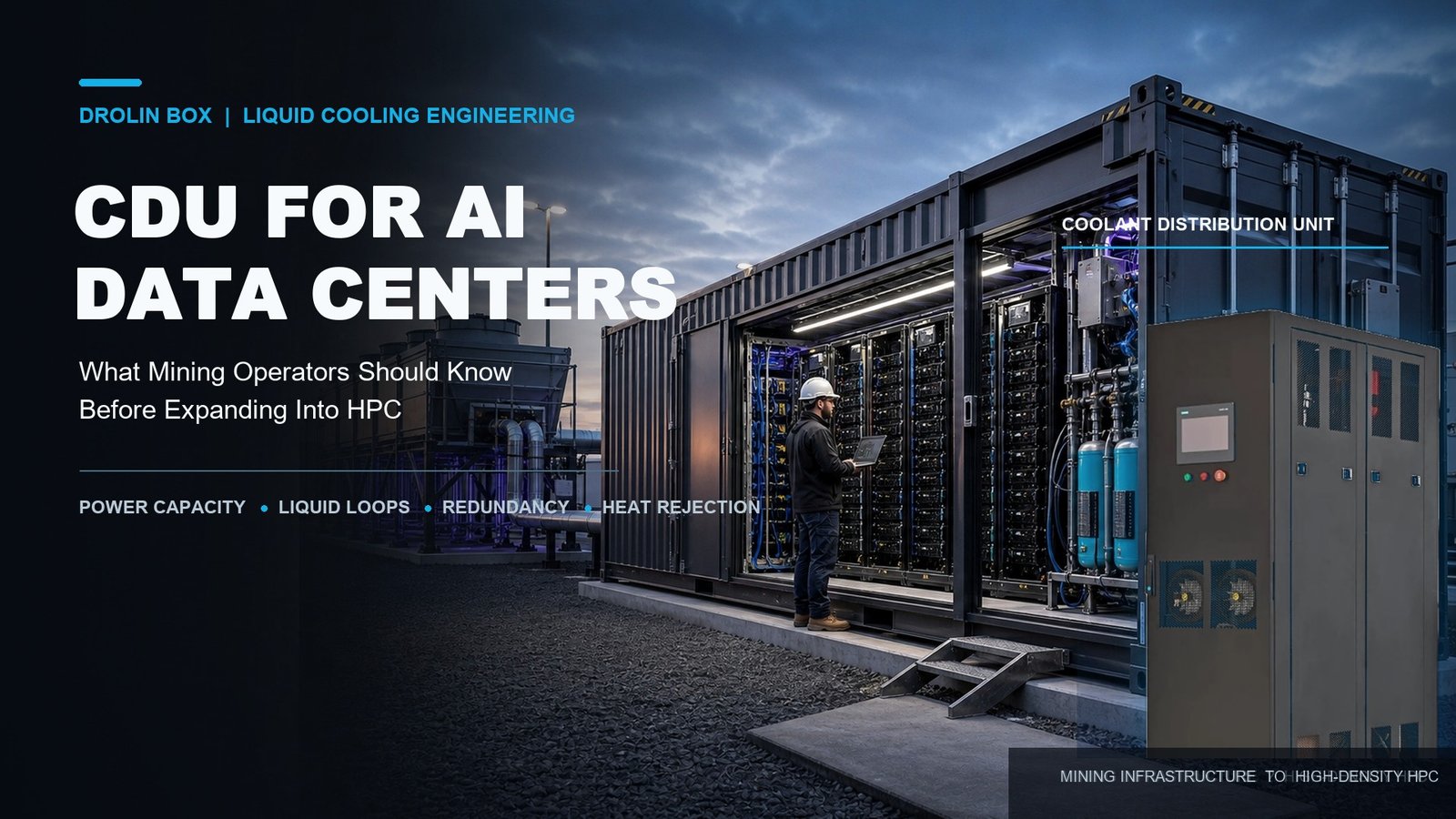
A coolant distribution unit is the thermal and hydraulic bridge between the facility cooling system and the technology cooling system serving the IT equipment.
In a liquid-to-liquid architecture, the CDU normally provides:
– a plate heat exchanger that separates facility water from the IT coolant loop
– pumps that maintain secondary-loop flow and pressure
– temperature, pressure and flow control
– filtration and coolant-quality management
– expansion, filling, draining and air-removal functions as required
– leak, low-flow, high-temperature and abnormal-pressure alarms
– PLC control and communication with BMS or DCIM platforms
– isolation points for maintenance and fault containment
This separation matters. ASHRAE’s water-cooled server guidance notes that a CDU makes the water quality between the IT equipment and the CDU easier to control than if the server loop were directly exposed to the facility water system.
Think of the CDU as a controlled border. Heat crosses it. Contamination, unstable pressure and untreated facility water should not.
Schneider Electric’s liquid-cooling guidance describes multiple architectures combining rack-mounted or floor-mounted CDUs with liquid-to-liquid or liquid-to-air heat rejection. The correct architecture depends on the existing building system, deployment scale, schedule, efficiency target and available outdoor heat rejection.
Go liquid-to-air for a limited retrofit only when the room air-cooling system can absorb the rejected heat. Go liquid-to-liquid when the project needs scalable, high-density cooling connected to a real facility-water or outdoor heat-rejection loop.
Mining Cooling and AI Cooling Are Different Operating Businesses
| Decision Area | Liquid-Cooled Mining Farm | AI or HPC Data Center |
| Load profile | Usually stable and repetitive across similar ASIC miners | High rack density with workload changes and mixed equipment loads |
| Hardware layout | Hundreds of similar miners and repeated pipe branches | GPU compute trays, manifolds, network, storage and power shelves |
| Cooling capture | Hydro or immersion architecture may capture most miner heat | Direct-to-chip commonly leaves residual heat for air cooling |
| Water specification | Defined by miner and cooling-system materials | Defined by server OEM, cold plates, manifolds and warranty conditions |
| Uptime logic | Curtailment or partial shutdown may be commercially acceptable | Job interruption can trigger SLA loss and expensive workload recovery |
| Monitoring | Site-level temperature, pressure, flow and miner alarms | Rack-level telemetry, leak detection, BMS or DCIM integration and trend analysis |
| Redundancy | Often designed around farm economics and replaceable modules | Must be designed around failure domains, customer commitments and high-value IT assets |
| Expansion model | Add miners or containers against available megawatts | Add validated rack pods with power, networking, cooling and controls together |
Mining operators should view HPC expansion as a new service business, not simply a new machine type. The customer is buying compute availability, data access, security and predictable performance. Cooling is one part of that contract, but it is the part that can stop the entire rack in seconds.
Size the CDU from Captured Heat, Not Facility Megawatts
The basic liquid-cooling equation is:
Heat transfer kW = mass flow kg/s x specific heat kJ/kg.K x coolant temperature rise K
For water, a useful early estimate is:
Flow m3/h = heat load kW x 3.6 / [4.186 x Delta T C]
At a 10C coolant rise:
– 120kW requires approximately 10.3m3/h
– 600kW requires approximately 51.6m3/h
– 1MW requires approximately 86m3/h
These are theoretical heat-balance values. Real sizing must include the coolant mixture, server pressure drop, manifold losses, filter loading, heat-exchanger approach temperature, pump operating point, control margin and redundancy strategy.
Consider a six-rack AI pod:
– 6 racks x 120kW = 720kW total rack power
– if the server vendor confirms that 90% is captured by liquid, the CDU duty is approximately 648kW
– the remaining 72kW still needs an air-cooling path
– the project must then add design margin and define operation during one pump or one CDU failure
That calculation could lead to an 800kW-class CDU, a 1MW unit, or multiple smaller CDUs arranged for redundancy. The correct answer depends on the required failure mode. A nameplate larger than the normal load is not automatically redundant.
DroLinBox reference CDU configurations cover 200kW, 400kW, 600kW, 800kW and 1MW heat-transfer capacities, with corresponding reference flow rates from 20m3/h to 100m3/h on both facility and technology loops. These are configuration references. Final capacity must be verified at the project’s actual temperatures, coolant, pressure loss and redundancy requirement.
Pro Tip:
Ask for the heat-exchanger performance at your real primary and secondary supply temperatures. A 1MW rating at one temperature approach may deliver materially less capacity at another.
Approach Temperature Can Decide Whether You Need a Chiller
CDU capacity is not only about flow. It is also about temperature difference.
The heat exchanger requires a temperature gap between the hot IT return and the cooler facility supply. This is commonly discussed as approach temperature. A smaller approach improves the ability to run warm-water cooling but usually requires a larger heat exchanger, more surface area or different operating conditions.
DroLinBox’s reference CDU data uses a 35/45C facility-side loop and a 40/50C technology-side loop. In this example, the supply-side approach is approximately 5C. That temperature relationship can support dry-cooler operation in suitable climates, but it does not create free cooling everywhere.
At high summer ambient temperatures, a dry cooler may no longer provide the required facility-water supply temperature. The project may need a larger cooler, evaporative assistance, a cooling tower, a chiller or a hybrid design. Antifreeze concentration, altitude, coil fouling and fan redundancy also change real performance.
A CDU transfers heat. It does not make the heat disappear.
Approve the CDU and heat-rejection equipment as one system at the local design-day temperature.
Water Quality Is a Warranty and Uptime Issue
Mining sites sometimes treat water quality as a maintenance detail. In AI direct-to-chip cooling, it is part of the IT equipment specification.
The secondary technology cooling system can include cold plates, quick disconnects, flexible hoses, manifolds, seals and multiple metals. Poor chemistry can create corrosion, galvanic reactions, biological growth, particle blockage or seal damage. Untreated cooling-tower water should never be sent directly through expensive server cold plates.
The project should define:
– approved coolant and glycol or inhibitor concentration
– pH, conductivity and corrosion limits
– dissolved oxygen and biological control where applicable
– particle size and filtration requirement
– material compatibility across pipes, manifolds, cold plates and quick disconnects
– flushing, passivation and cleanliness procedures before server connection
– sampling points and laboratory-test intervals
– refill and contamination-response procedures
DroLinBox’s reference design uses stainless-steel internal piping, approximately 300-micron filtration on the facility side and 100-micron filtration on the technology side. Those values are product references, not universal AI-server requirements. The GPU or server OEM’s specification takes priority and may require a different filtration level, coolant or material list.
Pro Tip:
Make water-quality acceptance part of commissioning. A clean-looking loop is not proof of acceptable conductivity, particle count or corrosion protection.
Redundancy Must Survive a Real Failure
The words “dual pump” are not enough for an AI proposal.
Confirm whether each pump can deliver the full design flow at the required system head. Confirm how the controls transfer duty, how check valves prevent reverse flow, and whether a failed pump can be isolated and replaced online. Then look beyond the pump.
An AI-ready CDU strategy may require:
– duty and standby pumps sized for full load
– independent power feeds or protected control power
– redundant sensors for critical measurements
– online filter isolation or parallel filter paths
– bypass and balancing valves
– leak detection at the CDU, manifold and rack
– multiple CDUs or loop sections to limit the failure domain
– spare pumps, seals, filters and control components on site
– tested communication-loss and sensor-failure logic
Google reports using in-row CDUs with redundant components and UPS support to isolate rack liquid loops from the facility loop. Its published experience is a useful lesson: availability comes from the architecture around the heat exchanger, not from the heat exchanger alone.
Define the requirement in operational language: “The loss of one pump shall not interrupt IT cooling at design load” is clearer than “dual pumps included.”
Controls Must Follow AI Loads Without Hunting
ASIC loads are often highly stable. AI workloads can change as jobs start, stop or move between racks. The cooling system must respond without unstable valve movement, pressure swings or supply-temperature oscillation.
Useful CDU telemetry includes:
– primary and secondary supply and return temperatures
– flow and differential pressure
– pump speed, current and operating status
– filter differential pressure
– coolant tank level where applicable
– conductivity, pH or other specified water-quality indicators
– heat load calculated from flow and Delta T
– leak alarms and alarm location
– valve position and control mode
DroLinBox CDU controls can be configured around PLC monitoring and industrial communication. For AI projects, confirm the required BMS and DCIM interface, including Modbus RTU or TCP, SNMP, alarm priorities, trend intervals, remote access policy and cybersecurity ownership.
Do not settle for a green running light. The operator needs enough data to see a filter loading, pump degradation or temperature drift before the GPU platform reacts.
What Mining Operators Can Reuse
The move into HPC is not a complete restart. Mining operators may already own valuable infrastructure:
– large utility interconnections and transformers
– medium-voltage and low-voltage distribution experience
– land with expansion space
– dry coolers, cooling towers or water-treatment equipment
– modular container deployment and lifting logistics
– 24/7 remote operations
– experience with high ambient temperatures, dust and remote maintenance
– teams accustomed to monitoring power cost and PUE
Those assets can shorten the path to an AI-ready site. The value depends on condition, location and compatibility.
A remote mining site with cheap electricity but poor fiber connectivity, unstable utility service or no technical labor pool may still be a weak AI location. HPC customers also evaluate network latency, carrier diversity, physical security, fire protection, compliance, spare-parts response and contractual uptime.
Reuse the megawatts. Requalify everything connected to them.
The ROI Model Changes from Hashprice to Availability
Mining ROI is dominated by coin economics, machine efficiency and electricity price. AI infrastructure economics are driven by GPU utilization, contract revenue, financing, network cost and service availability.
The cooling CAPEX model should include:
– CDU and pump redundancy
– rack manifolds, hoses and quick disconnects
– facility piping and valves
– water treatment, flushing and commissioning
– dry coolers, cooling towers, chillers or hybrid heat rejection
– residual air-cooling capacity
– leak detection and controls integration
– electrical feeds for pumps and fans
– spare parts and service tools
The OPEX model should include:
– pump and heat-rejection fan energy
– chiller energy when required
– water, chemicals and glycol
– filters, laboratory testing and preventive maintenance
– technician coverage and response time
– planned and unplanned downtime
For AI, the cheapest CDU is rarely the one with the lowest purchase price. It is the one that meets the server operating envelope, avoids stranded GPU capacity and can be maintained without interrupting contracted compute.
Pro Tip:
Calculate the value of one offline rack-hour before negotiating away redundancy, leak detection or online service features. The answer often changes the procurement decision quickly.
A Safer Expansion Path from Mining to HPC
Step 1: Qualify the Site
Verify utility capacity, power quality, redundancy, fiber routes, security, environmental conditions and outdoor heat-rejection potential. Do not start with a container rendering.
Step 2: Select the IT Platform
Obtain the exact rack power, liquid heat-capture ratio, coolant temperature, flow, pressure, chemistry, quick-disconnect and control requirements from the server vendor.
Step 3: Build One Validated Cooling Pod
Start with one or several racks, a properly sized CDU, manifolds, residual air cooling and the intended BMS or DCIM interface. Test normal load, partial load and load transitions.
Step 4: Test Failure Modes
Simulate pump loss, sensor failure, filter loading, power transfer, communication loss and high outdoor temperature. Verify alarms and cooling continuity before customer workloads arrive.
Step 5: Expand in Repeatable Blocks
Scale the validated power-and-cooling pod instead of redesigning the complete plant for every rack generation. Modular CDUs can reduce the initial commitment and limit failure domains, while larger centralized units may reduce unit cost at scale.
Go modular first when the business model is still being proven.
Information Required for an AI CDU Proposal
A serious CDU quotation should request:
1. server and GPU platform
2. rack quantity and maximum rack power
3. percentage of heat captured by liquid
4. required technology-loop supply and return temperatures
5. minimum and maximum flow per rack
6. allowable rack and manifold pressure drop
7. coolant specification and material restrictions
8. quick-disconnect and manifold requirements
9. facility-water supply and return temperatures
10. local summer and winter design conditions
11. available dry cooler, tower or chiller capacity
12. required redundancy and failure-mode statement
13. BMS or DCIM communication protocol
14. certification and electrical requirements
15. expansion plan for the next server generation
Without this information, a “1MW CDU” is only a cabinet with a large number attached to it.
Explore DroLinBox CDU systems covering reference capacities from 200kW to 1MW. For a preliminary AI or HPC cooling evaluation, contact DroLinBox with your rack model, rack quantity, liquid temperatures, project location and redundancy requirement.
Final Verdict
Mining operators have a credible route into AI infrastructure because they already understand industrial power, modular construction and continuous thermal management. Their advantage disappears if they assume that megawatt experience automatically solves rack-level engineering.
An AI data center CDU must be selected around the server platform, liquid heat capture, water chemistry, pressure envelope, heat-exchanger approach, outdoor climate, controls and failure strategy. It must also operate as part of a mixed cooling system because not every component in an AI rack is necessarily liquid cooled.
The right expansion question is not, “Can this mining site supply enough power?”
It is, “Can this site deliver contracted compute while one cooling component is being serviced on the hottest day of the year?”
Answer that question before buying the GPUs.
FAQ
What size CDU is required for a 120kW AI rack?
Start with the server vendor’s confirmed liquid heat-capture ratio. If 90% of a 120kW rack is liquid cooled, the preliminary CDU load is about 108kW. Add the real coolant temperatures, flow, pressure loss, margin and redundancy requirement before selecting the unit.
Can a mining CDU be used in an AI data center?
Potentially, but only after verifying server-OEM coolant, filtration, material, pressure, control, leak-detection and redundancy requirements. A matching kW rating alone does not establish compatibility.
Does a CDU eliminate the need for air cooling?
Not always. Direct-to-chip systems often leave networking, storage, power supplies and other components air cooled. The project must calculate residual room or rack heat separately.
Does a CDU eliminate the need for a chiller?
No. The answer depends on required coolant temperature, heat-exchanger approach, local ambient conditions and the selected heat-rejection method. Warm-water systems may use dry coolers for many operating hours, but hot climates may still require assisted or mechanical cooling.
Is one 1MW CDU better than multiple smaller units?
Not automatically. One large unit may reduce unit cost and footprint, while multiple units can improve scalability and limit failure domains. Compare the required redundancy, maintenance method, piping layout and expansion plan.