







El más barato contenedor para minería suele ser el más caro una vez que llega al lugar.
La cotización puede parecer sencilla: un contenedor de 20 pies, 40 pies, 40HC o 53 pies, una cierta cantidad de
Ranuras para ASIC, ventiladores o enfriamiento por líquido, la distribución y el suministro de energía. Pero el costo real de un contenedor para minería no es la caja de acero. Es el costo de llevar la electricidad a los mineros ASIC, eliminar el calor del sistema, mantener la instalación en funcionamiento y evitar ese tipo de problemas de mantenimiento que, sin que nos demos cuenta, acaban con el retorno de la inversión.
Por eso, un comprador serio no debería limitarse a preguntar: “¿Cuánto cuesta un contenedor para minería?”. La pregunta más adecuada es: “¿Qué costos están incluidos, cuáles no están incluidos en el contenedor y cuáles se generarán mensualmente después de la puesta en marcha?”.”
Para una granja minera de entre 3 MW y 5 MW, esta diferencia no es un simple detalle contable. Puede determinar si la instalación se convierte en un activo de infraestructura rentable o en un costoso conjunto de equipos que generan mucho calor.
El costo no es el equipo. Es el sistema de implementación
El precio de un contenedor para minería suele estar compuesto por varias partes:
| Capa de costos | Lo que suele incluir | Por qué es importante |
|---|---|---|
| Caja del contenedor | 20 pies, 40 pies, 40HC, 45HC, 53 pies (carrocería) y modificaciones estructurales | Controla el transporte, la elevación, la distribución y el espacio interno disponible |
| Sistema eléctrico | Gabinete principal, disyuntores, barra colectora, PDU, cables, conexión a tierra, protección contra rayos | Determina si la carga del minero puede funcionar de manera segura |
| Sistema de enfriamiento | Ventiladores, rejillas de ventilación, filtros, cortina de agua, unidad de condensación (CDU), estación de bombeo, enfriador seco, tuberías | Determina si los ASIC pueden mantener una tasa de hash estable |
| Estantes para mineros | Estanterías, tendido de cables, espacio para servicios, flujo de aire o acceso al circuito de agua | Determina la velocidad de mantenimiento y la capacidad real |
| Sistema de control | PLC, sensores, alarmas, monitoreo remoto, datos de temperatura y presión | Determina la rapidez con la que los operadores detectan los problemas |
| Pruebas de fábrica | Inspección eléctrica, prueba de presión, prueba del ventilador, prueba de fugas, lógica de control | Reduce el riesgo asociado a la puesta en marcha de la planta |
| Logística | Transporte marítimo, transporte por carretera, grúa, descarga, seguro, aduanas | A menudo se subestima en las zonas mineras remotas |
| Obras en el sitio | Cimientos, transformador, conexión a la red eléctrica, cercado, drenaje, tratamiento de agua | Por lo general, fuera de la cita entre comillas |
Si dos proveedores ofrecen precios muy diferentes, no compares primero la cifra final. Compara el alcance de lo que incluyen.
Un contenedor de bajo costo puede no incluir la interfaz del transformador, los componentes eléctricos certificados, la capacidad del enfriador en seco, el monitoreo remoto, el sistema de reemplazo de filtros o el dimensionamiento adecuado de los cables. Esas exclusiones no desaparecen; simplemente pasan de la cotización del proveedor al presupuesto de tu planta.
Consejo de experto:
Si una cotización dice “plug and play”, pero no especifica la corriente del gabinete de alimentación, la cantidad de PDU, el trazado de los cables, la capacidad de enfriamiento, los puntos de sensores ni el alcance de la puesta en marcha, aún no es una cotización técnica. Es solo un eslogan de ventas.
Costo de los contenedores con enfriamiento por aire: menor inversión inicial (CAPEX), mayor sensibilidad al emplazamiento
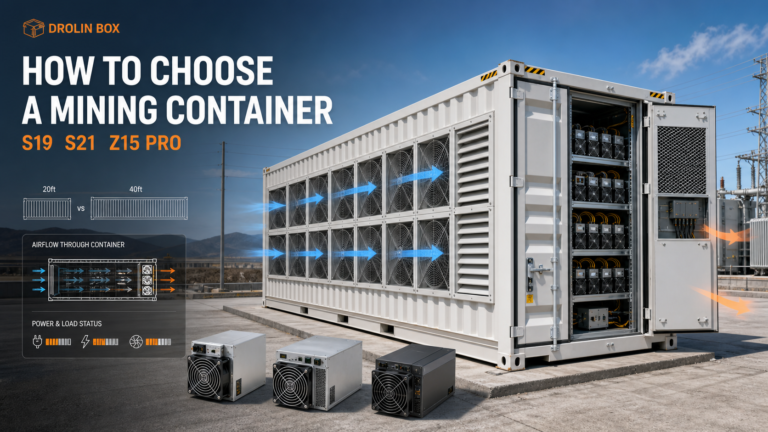
Los contenedores mineros con enfriamiento por aire suelen ser la opción con menor inversión inicial (CAPEX). Para los compradores que implementan ASICs S19, S21, Z15 Pro o similares con enfriamiento por aire, las ventajas son evidentes: implementación más rápida, mantenimiento más sencillo, menos componentes en el circuito de refrigeración líquida y capacitación más fácil para los operadores.
Según los datos del producto DroLinBox, un contenedor de refrigeración por aire de 20HC puede albergar alrededor de 168 mineros de clase S19 con una potencia operativa de aproximadamente 650 kW. Un contenedor de refrigeración por aire de 40HC puede albergar hasta 336 mineros de clase S19/S21 o 270 mineros de clase S21 XP con una potencia operativa de aproximadamente 1,300 kW. Un diseño de refrigeración por aire de 45HC puede llegar a albergar hasta 420 mineros de clase S19/S21 con una potencia operativa de aproximadamente 1,500 kW.
A primera vista, eso parece atractivo, sobre todo para los compradores que necesitan una implementación rápida y un costo inicial más bajo. La pregunta que queda en el aire es la del entorno del sitio.
El costo de la refrigeración por aire depende de:
- temperatura ambiente local
- polvo y arena
- trayectoria del aire de admisión
- recirculación del aire de escape
- poder de los fans
- frecuencia de reemplazo del filtro
- requisitos de ruido
- densidad de potencia del minero
Si el lugar es fresco, lo suficientemente seco, está bien ventilado y no está sobrecargado, el enfriamiento por aire puede ser la opción más rentable. Si el lugar es caluroso, polvoriento, está abarrotado o se utilizan mineros de alta potencia, el precio de compra más bajo puede traducirse en un mayor costo de mantenimiento y una tasa de hash inestable.
Opta por el enfriamiento por aire cuando la velocidad y el presupuesto sean lo más importante.
No te lances a la refrigeración por aire si el diseño del flujo de aire todavía es solo un dibujo con flechas.
Costo de los contenedores con enfriamiento por líquido: mayor inversión inicial (CAPEX), mejor control térmico
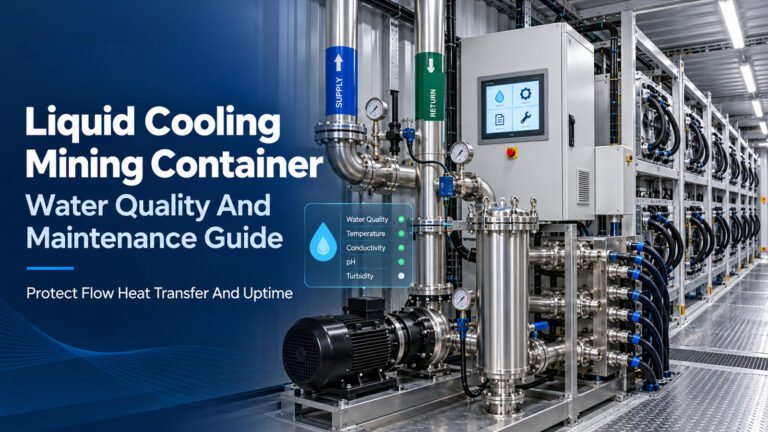
Los contenedores para minería con enfriamiento líquido son más caros porque no son solo contenedores. Son sistemas térmicos compactos.
Un sistema de enfriamiento por líquido de alta precisión incluye el cuerpo del contenedor, bastidores internos, distribución de energía, estación de bombeo, tuberías, filtros, control de la calidad del agua, CDU o sistema de intercambio de calor, interfaz con el enfriador seco, sensores, control por PLC y lógica de puesta en marcha.
Según los datos de las especificaciones de DroLinBox, un contenedor de enfriamiento líquido integrado de 40HC tiene capacidad para 192 mineros hidráulicos de clase S19/S21, con una capacidad de transferencia de calor de 1,300 kW a una temperatura ambiente de 25 °C, un gabinete de alimentación de 2,500 A y una configuración de 12 PDU de 175 A cada una. Una solución integrada de 45HC admite 224 mineros hidráulicos de clase S19/S21 con una configuración de alimentación de 2 x 1 600 A. Una solución de superposición de 40HC admite hasta 420 mineros hidráulicos de clase S19/S21 con una capacidad de transferencia de calor de 2,400 kW y un diseño de estación de bombeo doble.
Por eso hay que interpretar de manera diferente las cotizaciones de sistemas de enfriamiento líquido. La carcasa del contenedor es solo una parte del precio. El principal factor de costo es el circuito de enfriamiento.
Para un contenedor de minería con enfriamiento por líquido, solicita:
- capacidad nominal de transferencia de calor
- Capacidad de la planta de tratamiento de aguas residuales (CDU) o de la estación de bombeo
- caudal primario y secundario
- temperatura del agua de entrada y de retorno
- capacidad del enfriador seco a la temperatura ambiente local
- precisión del filtro y método de reemplazo
- requisitos de calidad del agua
- Monitoreo del pH y la conductividad
- sensores de presión y temperatura
- lógica de alarma y monitoreo remoto
Consejo de experto:
Un proyecto de enfriamiento por líquido de 1 MW nunca debe evaluarse únicamente en función del precio del contenedor. Un contenedor más barato con una capacidad insuficiente de la unidad de condensación (CDU), un enfriador seco de tamaño inadecuado o un sistema de filtración deficiente puede terminar costando más que los ahorros obtenidos tras una sola temporada de calor.
La carga de los mineros determina el costo real de la infraestructura
El número de mineros es la cifra más fácil de vender. Los kilovatios son la cifra que realmente importa.
Los datos públicos sobre las especificaciones de los mineros muestran que el Antminer S21 Hyd 335TH consume alrededor de 5,360W, mientras que el S19 Pro+ Hyd 198TH consume alrededor de 5,445W. Esto significa que un contenedor hidroeléctrico de 192 unidades ya representa una carga de TI de clase de 1 MW, sin contar la energía auxiliar.
| Modelo de minero | Potencia nominal | Carga de TI de 192 unidades | Qué significa esto en términos de costos |
|---|---|---|---|
| S21 Hyd 335TH | 5,36 kW | alrededor de 1 029 kW | Requiere un diseño eléctrico y de refrigeración de clase 1 MW |
| S19 Pro+ Hyd 198TH | 5,445 kW | alrededor de 1 045 kW | Carga similar, menor densidad de hashrate |
| 420 x S21 Hyd Español de América Latina (es-419) | 5,36 kW cada uno | alrededor de 2 251 kW | Requiere una planificación de la generación de energía y la disipación de calor de más de 2 MW |
Si un comprador solicita “192 mineros”, el proveedor aún necesita saber de qué tipo de mineros se trata. Un contenedor de 192 espacios con S21 Hyd genera un resultado comercial muy diferente al de uno con el mismo número de espacios pero lleno de mineros hidráulicos más antiguos. El costo de la electricidad puede ser similar, pero el potencial de ingresos no lo es.
Por eso mismo, la infraestructura más barata no siempre es la mejor. Si el contenedor permite ahorrar un 10 por ciento en CAPEX, pero obliga al comprador a lidiar con una temperatura de operación inestable, un acceso deficiente para el mantenimiento o limitaciones recurrentes, el costo real se paga en forma de pérdida de hashrate.
La trampa de los costos de refrigeración: enfriador seco, CDU y temperatura ambiente
El costo de la refrigeración es el factor que hace que muchos presupuestos para contenedores de minería se vuelvan poco realistas.
En el caso de la refrigeración por aire, el comprador asume los costos relacionados con la potencia de los ventiladores, la filtración, el control de polvo, la trayectoria del flujo de aire y el diseño de la instalación. En el caso de la refrigeración líquida, el comprador asume los costos relacionados con la unidad central de refrigeración (CDU), la estación de bombeo, el enfriador seco, las tuberías de acero inoxidable, la filtración, la gestión del líquido refrigerante y los sensores.
Los datos del enfriador seco de microcanales DroLinBox ofrecen un punto de referencia útil: capacidad de transferencia de calor de 1,200 kW a una temperatura ambiente de 25 °C, tubería de acero inoxidable 304 DN100, temperatura del agua de salida de 35 °C ± 1 °C, control por PLC, control de frecuencia variable del ventilador y monitoreo remoto.
La frase “a una temperatura ambiente de 25 °C” es importante. Un enfriador seco que parezca funcionar bien a 25 °C podría no rendir de la misma manera en un entorno de verano a 40 °C. Una granja de minería en Texas, el Medio Oriente, Asia Central o el interior de América Latina no debería dimensionar el sistema de enfriamiento basándose en las cifras optimistas de un folleto publicitario.
Haz tres preguntas:
- ¿Cuál es la temperatura ambiente de diseño?
- ¿Qué temperatura del agua de salida se debe mantener?
- ¿Qué pasa con la estabilidad de los mineros si el sitio supera esa condición?
El enfriador seco no es solo un accesorio. Es la parte exterior de tu retorno de inversión.
Costo eléctrico: transformador, PDU y la factura mensual
La electricidad es ese gasto que nunca deja de existir.
La Administración de Información Energética de EE. UU. indicó que el promedio de la tarifa eléctrica industrial en EE. UU. fue de 8,66 centavos/kWh en abril de 2026. La misma tabla muestra grandes diferencias entre los estados: Texas con 6,33 centavos/kWh, Georgia con 6,84 centavos/kWh, Washington con 7,01 centavos/kWh y California con 19,87 centavos/kWh. Esa diferencia es lo suficientemente grande como para cambiar por completo el análisis de viabilidad del negocio.
Usa este modelo sencillo:
Costo mensual de la electricidad = Carga de TI × PUE × 24 horas × 30 días × precio de la electricidad
Para una instalación del S21 Hyd de 192 unidades:
- Carga de TI: aproximadamente 1.029 kW
- Con un PUE de 1,06, la carga de la instalación es de aproximadamente 1 091 kW
- Con un PUE de 1,15, la carga de la instalación es de aproximadamente 1 183 kW
- Diferencia: aproximadamente 92 kW en funcionamiento continuo
A $0.0633/kWh, esa diferencia de 0.09 en el PUE cuesta alrededor de $4,200 al mes. A $0.1987/kWh, cuesta más de $13,000 al mes.
Eso es sin contar el precio del minero, la comisión del grupo de minería, los costos de reparación ni el tiempo de inactividad.
Consejo de experto:
Cuando un proveedor afirme tener un PUE bajo, pregunta qué se incluye en esa cifra. ¿Incluye el número los ventiladores, las bombas, el enfriador seco, las pérdidas del transformador, la iluminación y el monitoreo? Si la respuesta es imprecisa, no utilices ese PUE en tu modelo de retorno de inversión.
Costo logístico: el tamaño del contenedor puede afectar el presupuesto
Un contenedor de 40 pies o 40HC es más fácil de cotizar, transportar y manejar a nivel mundial. Un contenedor de 45HC o 53 pies puede ofrecer más espacio, pero los formatos más grandes pueden generar mayores costos de transporte por carretera, restricciones en las rutas, requisitos de grúas y riesgos en la manipulación en el sitio.
El costo logístico no se limita únicamente al flete marítimo.
Un presupuesto logístico adecuado debería incluir:
- embalaje y carga para exportación
- transporte marítimo
- tasas portuarias de destino
- despacho de aduana
- transporte terrestre por carretera
- equipo de descarga
- plan de grúas o montacargas
- condiciones de las vías de acceso al sitio
- ubicación de los contenedores
- seguro
- envío de repuestos
En el caso de las minas remotas, las últimas 50 millas pueden resultar más complicadas que el transporte marítimo.
Elige Go 40HC para una implementación global repetible.
Utiliza contenedores más grandes solo cuando ya se hayan confirmado la ruta, el plan de uso de la grúa y los cimientos del sitio.
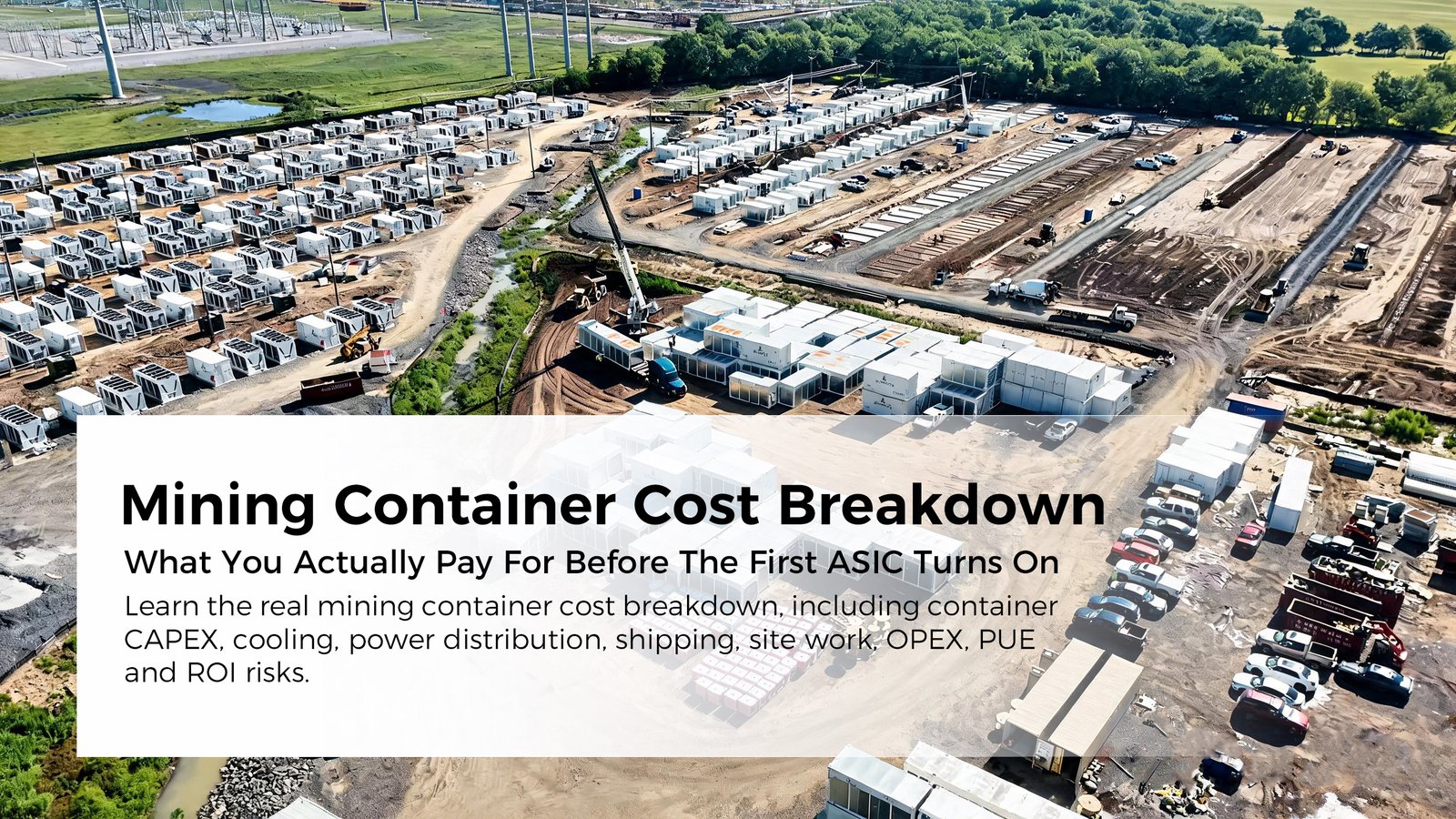
Costo de los trabajos en el sitio: el presupuesto fuera de la cotización del proveedor
Muchos compradores se centran en la factura del contenedor y se olvidan de la factura de la obra.
Es posible que el contenedor ya esté listo, pero es posible que el sitio aún necesite:
- transformador y conexión de media tensión
- puesta a tierra y protección contra rayos
- plataforma de concreto o cimientos endurecidos
- drenaje
- vallas y seguridad
- conexión de red
- tratamiento del agua o preparación de anticongelante
- almacenamiento de filtros y válvulas de repuesto
- equipo contra incendios y de seguridad
- inspección eléctrica local
- mano de obra de instalación
Por eso un “contenedor barato” puede resultar un fracaso desde el punto de vista financiero. Aunque permita ahorrar dinero en el momento de la compra, deja demasiadas responsabilidades sin resolver en el lugar de la obra.
Un buen proveedor de contenedores para la industria minera no tiene por qué encargarse de todos los elementos de obra civil locales. Sin embargo, la propuesta debe definir claramente qué está incluido y qué debe preparar el comprador.
Costo del tiempo de inactividad: la partida que los compradores pasan por alto
El tiempo de inactividad no parece tan grave en una hoja de cálculo. En el mundo real, es brutal.
Si un contenedor de 1 MW pierde la refrigeración estable, el comprador no solo se enfrenta a reparaciones de ventiladores, filtros, bombas o sensores, sino que pierde ingresos por minería cada hora. Los diseños de mantenimiento que requieren el apagón total del circuito para reemplazar un solo filtro conllevan un costo real. Las configuraciones de las PDU que obligan a los técnicos a redirigir los cables en cada servicio añaden otro costo. Los enfriadores secos de capacidad insuficiente, que provocan la limitación diaria del rendimiento de los mineros, también tienen su propio y elevado costo.
La pregunta correcta no es: “¿Cuál es el contenedor más barato?”.”
La pregunta correcta es: “¿Qué diseño reduce las paradas no planificadas?”
Busca:
- diseño de bomba redundante
- filtros reemplazables
- acceso libre para mantenimiento
- lógica de alarma remota
- caminos eléctricos etiquetados
- datos reales de los sensores
- lista de piezas de repuesto
- registros de pruebas de fábrica
- lista de verificación para la puesta en servicio
El control de costos no consiste en comprar menos. El control de costos consiste en evitar problemas futuros.
Un marco práctico para el desglose de costos
Utiliza este marco antes de comparar proveedores:
| Partida de costos | Contenedor de enfriamiento por aire | Contenedor de enfriamiento por líquido |
|---|---|---|
| Caja del contenedor | Medio | De medio a alto |
| Gabinete eléctrico y PDU | Alta importancia | Alta importancia |
| Equipos de refrigeración | Ventiladores, rejillas de ventilación, filtros y cortina de agua, si es necesario | CDU, estación de bombeo, enfriador seco, tuberías, filtros |
| Control y monitoreo | Alarmas de temperatura, ventilador, humo y energía eléctrica | Temperatura, presión, caudal, pH, conductividad, alarmas |
| Preparación del terreno | Conducto de aire, cimientos, transformador | Cimientos, transformador, espacio para el circuito de agua, espacio para el enfriador seco |
| Costo de mantenimiento | Filtros, mantenimiento de ventiladores, limpieza de polvo | Calidad del agua, filtros, bombas, válvulas, sensores |
| La mejor opción | Implementación rápida, menor inversión en capital (CAPEX) y operación más sencilla | Alta densidad, mejor control térmico, sitios profesionales |
Para los compradores que se encuentran en una etapa inicial o que tienen un presupuesto limitado, un contenedor de minería con enfriamiento por aire de 20 o 40 pies puede ser el mejor primer paso. Para una implementación de alta densidad de S19/S21 Hydro, el enfriamiento por líquido resulta más lógico, ya que el costo está relacionado con la estabilidad, no solo con la capacidad.
Veredicto final para los compradores de 2026
El desglose de los costos de un contenedor para minería debería comenzar con los kilovatios, no con los pies cuadrados.
Si el comprador solo compara el precio del contenedor, el proveedor más barato suele parecer la mejor opción. Si el comprador compara el costo total de implementación, el mejor proveedor es aquel que aclara, antes de realizar el pedido, los detalles sobre la carga eléctrica, la capacidad de enfriamiento, el alcance de la logística, la preparación del sitio y la responsabilidad de mantenimiento.
En los proyectos de refrigeración por aire, priorice la rápida implementación, un bajo CAPEX, una disciplina estricta en el flujo de aire y un control eficaz del polvo.
Los proyectos con enfriamiento por líquido requieren prestar especial atención a la capacidad de la CDU, el dimensionamiento del enfriador seco, la calidad del agua, la redundancia de las bombas y la visibilidad de los sensores.
En todos los proyectos, calcula siempre los costos mensuales de electricidad utilizando un PUE realista y toma en cuenta el riesgo de tiempo de inactividad.
La caja de acero es la parte fácil.
La verdadera inversión es un sistema de alimentación y refrigeración que debe funcionar todos los días.