







The fastest way to receive a bad mining container quote is to send one sentence: “How much is a 40ft container?”
A supplier can answer that question with a number, but the number may have little connection to the project you need to build. A 40ft shell configured for air-cooled miners is not priced like a high-density hydro container. A unit delivered to Texas is not engineered, certified or shipped in the same way as one deployed in Kazakhstan, Canada or the Middle East.
The useful question is not simply, “What is the container price?” It is:
What mining container configuration can safely operate my miners at my site, within my available power capacity, and what is included in the delivered project price?
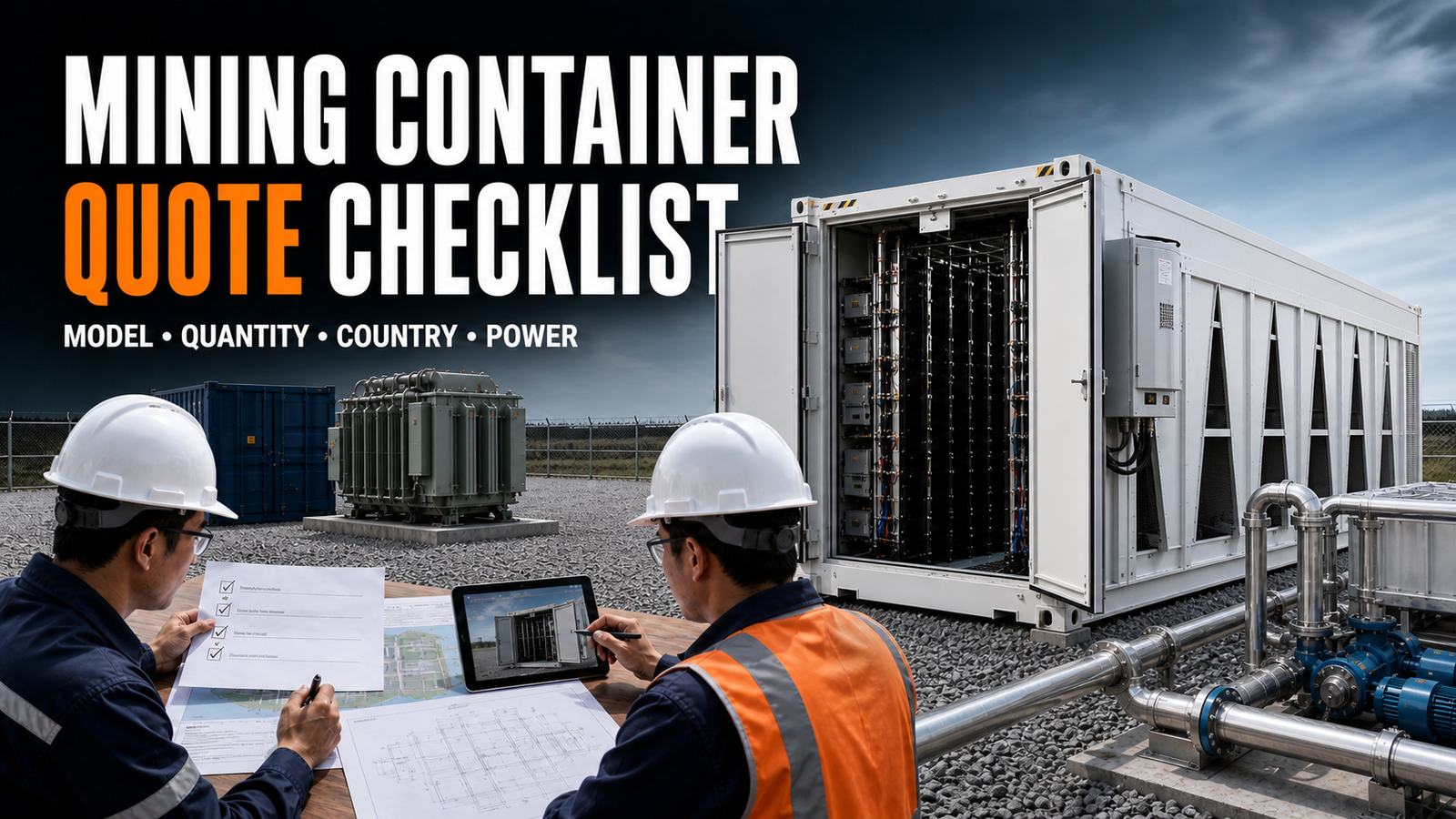
This mining container quote checklist explains what buyers should prepare before requesting pricing. It also provides a copy-ready RFQ template that can shorten technical clarification, reduce quotation revisions and move a serious project toward an executable proposal.
A Container Price Is Not a Project Price
The steel structure is only one part of a mining container. The quoted scope may also include racks, electrical panels, PDU branches, network cabinets, ventilation equipment, water manifolds, CDU capacity, dry coolers, pumps, sensors, PLC controls, fire protection, lighting, filtration and commissioning support.
Two suppliers may both quote a “40ft mining container” while offering completely different systems. One price may stop at the factory gate. Another may include cooling equipment, export packing, ocean freight, site installation, startup and spare parts.
Before comparing prices, separate the quotation into three levels:
| Quote Level | Buyer Information Available | What the Supplier Can Reliably Provide |
|---|---|---|
| Budgetary estimate | Miner model, quantity, country and available power | Recommended container category, approximate quantity and preliminary price range |
| Technical proposal | Electrical, cooling, climate, layout and logistics data | System configuration, major equipment list, power and cooling calculations, layout and exclusions |
| Executable commercial quote | Frozen scope, interfaces, delivery term, certifications and schedule | Final price, lead time, payment milestones, acceptance criteria and contractual boundaries |
Go fast, but label the price correctly. A budgetary estimate is useful for feasibility work. It becomes dangerous only when a buyer treats it as a final delivered project cost.
The Four Inputs Required for a Useful Mining Container Quote
If you want an initial response without a week of emails, provide four items in the first message:
- Exact miner brand and model
- Miner quantity, including planned expansion
- Project country and site location
- Available electrical capacity, voltage, frequency and phase
These four inputs do not complete the engineering. They allow the supplier to reject impossible configurations early and recommend the correct solution family: 20ft or 40ft, air or liquid cooling, integrated or separated heat rejection, single phase or phased deployment.
1. Exact Miner Brand and Model
“S21” is not enough. State whether the equipment is air cooled, hydro cooled or immersion configured, and include the full model suffix. Miner dimensions, power draw, voltage, current, connection type and cooling requirements can change between models in the same product family.
For example, BITMAIN’s published S21 XP Hyd specification lists a typical wall power of 5,676W at 35°C, 380–415V AC input, 50–60Hz frequency, 8–10 L/min water flow, 20–50°C inlet water temperature and a maximum water pressure of 3.5 bar. It also defines fluid pH and conductivity conditions.
That information directly affects busbar sizing, branch protection, PDU count, manifold design, pump duty, heat exchanger selection and dry-cooler capacity. A container designed from an assumed “approximately 5kW per miner” value can be wrong before manufacturing starts.
Attach the manufacturer’s latest specification sheet whenever possible. If the farm will use mixed models or multiple power modes, list each configuration on a separate line.
Consejo de experto: Quote from the highest continuous operating mode you genuinely plan to use. Buying infrastructure around the lowest miner setting may reduce CAPEX on paper, but it can remove your ability to increase hashrate later.
2. Miner Quantity and Expansion Plan
Provide both the initial quantity and the target quantity. A buyer installing 96 miners now and another 96 six months later may need a different distribution and cooling strategy from a buyer who will never exceed the first batch.
The supplier should calculate at least:
- Initial IT load
- Final IT load after expansion
- Container quantity and utilization rate
- Cooling duty at initial and final load
- Spare electrical and hydraulic capacity
- Whether the project should be released in independent phases
Do not force every miner into the smallest possible number of containers. Maximum equipment count is not the same as the most reliable commercial configuration. Maintenance access, airflow resistance, coolant distribution, cable routing and redundancy can justify leaving spare positions.
3. Project Country and Exact Site Location
The country influences certification, customs, voltage practices, transport, language, documentation and after-sales planning. The site location determines temperature, altitude, humidity, dust, corrosion exposure, freezing risk and heavy-haul access.
“United States” is not a complete location. West Texas, Washington State and northern New York create different thermal and logistics assumptions. The same applies to a project described only as “Middle East,” “Africa” or “Central Asia.”
For an early mining container quote, provide the nearest city and expected installation elevation. For a technical proposal, provide the site coordinates or a climate design basis approved by the project engineer.
4. Available Electrical Capacity
State whether the number represents utility allocation, transformer rating or spare capacity available at the container terminals. These are not interchangeable.
A useful electrical summary includes:
- Available kW, kVA or MVA
- Transformer quantity and rating
- Secondary voltage
- Frequency and phase
- Neutral and grounding arrangement
- Existing switchgear and feeder capacity
- Maximum permitted demand or utility limit
- Whether cooling auxiliaries share the same transformer
Do not send only the monthly energy allocation or utility bill. A mining container is constrained by instantaneous power capacity, protection coordination and physical connection interfaces.
Calculate the Load Before Asking How Many Containers You Need
A preliminary model starts with a simple relationship:
Miner IT Load = Miner Quantity × Nameplate Power per Miner
Then add the power required by fans, pumps, CDU controls, dry coolers, lighting, networking and other auxiliaries. The resulting facility demand must remain within the actual electrical system capacity, engineering margin and applicable local requirements.
Assume 180 miners at 5.676kW each. The miner load alone is approximately 1,021.7kW. That does not mean a 1MW electrical connection is sufficient. Cooling auxiliaries, electrical losses, operating margin and manufacturer power tolerance still need to be included.
Published container specifications show why this matters. BITMAIN’s ANTSPACE HK3 V6, used here only as an industry reference, lists 210 hydro miners, approximately 1,047–1,050kW operating power and 400V ±5% input. It also specifies external cooling flow, cable requirements, transformer relationships and site preparation conditions.
The label “one container” therefore tells the buyer almost nothing about the power infrastructure required around it.
Air Cooling Buyers Must Provide Airflow and Environment Data
An air-cooled mining container quote depends on more than miner count. The supplier needs to understand the miner heat load, pressure resistance, filter strategy and the path used to keep exhaust air away from the intake.
Prepare the following:
- Miner model and exhaust airflow data
- Maximum and minimum ambient temperature
- Dust, sand, snow, rain and corrosion exposure
- Required filtration level and maintenance frequency
- Noise limits at the property boundary
- Available clearance at intake and exhaust sides
- Whether water-curtain or evaporative assistance is permitted
Hot-air recirculation can reduce capacity even when the container has enough fans. Include a site layout or photographs showing nearby walls, containers, terrain and prevailing wind. Our ASIC mining container ventilation guide explains why fan quantity alone does not prove airflow performance.
Liquid Cooling Buyers Must Define the Complete Heat-Rejection Chain
For hydro miners, asking only for a liquid cooling container price leaves the largest design questions unanswered. The complete chain is:
Miner → internal coolant loop → CDU or heat exchanger → external loop → dry cooler or cooling tower → ambient environment.
The quotation request should state:
- Total miner heat load
- Required miner inlet temperature
- Flow and pressure limits per miner
- Coolant type, pH and conductivity requirements
- CDU capacity and redundancy preference
- Dry cooler, wet tower or hybrid heat-rejection preference
- Site design dry-bulb and wet-bulb temperatures
- Freeze protection and water-treatment requirements
- Maximum acceptable noise level
- Whether outdoor cooling equipment is included in the quote
Consejo de experto: Never request “one 1MW CDU” before calculating the real captured heat and design temperatures. A 1MW nameplate does not guarantee 1MW performance at every flow rate, approach temperature or outdoor condition.
For more detail, review our CDU engineering guide y liquid cooling mining container buying guide.
Site Information That Changes the Quote
Several conditions are often discovered after the purchase order, when they are most expensive to solve. Include them before pricing:
Ground and Structural Conditions
- Foundation type and allowable load
- Container stacking requirement
- Seismic, wind, snow and flood design criteria
- Drainage and equipment maintenance clearances
Water Conditions
- Water source and available flow
- Water analysis, conductivity, hardness and chlorides
- Discharge or blowdown restrictions
- Water treatment and refill responsibility
Communications and Controls
- Available fiber or Ethernet connection
- Remote monitoring requirements
- BMS, EMS or SCADA integration
- Required alarms, sensors and data retention
Local Compliance
- Electrical and fire codes
- Certification requirements
- Inspection authority or AHJ expectations
- Required document language
A supplier cannot confirm compliance from the country name alone. Ask the local engineer or authority to provide the required code edition and approval path.
Logistics Information Is Part of the Mining Container Quote
Global shipping is not one line called “freight.” A meaningful logistics price needs a destination, delivery boundary and equipment route.
Provide:
- Preferred destination port
- Final site address
- Requested Incoterm and named place
- Container dimensions and any oversized components
- Road, bridge, turning-radius and gate restrictions
- Crane capacity and unloading responsibility
- Customs broker and import certification requirements
- Whether inland transport and installation should be quoted
The International Chamber of Commerce explains that Incoterms® rules clarify the tasks, costs and risks assigned to sellers and buyers. Therefore, write the term with the named place and version, such as “CIF Port of Houston, Incoterms® 2020,” rather than writing only “CIF.”
Consejo de experto: Confirm the heavy-haul route before freezing the equipment design. A cheaper oversized module can become the more expensive option if the final road requires escorts, bridge studies or a different crane plan.
Define What the Price Must Include
Ask every supplier to return the quote using the same scope table. Otherwise, the lowest price may simply contain the most exclusions.
| Scope Item | Buyer Should Request |
|---|---|
| Container and structure | Dimensions, materials, corrosion system, doors, access and structural design basis |
| Sistema eléctrico | Main panel, breakers, PDU, busbar, cables, grounding, metering and protection |
| Sistema de enfriamiento | Fans or liquid loop, CDU, pumps, heat exchanger, dry cooler or tower, controls and treatment |
| Controls and network | PLC, sensors, alarms, remote monitoring, switches and communication interfaces |
| Pruebas de fábrica | Inspection plan, FAT scope, test records and witness options |
| Documentation | Drawings, manuals, single-line diagram, P&ID, parts list and certificates |
| Logística | Export packing, freight, insurance, customs boundary and inland delivery |
| Site services | Supervision, installation, commissioning, SAT, training and handover |
| After-sales | Warranty, remote response, spare parts, consumables and service exclusions |
Nuestro mining container installation checklist provides a more detailed path from factory testing to site commissioning.
Common Buyer Mistakes That Produce Misleading Prices
- Asking for a container before selecting the miner. The miner determines the load and cooling architecture.
- Using hashrate instead of electrical power. The infrastructure is sized from kW, current and heat, not TH/s alone.
- Providing utility capacity but not transformer capacity. Power may be allocated but not yet deliverable at the container.
- Ignoring auxiliary power. Fans, pumps and heat rejection consume part of the site capacity.
- Comparing EXW with delivered pricing. Freight, customs, cranes and commissioning can change the ranking.
- Hiding future expansion. The cheapest first phase may create expensive redesign work later.
- Requesting guaranteed PUE without site conditions. PUE depends on climate, load, equipment and measurement boundary.
- Assuming all 40ft containers are equivalent. Capacity, access, certification and included equipment vary widely.
Copy-and-Paste Mining Container RFQ Template
Use the following template in your first email or contact-form message:
MINING CONTAINER QUOTE REQUEST

1. Project country:
2. Nearest city / site location:
3. Miner brand and exact model:
4. Cooling type: Air / Hydro / Immersion / Not decided
5. Initial miner quantity:
6. Final planned miner quantity:
7. Power per miner and operating mode:
8. Available site power: kW / kVA / MVA
9. Transformer rating and quantity:
10. Secondary voltage / frequency / phase:
11. Maximum and minimum ambient temperature:
12. Altitude and humidity:
13. Dust, corrosion, snow or freezing conditions:
14. Preferred container size: 20ft / 40ft / Open to recommendation
15. Required cooling scope: Container only / CDU / Dry cooler / Full system
16. Required redundancy: N / N+1 / Not decided
17. Destination port and final site address:
18. Requested Incoterm and named place:
19. Installation and commissioning required: Yes / No
20. Target delivery and energization date:
21. Required local certifications or codes:
22. Drawings, site photos or single-line diagram attached:
23. Additional requirements:
If the project is still early, complete items 1 through 10 first. That is normally enough for a supplier to recommend the solution category and prepare a budgetary mining container quote.
What a Professional Supplier Should Return
A strong response should contain more than a price and delivery time. Expect to receive:
- Design assumptions and input data
- Recommended container quantity and configuration
- Miner capacity and power calculation
- Cooling capacity and environmental design point
- Electrical single-line concept and connection boundary
- Major equipment list
- Layout or interface drawing
- Included and excluded scope
- Lead time and buyer decision deadlines
- Testing, installation and commissioning plan
- Warranty and spare-parts proposal
- Quote validity and change-control conditions
If the supplier does not state the design assumptions, the buyer cannot know what will invalidate the price later.
Final Verdict: Better Inputs Produce a More Bankable Price
A fast mining container quote is not necessarily a good quote. The objective is to receive a price that matches the miners, power system, climate, cooling architecture, logistics route and deployment schedule.
Start with four facts: miner model, miner quantity, project country and available electrical capacity. Then add site, cooling and logistics data until the proposal becomes executable.
DroLinBox provides air- and liquid-cooling mining containers, CDU and dry-cooler integration, power-distribution planning, manufacturing, logistics and commissioning coordination. Explore our mining container solutions, review our project services, or send the completed RFQ checklist to our team.
Do not ask only for the cheapest steel box. Ask for the shortest credible path from available power to stable mining revenue.