







A mining site can have 5 MW of power on paper and still fail an AI deployment review.
The problem is usually not the headline power number. It is the gap between utility capacity and usable AI capacity: transformer loading, power quality, rack-level distribution, liquid cooling, network connectivity, site security, commissioning procedures and long-term maintenance all have to work together.
The fastest path from mining to AI is not to reuse every existing asset. It is to identify which power, cooling, control and site systems are actually reusable.
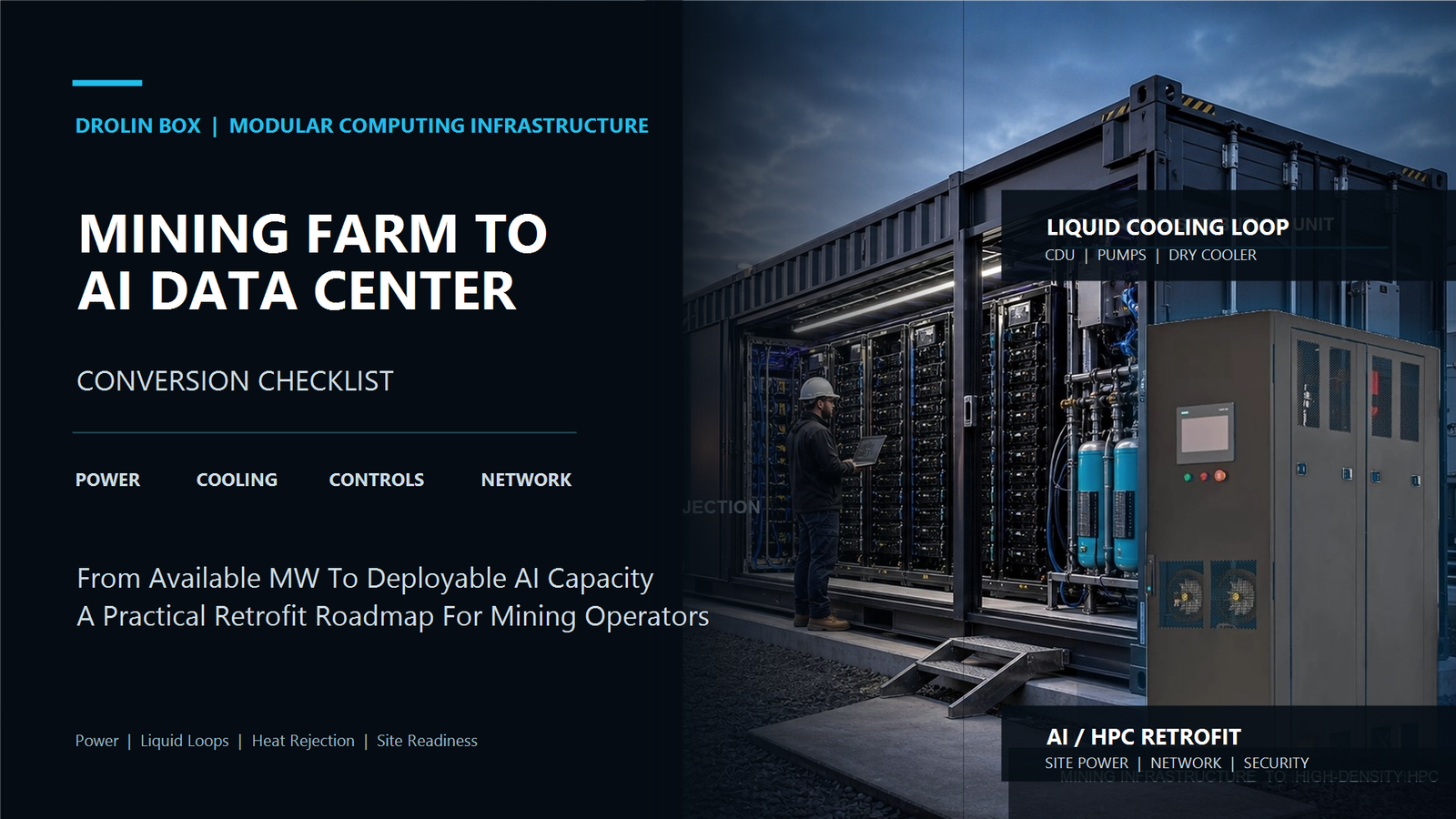
This mining farm to AI data center conversion checklist explains how operators can evaluate an existing site before investing in a cooling retrofit or GPU infrastructure upgrade.
1. Start With A Reuse Audit
The first step is to separate existing assets into three categories:
| Asset Category | Examples | Evaluation Result |
|---|---|---|
| Potentially reusable | Utility connection, substation, transformer yard, roads, foundations, perimeter fencing | Reuse only after capacity, condition and compliance checks |
| Reusable with modification | Containers, power distribution, monitoring system, fiber routes, drainage and fire systems | Requires engineering redesign or expansion |
| Usually replaced or newly added | GPU rack cooling, CDU, high-speed network, leak detection, liquid piping and AI-ready controls | Must be designed around the new workload |
A mining container may have been optimized for ASIC density, airflow and simple power distribution. An AI data center requires a different balance between electrical stability, cooling topology, network performance and serviceability.
The existing site should therefore be treated as a starting point, not a completed AI facility.
Site Data To Collect Before Engineering
Operators should prepare:
Country and project location
Utility service capacity and permitted load
Actual continuous power available at the site
Transformer rating, voltage and impedance
Main switchgear and feeder configuration
Existing PDU or distribution cabinet information
GPU platform and expected rack power
Number of racks and expansion phases
Summer and winter design temperatures
Elevation and humidity
Water quality and freezing conditions
Existing containers, buildings and foundations
Road width, crane access and equipment delivery route
Fiber availability and network carrier options
Fire protection, drainage and physical security information
Without this data, a supplier can quote equipment, but the project team cannot reliably confirm whether the site is ready for AI.
Совет от профессионала: Ask for a site data sheet before asking for a final cooling quotation. A serious feasibility review begins with operating conditions, not only the requested equipment name.
2. Available Power Is Not The Same As AI-Ready Capacity
Mining operators often start with a statement such as “the site has 5 MW available.” That figure needs to be broken down.
Four Power Numbers Should Be Separated
Utility or interconnection capacity
The maximum capacity approved or contracted with the local utility.Transformation capacity
The rating of installed transformers and their operating limits under local ambient conditions.Distribution capacity
The actual capacity of switchgear, busbars, feeders, PDU systems, protection devices and cables.Deployable AI capacity
The continuous and reliable power that can be delivered to GPU racks while maintaining operating margin, redundancy and maintenance access.
These four numbers may be very different.
For example, a site may have a 5 MW utility connection but only 3 MW of installed transformation capacity. Facilities might feature 3 MW of transformers yet lack sufficient low-voltage distribution for high-density racks. Alternatively, distribution capacity could be adequate while completely lacking maintenance redundancy.
IT Load And Facility Load
AI infrastructure planning should distinguish between:
IT Load: GPU servers, CPUs, storage and network equipment
Cooling Load: CDU pumps, dry cooler fans, chillers or other mechanical equipment
Electrical Distribution Losses: Transformers, switchgear, cables and PDUs
Facility Load: The total power consumed by IT and supporting infrastructure
A simple planning relationship is:
Facility Power = IT Load x PUE
If a project has 1 MW of IT load and an estimated PUE of 1.30:
1 MW x 1.30 = approximately 1.30 MW facility demand
This is a planning example, not a final design value. Actual PUE depends on ambient conditions, cooling architecture, pump and fan efficiency, electrical losses, controls and the measurement boundary.
A mining site that previously operated at a high utilization rate may not have enough margin for AI workloads, even when its nameplate capacity appears sufficient.
Power Quality Matters More At High Density
GPU systems can create stricter requirements for:
Voltage stability
Фазовый баланс
Short-circuit protection
Harmonic performance
Grounding and bonding
UPS or ride-through strategy
Generator coordination
Maintenance bypass
Dual power paths
Protection selectivity
A transformer sized only for average load may not be adequate for startup events, transient behavior or future expansion.
Совет от профессионала: Do not use the old ASIC miner count as the basis for the GPU electrical design. Start with the selected GPU platform, rack power, power path and expansion schedule.
3. ASIC Miner Loads And GPU Rack Loads Are Different
An ASIC mining farm and an AI/HPC facility may consume a similar amount of electricity, but their infrastructure requirements can be very different.
Typical ASIC Mining Site Characteristics
An ASIC mining site often includes:
Many individual mining machines
Repetitive rack or shelf layouts
Air cooling or direct liquid cooling
Simple east-west network traffic
Limited storage requirements
High operating hours
Strong focus on cost per kilowatt-hour
Fast replacement of individual machines
The electrical system may be distributed across many similar loads. The cooling design often focuses on total heat removal, airflow organization, dust control or miner-level liquid connections.
Typical AI/HPC Characteristics
An AI or HPC deployment may require:
High-density GPU racks
High-speed GPU-to-GPU interconnects
Large east-west data flows
High-performance storage
Dedicated management networks
Higher rack-level thermal density
Direct-to-chip liquid cooling or another liquid-cooling architecture
Strict temperature and flow control
More complex commissioning and maintenance procedures
Stronger physical and cybersecurity controls
NVIDIA describes the GB200 NVL72 as a rack-scale, liquid-cooled design connecting 36 Grace CPUs and 72 Blackwell GPUs. This type of architecture demonstrates why a traditional mining layout cannot be evaluated only by total megawatts or floor area.
The important question is not:
“Can the existing site supply enough electricity?”
The better question is:
“Can the existing site deliver stable power, heat rejection, network performance and maintainability to the selected AI racks?”
Why Rack Density Changes The Design
Mining containers may distribute power and heat across many machines. AI racks can concentrate a much larger thermal and electrical load into a smaller footprint.
That changes:
PDU and busway sizing
Cable routing
Rack clearances
Cooling-loop flow rate
Pressure-drop calculations
CDU capacity
Pump selection
Heat exchanger sizing
Fire protection zoning
Service access
Network pathway design
The GPU OEM’s rack and server documentation should define the actual load, cooling interface and environmental requirements. Generic “AI-ready” labels are not enough for engineering approval.
4. Can A Traditional Air-Cooled Mining Site Support High-Density GPU Systems?
Sometimes it can. Often it needs a major retrofit.
The answer depends on the selected GPU platform and the existing site conditions.
Assets That May Be Reused
A traditional mining site may provide useful infrastructure such as:
Land and site access
Utility connection
Transformer yard
Existing buildings or containers
Foundations
Internal roads
Drainage
Perimeter fencing
Security gates
Fiber entry routes
Operations staff
Existing remote monitoring
These assets can reduce project cost and deployment time if they pass inspection.
Assets That Usually Need Revalidation
The following items should be reassessed before conversion:
Transformer continuous rating
Low-voltage distribution
PDU and cabinet configuration
Cable tray capacity
Grounding system
Cooling plant location
Outdoor dry cooler space
Pump station location
Очистка воды
Drainage and leak containment
Fire detection and suppression
Network room and fiber pathways
Physical access control
Maintenance clearances
Air cooling may still be suitable for lower-density GPU systems or hybrid workloads if the selected equipment remains within the site’s thermal envelope. It should not be assumed that the same fans, filters and container layout can support a high-density liquid-cooled rack.
A Practical Conversion Decision
A site is more likely to be suitable when:
Power capacity is documented rather than estimated
Transformers and switchgear have tested operating margins
The site has stable fiber connectivity
There is room for dry coolers and pump stations
The ground is suitable for equipment foundations
Roads support heavy equipment delivery
The climate and elevation are included in heat-rejection calculations
Water, glycol and filtration requirements can be managed
The operator can create a secure AI operating zone
The electrical and cooling systems can be expanded in modules
A site is less suitable when its only advantages are cheap electricity and empty land.
Совет от профессионала: For a first AI conversion, consider retaining the existing mining operation while building a separately controlled 200 kW pilot block. This creates a real operating test before the full site is converted.
5. Understand The CDU Primary Side And Secondary Side
A CDU, or Coolant Distribution Unit, is commonly used to separate and manage two cooling circuits.
The exact design depends on the GPU platform, coolant type, heat load and facility architecture, but the basic concept is as follows.
Primary Side: Facility Water System
The primary side is connected to the facility heat-rejection system. It may connect to:
Dry cooler
Cooling tower
Chiller
Primary pump
Expansion tank
Water treatment system
Outdoor piping
Heat exchanger inside the CDU
The primary loop carries heat away from the CDU to the outdoor heat-rejection equipment.
Secondary Side: Technology Cooling System
The secondary side serves the IT equipment. It may connect to:
GPU cold plates
Server manifolds
Rack manifolds
Technology cooling supply and return headers
Secondary pump
Фильтры
Expansion components
Обнаружение утечек
Temperature, pressure and flow sensors
The CDU transfers heat between the two sides while controlling the secondary coolant conditions supplied to the racks.
Basic Cooling Chain
A simplified liquid-cooling path is:
GPU Cold Plate → Rack Return → CDU Heat Exchanger And Pump → Rack Supply → GPU Cold Plate
The facility-side path is:
CDU Primary Return → Dry Cooler Or Other Heat Rejection → Primary Supply → CDU
This separation can help the operator manage coolant quality, pressure, temperature and maintenance requirements on the IT side.
For a detailed explanation of the cooling architecture, see CDU для центров обработки данных искусственного интеллекта.
What Must Be Defined In The Specification
The project specification should define:
Primary-side supply and return temperature
Secondary-side supply and return temperature
Flow rate on each side
Pressure range
Pump head
Heat exchanger capacity
Maximum allowable pressure drop
Тип охлаждающей жидкости
Materials compatibility
Filtration level
Expansion and filling method
Leak detection and isolation method
Control protocol
Redundancy strategy
Maintenance bypass
A CDU quotation without operating conditions is incomplete.
6. Size The Cooling System From Heat Load, Not Site Power Alone
A dry cooler or CDU should not be selected only because the mining site has 1 MW, 5 MW or 10 MW of electrical service.
Cooling design should start with the actual heat that must be rejected.
Basic Heat-Rejection Framework
A practical planning model is:
Required Cooling Capacity = IT Heat Load + Pump Heat + Fan Heat + Distribution Losses + Design Margin
Most electrical power consumed by IT equipment eventually becomes heat. However, not every facility electrical load enters the same cooling loop.
The engineering team should clarify:
IT load
Percentage of IT load handled by liquid cooling
Air-cooled auxiliary load
CDU pump power
Dry cooler fan power
Room or container heat
Outdoor design temperature
Required redundancy
Future expansion margin
Example Flow Calculation
For an illustrative 200 kW liquid-cooling load using water with a 10°C supply-return temperature difference:
Flow = Heat Load / Specific Heat / Temperature Difference
The estimated flow is approximately:
200 kW / 4.18 kJ/kg·K / 10 K = 4.8 kg/s
This is roughly 17 m³/h for water.
At the same assumptions:
| Liquid Cooling Load | Approximate Flow At 10°C Delta T |
| 200 kW | 17 m³/h |
| 500 kW | 43 m³/h |
| 1 MW | 86 m³/h |
These are engineering examples, not final product specifications. Glycol concentration, fluid temperature, density, heat capacity, altitude and required design margin will change the result.
Температура на входе
Approach temperature describes the temperature difference between the fluid leaving the heat exchanger and the ambient or facility-side condition used for heat rejection.
A smaller approach temperature can require:
Larger heat-exchanger surface area
More airflow
More fan power
Lower fluid temperature
Larger dry cooler footprint
A high ambient temperature can reduce dry cooler capacity. A system sized for a mild climate may not deliver the same heat-rejection capacity during peak summer conditions.
Read Сухой охладитель для жидкостного охлаждения центров обработки данных before finalizing the outdoor heat-rejection strategy.
Совет от профессионала: Request dry cooler performance at the project’s actual summer design temperature, not only at a favorable laboratory condition.
7. Check Coolant, Water Quality And Freeze Protection
Liquid cooling is not only a matter of adding pipes to a mining site.
The quality of the working fluid can affect:
Heat-transfer performance
Corrosion risk
Pump life
Filter loading
Производительность теплообменника
Cold-plate reliability
Warranty compliance
Long-term maintenance cost
The final fluid specification should follow the requirements of the GPU, server, CDU and piping materials.
Water Quality
The project team should define:
Проводимость
Твёрдость
pH
Corrosion control
Particulate limits
Microbiological control
Filtration method
Sampling frequency
Makeup-water procedure
Do not select a coolant only because it is inexpensive or locally available.
Защита от замерзания
Outdoor piping and dry cooler systems may face sub-zero temperatures. The project may require:
Glycol mixture
Система обогрева трубопроводов
Изоляция
Drain-down design
Recirculation during standby
Сигналы тревоги при низкой температуре
Freeze protection interlocks
Glycol can change viscosity, heat capacity and pressure drop. Pump sizing and flow calculations must be updated when glycol is introduced.
Leak Detection
A conversion project should consider:
Point leak sensors
Cable-type leak detection
CDU drip trays
Rack-level isolation valves
Automatic pump shutdown
Alarm escalation
Local visual alarms
Remote notifications
Emergency drainage
Spare seals and hoses
The purpose is not only to detect a visible leak. It is to identify abnormal moisture or flow behavior before it damages computing equipment.
8. Build Controls Around Operations, Not Only Installation
A working cooling system needs clear operating visibility.
A practical monitoring system may include:
Температура подачи
Температура на выходе
Differential temperature
Supply pressure
Return pressure
Differential pressure
Расход
Pump speed
Состояние насоса
Скорость вращения вентилятора
Ambient temperature
Coolant level
Filter differential pressure
Leak status
Door or access status
Power quality
История срабатываний сигнализации
A PLC can manage local sequences and interlocks. A BMS, DCIM or remote monitoring platform can provide higher-level visibility, trend analysis and alarm management.
Alarm Logic Should Be Defined Early
The project team should specify:
Warning thresholds
Trip thresholds
Alarm delays
Sensor-failure behavior
Pump-failure response
Fan-failure response
High-temperature response
Low-flow response
Leak response
Communication-loss response
Manual override rules
Restart procedure
Remote monitoring is useful only when the alarm has a clear owner and a defined response.
The project should also consider cybersecurity, user permissions, secure remote access and network segmentation. Connecting a PLC to the internet without access control creates a new operational risk.
9. Network, Fiber And Physical Security Requirements
Mining farms may operate with relatively simple network requirements. AI/HPC systems can require high-bandwidth, low-latency communication between servers, switches and storage.
A conversion plan should assess:
Network Infrastructure
Fiber availability at the site
Carrier diversity
Entrance pathways
Backbone topology
High-speed Ethernet or InfiniBand requirements
Top-of-rack switch location
Management network
Out-of-band access
Storage network
Redundant network paths
Fiber patching and labeling
Electromagnetic separation from power cables
NVIDIA’s current rack-scale AI architecture materials emphasize that networking is a fundamental part of large-scale AI performance. The cooling plant may be technically excellent, but the deployment can still fail if the network cannot support the workload.
Physical Security
Operators should review:
Site perimeter
Vehicle and visitor control
Camera coverage
Access logs
Rack or container access
Network-room access
Emergency exits
Fire detection
Fire suppression
Cable protection
Backup power for security systems
Local regulations and insurance requirements
A mining site can be physically remote and still require data-center-grade access control once it hosts customer AI workloads.
10. Plan Expansion In 200 kW, 500 kW And 1 MW Blocks
Phased expansion reduces technical and financial risk.
These values should be treated as planning bands for IT load unless the project specification states otherwise.
Phase 1: 200 kW Pilot
The 200 kW phase can be used to validate:
GPU platform compatibility
Rack-level liquid cooling
CDU operation
Dry cooler performance
Water quality
Обнаружение утечек
PLC alarms
Network performance
Maintenance procedures
Actual PUE
The pilot should be designed with room for measurement and troubleshooting. It should not be installed as an isolated experiment that cannot connect to future blocks.
Phase 2: 500 kW Expansion
At 500 kW, the project should formalize:
Modular CDU capacity
Dry cooler module arrangement
Резервирование насосов
Power distribution blocks
Network expansion
Запасные части
Service access
Maintenance bypass
N+1 strategy where required
N+1 means that the system has the required number of operating modules plus one additional module. The correct application depends on the customer’s uptime target and maintenance philosophy.
Phase 3: 1 MW Production Block
At 1 MW, the project should evaluate:
Separate power and cooling zones
A/B power distribution
Multiple CDU modules
N+1 pumps or fans
Heat-rejection redundancy
Fire zoning
Network path redundancy
Spare transformer or feeder strategy
Planned maintenance procedures
Full factory and site acceptance testing
A single oversized cooling machine may look simple on a quotation. Several coordinated modules may provide better serviceability and expansion flexibility.
For a broader modular deployment framework, see 5MW Modular Mining Farm Design Guide.
Совет от профессионала: Design the 200 kW block so it can become one complete operating zone inside the future 1 MW facility. Future expansion is easier when the first phase already has its own valves, sensors, controls, power boundaries and network identity.
11. Which Mining Sites Are Good Candidates For AI Conversion?
Strong Candidates
A mining site is a stronger candidate when it has:
Verified utility and transformer documentation
Sufficient continuous power margin
Modern switchgear and protection
Adequate grounding and bonding
Space for CDU and dry cooler installation
Reliable road and crane access
Stable fiber connectivity
Good drainage and flood protection
Secure perimeter and controlled access
Expandable foundations
A manageable climate and elevation
Skilled local maintenance support
Clear permitting and insurance requirements
Weak Candidates
A site deserves caution when it has:
Only a utility promise without installed distribution
Undersized transformers
Seasonal power restrictions
Poor voltage quality
No expansion room
Weak fiber connectivity
Flooding or standing-water risk
Narrow roads or limited crane access
No safe location for pumps and dry coolers
Uncontrolled water quality
No leak response procedure
Weak physical security
No local service capability
Low-cost electricity is valuable, but it does not compensate for an unsuitable facility.
12. Mining Farm To AI Data Center Conversion Checklist
| Area | Questions To Confirm | Evidence To Request |
| Utility power | What is contracted, installed and continuously deployable? | Utility documents, load study, single-line diagram |
| Transformer | Is the transformer rating suitable for continuous AI operation? | Nameplate, test report, protection settings |
| Distribution | Can switchgear, feeders, PDUs and cables support rack-level load? | Electrical drawings, cable schedule, inspection records |
| GPU workload | What GPU platform, server type and rack power are planned? | OEM data sheet and rack specification |
| Cooling load | What percentage of the IT load is liquid-cooled? | Thermal design basis |
| ХДС | What are primary and secondary temperatures, flow and pressure limits? | CDU data sheet and control sequence |
| Dry cooler | What capacity is available at design ambient temperature? | Performance curve and test conditions |
| Piping | Are pipe sizes, materials, valves and supports suitable? | Piping diagram and layout |
| Coolant | What fluid, filtration and water-quality limits apply? | Coolant specification and water test |
| Freeze protection | What happens during cold weather or power loss? | Freeze-protection sequence |
| Leakage | Where are sensors, isolation valves and alarms located? | Leak-detection layout |
| Controls | Who receives alarms and who can reset equipment? | PLC points list and alarm matrix |
| Network | Are fiber, fabric, storage and management networks sufficient? | Network topology and carrier information |
| Security | Can the site protect customer equipment and credentials? | Security plan and access-control procedure |
| Логистика | Can trucks, cranes and equipment reach the installation area? | Site plan, road survey and lifting plan |
| Commissioning | What are FAT, SAT and load-test acceptance criteria? | Test procedures and acceptance forms |
| Operations | Who maintains filters, pumps, fans, coolant and spare parts? | O&M plan and responsibility matrix |
13. Go Or No-Go Decision
A mining site should move forward only when the following questions have clear answers:
Can the site deliver the required continuous power, not only the contracted capacity?
Can the transformer and distribution system support the selected GPU racks?
Can the cooling system reject the calculated heat at the project’s worst design ambient?
Can the CDU maintain the required secondary-loop temperature, flow and pressure?
Can the site manage coolant quality, filtration and freeze protection?
Can the controls detect and respond to abnormal conditions?
Can the network support the workload and future expansion?
Can the site meet physical security and fire-safety expectations?
Can equipment be delivered, lifted, installed and maintained?
Can the project pass factory testing, site commissioning and customer acceptance?
If several answers are uncertain, the project is still in feasibility stage. It is too early to approve a final equipment list or promise a deployment date.
Drolin Box can review the project requirements and prepare the appropriate technical scope for modular mining containers, liquid-cooling systems, CDU integration, dry cooler deployment and phased computing-infrastructure expansion.
For project assessment, submit:
Project country and site location
Available and target power
Transformer information
GPU or server model
Expected rack quantity
Current mining-site layout
Ambient temperature and elevation
Water and freezing conditions
Site photos or drawings
Required deployment phase
Вы также можете ознакомиться с 500MW Data Center Site Selection Risk Guide before evaluating a larger power opportunity, or contact Коробка «Дролин» for a project discussion.
Часто задаваемые вопросы
Can every mining farm be converted into an AI data center?
No. A mining site may have useful power and land resources, but the transformer, distribution, cooling, network, security and permitting systems must be reassessed for the selected AI workload.
Is a CDU required for every GPU data center?
Not necessarily. The cooling architecture depends on the GPU platform, rack design, liquid-cooling method and facility-water strategy. A CDU is commonly used when the technology cooling loop needs separation and controlled heat transfer from the facility loop.
Can an air-cooled mining container be used for GPU servers?
It depends on the server thermal design and rack power density. Lower-density or hybrid systems may use air cooling, while many high-density GPU platforms require direct liquid cooling or another specialized architecture.
Should dry cooler capacity equal the mining farm’s total power capacity?
No. Dry cooler sizing should be based on the heat-rejection load, liquid-cooled fraction, design ambient temperature, flow, approach temperature, redundancy and future expansion.
What is the safest first step for a mining site AI conversion?
Start with a documented feasibility review and a modular pilot. A 200 kW pilot can validate power, cooling, controls, network and operating procedures before the project expands to 500 kW or 1 MW.
What information should buyers prepare before requesting a quotation?
Prepare the country, available power, transformer rating, GPU or server model, rack quantity, ambient conditions, elevation, water quality, site photos, layout drawings, delivery route and expected expansion phase.